Roluos Group
The Roluos Group's 9th-century pre-Angkor temples: distances from Siem Reap, ticket, and why they're the quietest stop on the pass.
Siem Reap: Full-Day Temple Trek Through the Cambodian Jungle
Quick facts
- Distance from Old Market
- ~13 km east, 25-30 min by tuk-tuk
- Ticket needed
- Angkor Pass (same pass as Angkor Wat)
- Time to allow
- 1-1.5 hours for Bakong, Preah Ko and Lolei together
- Age
- 9th century — the oldest major temples on the Angkor Pass
- Crowd level
- Among the quietest stops covered by the standard pass
Cambodia’s first Angkorian capital, before Angkor existed
The Roluos Group is the collective name for three 9th-century temples — Bakong, Preah Ko and Lolei — that were the heart of Hariharalaya, the capital founded by King Indravarman I around 879 AD, roughly two centuries before Angkor Wat was built. They’re the oldest major temples covered by the standard Angkor Pass, and structurally they’re the clearest link between earlier pre-Angkorian architecture and the later Angkor style that Angkor Wat and Angkor Thom would refine.
It’s about 13 km east of central Siem Reap — 25-30 minutes by tuk-tuk, in the opposite direction from the main park entrance, which is one reason many rushed one-day itineraries skip it entirely in favor of the Small Circuit.
Why Hariharalaya mattered — and why the capital moved
Indravarman I chose this site partly for water management: Hariharalaya sat near the Roluos River, and Indravarman built the Indratataka baray — a massive rectangular reservoir roughly 3.8 km by 800 m — to store monsoon runoff for dry-season irrigation, a technique that would become the defining infrastructure achievement of the entire Angkorian period. That baray-building tradition continued at Angkor itself with the East Baray and West Baray, both far larger.
The capital moved from Hariharalaya to the Angkor area under Yasovarman I (who also built Lolei) around 893 AD, partly because the Roluos site’s water catchment had limits that the Siem Reap River’s location didn’t share — a practical, engineering-driven relocation rather than a symbolic one, and a useful data point for understanding why Angkor itself ended up where it did.
Getting there and what it costs
Most visitors reach Roluos by tuk-tuk chartered from central Siem Reap, typically as an add-on to a half-day that also covers Banteay Srei or the eastern Grand Circuit temples — a standalone round trip to Roluos alone runs a similar per-day tuk-tuk rate to other outlier stops (see our tuk-tuk pricing guide for current negotiated ranges), since drivers price by day and distance rather than by temple. Because Roluos sits east of town in the opposite direction from the main park gate, it doesn’t combine efficiently with a Small Circuit day — plan it as part of an outlier-temple day instead, ideally alongside Banteay Srei, Kbal Spean, or the eastern end of the Grand Circuit (Pre Rup, Banteay Samre).
When to go
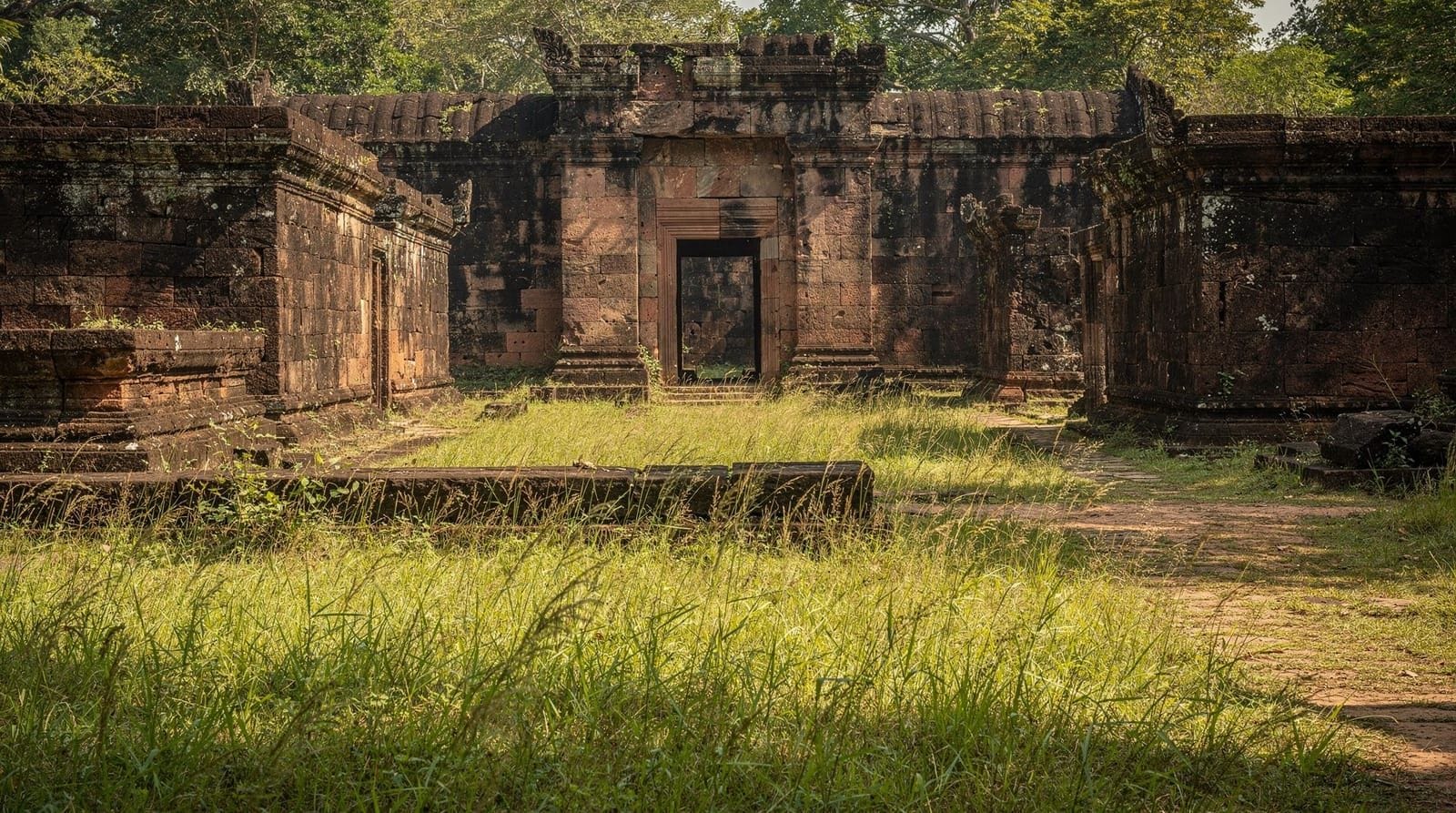
Because Roluos rarely draws crowds at any hour, timing here is less about beating tour buses and more about heat and light. Mid-morning (8:00-10:00) after the sunrise crowds have thinned out elsewhere in the park gives good light on Bakong’s sandstone tiers without the midday glare; late afternoon works too, since there’s no sunset-viewing crowd competing for space here the way there is at Phnom Bakheng or Angkor Wat’s western causeway. Unlike Ta Prohm or Angkor Thom, there’s little shade between structures, so avoid the 11:00-14:00 window if you’re sensitive to heat.
What you’ll actually see, up close
Bakong’s five sandstone tiers are in noticeably better structural condition than Preah Ko’s brick towers — sandstone weathers more slowly than the brick-and-stucco construction used at Preah Ko and Lolei, which is one reason Bakong reads as more “complete” to visitors even though all three temples are roughly the same age.
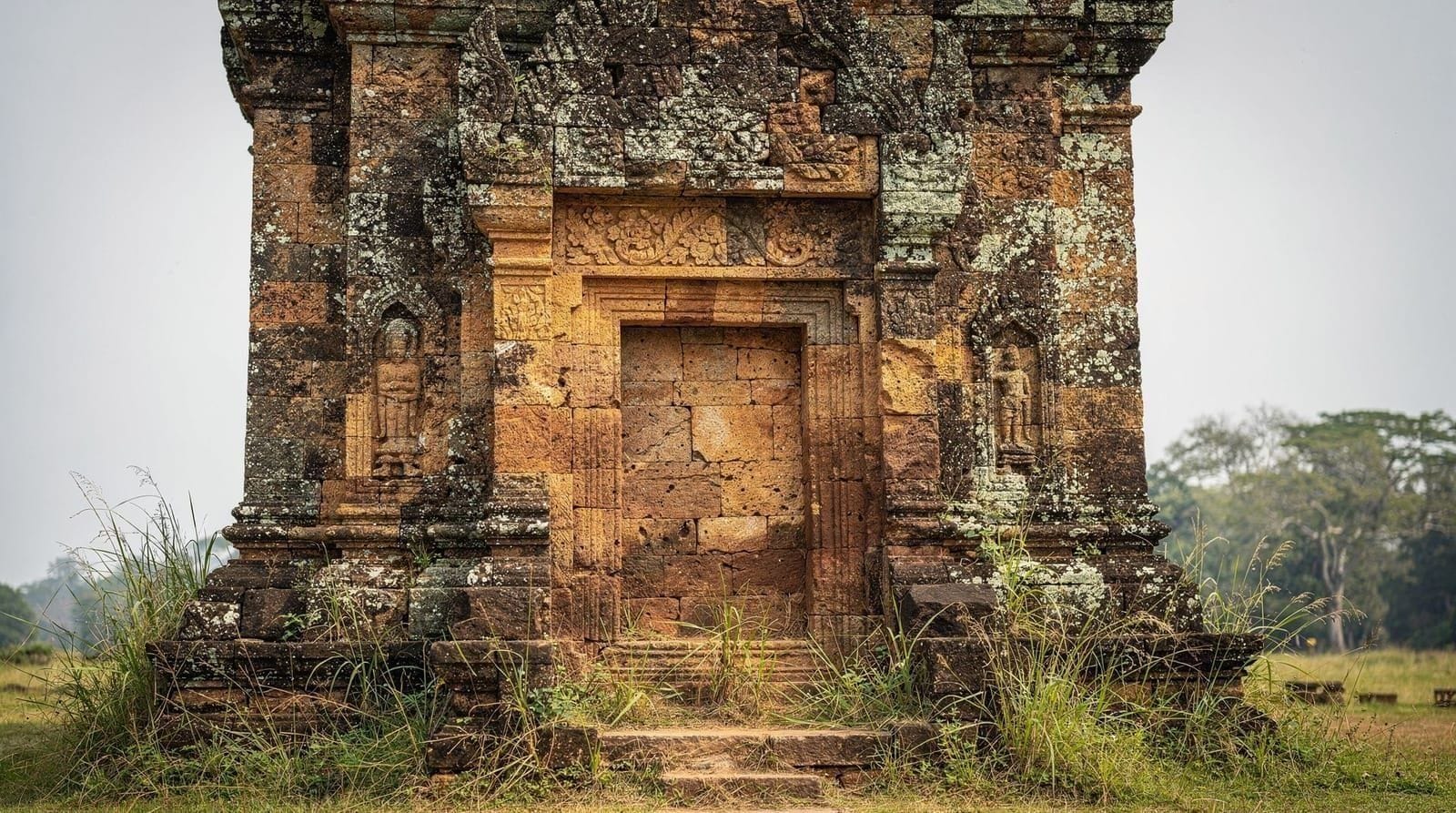
Look for the elephant statues at the pyramid’s corner tiers (weathered but still identifiable), the moat that still holds water seasonally, and the later Buddhist stupa awkwardly added to Bakong’s summit centuries after the original Hindu dedication — a visible reminder that these sites kept being used and modified long after their original construction, not preserved as static monuments. At Preah Ko, look closely at the stucco fragments still clinging to the brick towers: this was originally a fully plastered and painted surface, and what survives today is a small fraction of the original decorative scheme, a useful contrast with Bakong’s exposed structural sandstone.
Accessibility
Roluos is one of the flatter, easier stops on the Angkor Pass — Preah Ko and Lolei require no climbing at all, and Bakong’s summit is optional (the base-level temples are fully viewable without ascending). The pyramid’s stairways at Bakong are steep and uneven, similar to other Angkorian temple-mountains, so travelers with mobility concerns can see the full site without attempting the climb. Paths between the three temples are unpaved but level; there’s minimal shade, so heat rather than terrain is the main accessibility consideration.
Where to eat nearby
There isn’t a developed restaurant strip at Roluos the way there is near Angkor Wat’s main gate — small drink and snack stalls operate near Bakong’s entrance, selling water, coconuts, and basic fried snacks, but plan to eat a proper meal back in town or en route rather than expecting a sit-down option on site.
Bakong — the first Khmer temple-mountain
Bakong, consecrated in 881 AD, is the largest and most significant of the three: a five-tier sandstone pyramid representing Mount Meru, generally considered the prototype for the temple-mountain form later used at Angkor Wat, the Bayon and elsewhere. It’s surrounded by a moat and lesser structures, with sandstone elephant statues at the pyramid’s corners and a later Buddhist tower added to the summit centuries after the original construction. It’s tall enough to climb, and — unlike Ta Keo, Phnom Bakheng or Angkor Wat’s upper level — rarely has any queue at all.
Preah Ko — six brick towers dedicated to a king’s ancestors
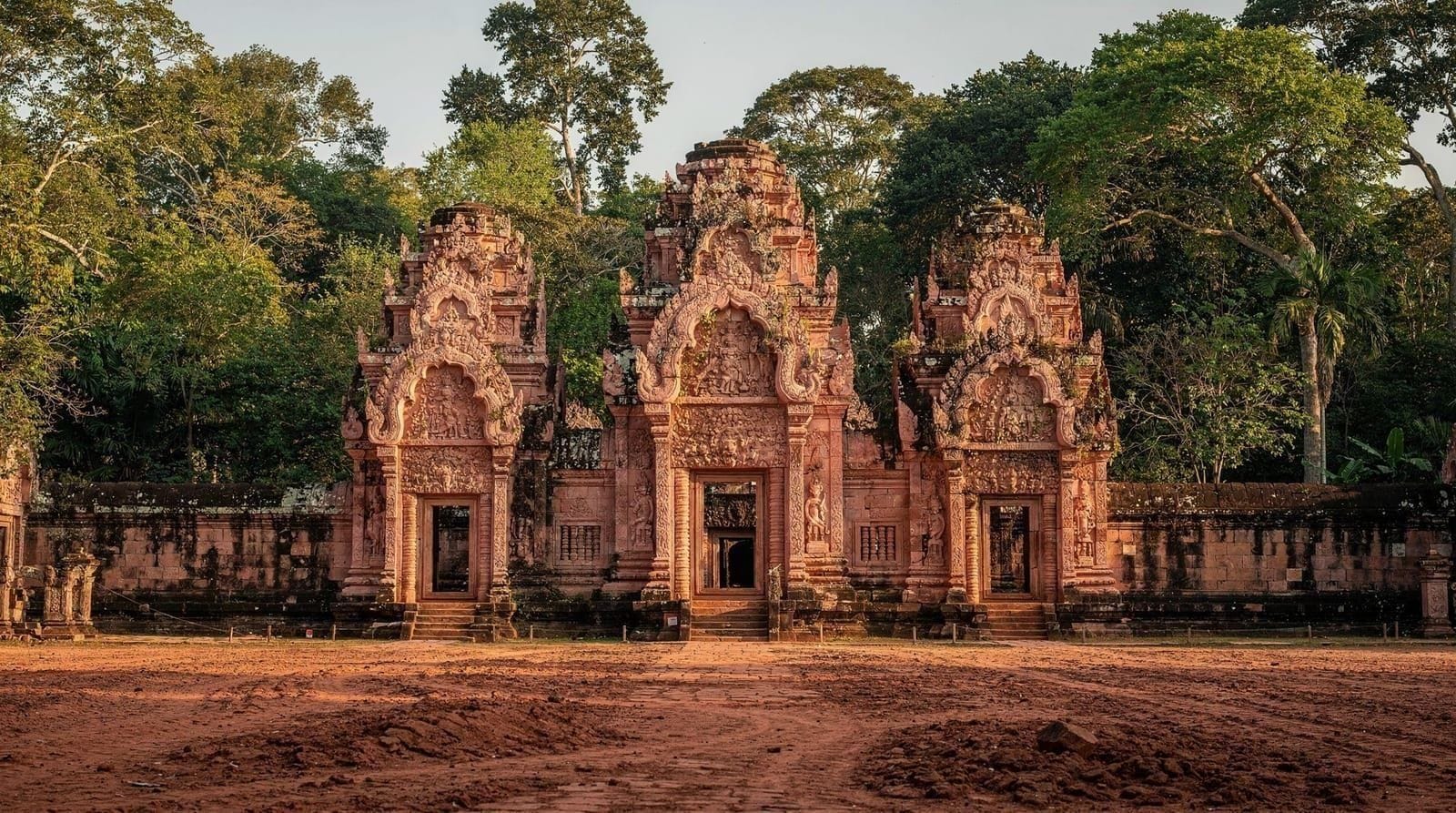
A short drive from Bakong, Preah Ko (“Sacred Bull”) consists of six brick towers arranged in two rows, built slightly earlier than Bakong and dedicated to Indravarman I’s parents and royal ancestors, guarded by stone Nandi bull statues (Shiva’s mount) that give the temple its name. The brick construction with sandstone lintels shows an earlier architectural stage than the later sandstone-dominant temples, and some of the stucco relief work on the brick towers — though weathered — is still visible.
Lolei — an island temple, now landlocked
Lolei was built later, around 893 AD under Yasovarman I, as an island temple in the middle of the Indratataka baray (reservoir) — the reservoir has long since dried up, so today Lolei sits on ordinary ground next to a working pagoda, not in water as originally designed. Its four brick towers have some of the best-preserved Sanskrit inscriptions in the Roluos Group, carved into the door frames.
Photography notes
Bakong photographs well from the eastern approach in early or mid-morning light, when the sandstone tiers pick up warm color without the harsh contrast of midday sun. Because there’s rarely anyone else around, it’s one of the few places on the pass where you can get a clean, uncluttered wide shot of a full temple-mountain without waiting for a gap in the crowd or cropping out other visitors — a genuinely rare thing at Angkor Wat or Ta Prohm during daylight hours. Preah Ko’s brick towers work better with a longer lens picking out individual stucco fragments and the Nandi statues, since the overall structure is less visually dramatic than Bakong’s pyramid form.
What’s overrated, what’s underrated
Nothing here is overrated — the entire Roluos Group is underrated relative to its historical significance, largely because it lacks a single “iconic” image the way Angkor Wat or Ta Prohm has. For visitors specifically interested in the architectural evolution of Khmer temples, Bakong in particular deserves more time than it typically gets.
How to combine it with the rest of your day
The Roluos Group pairs naturally with Banteay Srei, both being outside the main Small and Grand Circuit loops but easily combined into a half-day. Our full-day temple trek covering Banteay Srei, Kbal Spean and the Roluos Group links all three; a more focused option is the Roluos Group and handicraft center tour, which adds a stop at a local silk or stone-carving workshop.
If you’re also planning a Grand Circuit day, the Roluos Group, Banteay Samre and Pre Rup tour combines the pre-Angkorian temples with Pre Rup and the lesser-known Banteay Samre in one loop.
From Bakong to Angkor Wat: seeing the evolution firsthand
Visiting Roluos before or after the Small Circuit gives you something few other stops on the pass can offer: a direct, walkable comparison of how the temple-mountain form developed over roughly 250 years. Bakong’s five sandstone tiers (881 AD) are the earliest large-scale expression of Mount Meru symbolism in Khmer architecture — a stepped pyramid with modest ornamentation compared to what came later.
By the time builders reached Angkor Wat (started around 1113 AD under Suryavarman II), the same basic Mount Meru concept had evolved into a vastly more elaborate structure: five towers instead of Bakong’s single central shrine, kilometers of narrative bas-relief instead of scattered decorative panels, and a surrounding moat sized more like a small lake than Bakong’s modest water-filled ditch. Seeing Bakong first, even briefly, changes how Angkor Wat reads afterward — less as an isolated masterpiece and more as the endpoint of a long, visible architectural conversation that started at Roluos.
Roluos compared to the rest of the Angkor Pass
Visitors who’ve already done the Small Circuit and want a genuine change of pace often find Roluos delivers exactly that: no touts, no photo queues, and enough distance between the three temples to walk unhurried. It’s a useful counterpoint to the argument that the Angkor Pass “feels crowded everywhere” — that’s true at Angkor Wat’s causeway during sunrise or Ta Prohm’s signature tree-root corridors, but it’s not true across the whole pass. If crowd avoidance matters more to you than seeing the single most famous structures, a day built around Roluos, Banteay Srei, and the eastern Grand Circuit temples (Pre Rup, East Mebon, Ta Som) will feel like a different park entirely from the Small Circuit.
Practical notes
Fully covered by the standard Angkor Pass — see the Angkor Pass guide for pricing (1-day $37 / 3-day $62 / 7-day $72). There’s less shade here than at Ta Prohm or Preah Khan; bring water and sun protection. Small snack stalls operate near Bakong’s entrance. Because it’s outside the main park loop, most tuk-tuk drivers will quote a slightly higher day rate to include Roluos — confirm this before agreeing on price; see our tuk-tuk pricing guide.
Frequently asked questions about the Roluos Group
Is the Roluos Group covered by the Angkor Pass?
Yes, fully — no separate ticket is needed for Bakong, Preah Ko or Lolei.
Why is the Roluos Group significant if it’s not as famous as Angkor Wat?
It was Cambodia’s first Angkorian-era capital, built roughly two centuries before Angkor Wat, and Bakong is considered the architectural prototype for the temple-mountain form used throughout the later Angkor period.
How much time should I budget?
1-1.5 hours for all three temples at a relaxed pace — Bakong alone can take 30-45 minutes if you climb to the summit.
Is the Roluos Group worth visiting if I only have one day at Angkor?
Probably not as a priority — with only one day, most visitors should focus on the Small Circuit (Angkor Wat, Angkor Thom, Ta Prohm). Roluos is a strong choice for a second or third day, or for visitors specifically interested in earlier Khmer architecture.
Can I climb Bakong?
Yes, and unlike most climbable Angkor structures it’s rarely crowded, making it one of the more pleasant elevated views in the whole park.
Is Lolei still surrounded by water like it was originally built?
No — the reservoir it once sat in the middle of has long since dried up. Today it sits on dry ground next to a working Buddhist pagoda.
Why did the Khmer capital move away from Roluos so soon after it was built?
Primarily water management — Yasovarman I relocated the capital to the Angkor area around 893 AD, where the Siem Reap River offered better long-term irrigation potential than the Roluos site, whose Indratataka baray had already reached a practical size limit.
Is there anywhere to eat at Roluos?
Only small snack and drink stalls near Bakong’s entrance — there’s no proper restaurant strip on site, so plan a meal in town before or after your visit.
What should I bring for a Roluos visit?
Water and sun protection are more important here than at shadier sites like Ta Prohm — there’s minimal tree cover between the three temples, and no developed food infrastructure on site to fall back on.
Does Roluos need its own dedicated day, or can I do it quickly?
Most visitors comfortably see all three temples in 60-90 minutes, so it rarely needs a dedicated day on its own — pairing it with Banteay Srei, Kbal Spean, or the eastern Grand Circuit temples makes better use of the drive out from central Siem Reap.
Is Roluos suitable for a first-time visitor with only one day at Angkor?
Not as a priority. With a single day, the Small Circuit’s headline sites deliver more per hour spent. Roluos rewards visitors on their second or third Angkor day, or anyone specifically drawn to earlier, less-decorated Khmer architecture over the scale of the main park’s later temples.
Top experiences
Bookable activities with verified prices and instant confirmation on GetYourGuide.

Siem Reap: Full-Day Temple Trek Through the Cambodian Jungle
Siem Reap: Roluos Group Temples and Handicraft Center Tour

Siem Reap: Roluos Group, Banteay Samre and Pre Rup Tour

Siem Reap: Banteay Srei, Beng Mealea and Roluos Group Tour

Siem Reap: Floating Village, Preah Ko and Bakong Tour
More tours on Viator
Top-rated experiences with verified reviews, bookable on Viator (a Tripadvisor company).