Angkor temple history: a primer before you visit
Siem Reap: Angkor National Museum Admission Ticket
What's the basic history I should know before visiting Angkor?
Angkor was the capital of the Khmer Empire from roughly the 9th to 15th centuries. Different kings built different temples as Hindu or Buddhist state monuments — Angkor Wat (12th century, Hindu, King Suryavarman II) and Angkor Thom's Bayon (late 12th/early 13th century, Buddhist, King Jayavarman VII) are the two most important reigns to recognize.
How this primer is organized
Rather than a chronological king-by-king survey, which quickly becomes overwhelming for a casual reader preparing for a temple visit, this primer focuses on the handful of facts that most directly change what you notice while actually walking through the Small and Grand Circuits — who built the two most important structures, why the empire’s religious focus shifted between temples, and what caused the whole system’s eventual decline. Treat it as a compact briefing rather than a comprehensive history.
Why a little history changes what you see
Walking into Angkor Wat or Bayon without any historical context, you’ll still see something extraordinary — but knowing roughly who built what, and why, turns a series of impressive stone structures into a coherent story spanning nearly six centuries of a single, remarkably sophisticated empire. This primer covers the essentials in enough depth to enrich a visit, without requiring a history degree first.
Before Angkor: the pre-Angkorian period
The Khmer Empire didn’t emerge from nothing — it built on earlier Cambodian kingdoms, sometimes referred to collectively as the pre-Angkorian period, including the polities historians have labeled Funan and Chenla, which controlled parts of the Mekong Delta and surrounding regions from roughly the 1st to 8th centuries.
The Roluos Group’s temples, built shortly after King Jayavarman II’s declaration of a unified Khmer Empire in 802 AD, represent the transitional link between this earlier period and the later classical Angkorian architecture most visitors come specifically to see — a useful piece of context when standing at Bakong, the tallest of the Roluos temples, and realizing you’re looking at a structure roughly three centuries older than Angkor Wat itself.
The Khmer Empire, in outline
The Khmer Empire’s capital sat in the Angkor region from roughly the early 9th century until the mid-15th century, making it one of the longest-running continuous capital sites in Southeast Asian history. At its height in the 12th and 13th centuries, the empire controlled territory covering much of present-day Cambodia, Thailand, Laos and southern Vietnam, and its kings commissioned an extraordinary building program — not just the famous temples but an elaborate network of reservoirs (baray) and canals supporting intensive rice agriculture that sustained a population historians estimate may have reached into the hundreds of thousands within the Angkor area itself.
The two kings worth knowing by name
Suryavarman II (reigned roughly 1113-1150) commissioned Angkor Wat as a Hindu state temple dedicated to Vishnu — the temple’s unusual west-facing orientation is generally linked to this dedication and to the temple’s probable secondary function as Suryavarman’s funerary monument. Angkor Wat represents the peak of Khmer classical architectural and artistic achievement, particularly visible in its kilometer-long bas-relief galleries depicting Hindu epics and scenes from Suryavarman’s own military campaigns.
Jayavarman VII (reigned roughly 1181-1218) came to power after a period of instability and warfare with the neighboring Cham kingdom, and responded with one of the most ambitious building programs in Khmer history — a Buddhist state temple program including Bayon (built as the temple at the center of his new walled capital, Angkor Thom), Ta Prohm, and Preah Khan, alongside hospitals, rest houses and roads across the empire. Bayon’s famous carved faces are generally understood to blend the image of Jayavarman VII himself with the bodhisattva Avalokiteshvara, though the exact symbolism remains debated among scholars.
Recognizing these two reigns alone explains most of what you’ll see on the Small Circuit: Angkor Wat’s Hindu iconography belongs to Suryavarman II’s era; Bayon, Ta Prohm and Preah Khan’s Buddhist character and somewhat different architectural style belong to Jayavarman VII’s, roughly half a century later.
Religious shifts, visible in the stone
The Khmer Empire moved between Hindu and Buddhist state religion more than once across its history, and those shifts are literally carved into the temples: some Buddhist imagery at various sites was later defaced during periods of Hindu religious reassertion, and vice versa, leaving visible chisel marks and altered carvings that guides often point out as physical evidence of the empire’s religious politics playing out on temple walls centuries after construction.
Why Angkor declined
There’s no single agreed-upon cause for Angkor’s decline as the imperial capital through the 14th and 15th centuries — historians generally point to a combination of factors: extended drought and flood cycles that stressed the empire’s elaborate hydraulic infrastructure, military pressure from the rising Ayutthaya kingdom to the west (in present-day Thailand), shifting maritime trade routes that reduced Angkor’s economic centrality, and a longer-term religious and cultural shift toward Theravada Buddhism that reduced state investment in monumental temple construction. The capital was eventually relocated toward present-day Phnom Penh, though the Angkor region was never fully abandoned by local populations.
A note on “rediscovery”
Angkor is sometimes described in older travel writing as a “lost city,” which overstates the reality — Khmer Buddhist monks and local communities maintained connections to several Angkor sites throughout the centuries after the capital’s political decline, and Angkor Wat itself functioned continuously as a religious site. French naturalist Henri Mouhot’s widely read 1860s travel account brought Angkor to international Western attention and helped catalyze the systematic conservation and restoration work — much of it French colonial-era, later continued by international teams including the ongoing work of Cambodia’s own APSARA Authority — that shaped the site visitors see today.
Reading the architecture: what changed between eras
Beyond religious dedication, the physical architecture of Khmer temples shifted meaningfully across the centuries in ways visible to anyone looking for them. Earlier temples, like those in the Roluos Group (9th century), tend toward simpler brick construction and a more compact temple-mountain form. Angkor Wat (12th century) represents the peak of sandstone construction technique and decorative ambition, with its five-tower arrangement symbolizing Mount Meru, the mythical center of the Hindu and Buddhist universe.
Jayavarman VII’s later Buddhist temples (Bayon, Ta Prohm, Preah Khan, late 12th/early 13th century) show a shift toward larger, more sprawling complexes with extensive narrative bas-reliefs depicting not just mythology but the king’s own military campaigns and daily life under his rule — a noticeably different narrative focus from Angkor Wat’s more purely religious epic scenes.
The water management system behind the temples
Less visible to casual visitors but historically significant is the vast network of reservoirs (baray) and canals that supported Angkor’s population — the West Baray and East Baray, both enormous rectangular reservoirs visible on any map of the area, along with an extensive canal network, allowed intensive rice cultivation supporting a population historians estimate reached into the hundreds of thousands within the greater Angkor area at its peak.
This hydraulic infrastructure is increasingly understood by historians as central to both Angkor’s rise (enabling the agricultural surplus that funded temple construction and a large state apparatus) and its eventual decline (vulnerability to drought and flood cycles that stressed a system dependent on consistent water management). Neak Pean, one of the Grand Circuit’s temples, was itself built as a symbolic water temple on an artificial island within a baray, directly tying the empire’s religious and hydraulic engineering achievements together in a single structure.
A dated timeline, at a glance
| Date | Event |
|---|---|
| c. 1st-8th centuries | Pre-Angkorian Funan and Chenla polities control the Mekong Delta region |
| 802 AD | Jayavarman II declares a unified, independent Khmer Empire on Phnom Kulen |
| 9th century | Roluos Group built (Preah Ko, Bakong, Lolei) — the empire’s first Angkor-area capital |
| 1113-1150 | Reign of Suryavarman II; Angkor Wat built as a Hindu state temple dedicated to Vishnu |
| 1177 | The Cham sack Angkor, a major military crisis that shapes Jayavarman VII’s later reign |
| 1181-1218 | Reign of Jayavarman VII; Bayon, Ta Prohm, Preah Khan and Angkor Thom’s walls built as a Buddhist state program |
| 12th-13th centuries | Height of the empire’s territorial extent and hydraulic infrastructure (West and East Baray) |
| 1431 | Ayutthaya forces sack Angkor; the capital gradually relocates toward present-day Phnom Penh |
| 1860s | Henri Mouhot’s published travel account brings Angkor to wide Western attention |
| 1992 | Angkor Archaeological Park inscribed as a UNESCO World Heritage Site |
Reading the bas-reliefs: what the panels actually show
Angkor Wat’s outer gallery runs roughly 800 metres and is divided into eight major panels, each depicting a distinct scene rather than one continuous story — a detail that helps explain why the gallery can feel overwhelming without a guide or a floor plan in hand.
The western gallery depicts the Battle of Kurukshetra from the Mahabharata; the southern gallery shows Suryavarman II himself in a royal procession alongside his army, one of the few places at Angkor where a specific historical king, rather than a purely mythological scene, is directly depicted; the eastern gallery contains the Churning of the Sea of Milk, among the most famous single panels at Angkor, showing gods and demons using a serpent to churn the cosmic ocean; and the northern gallery depicts a battle between Vishnu and various demons.
A separate panel on the eastern gallery, the Judgment of Yama, shows heaven and hell in graphic, contrasting detail. Bayon’s bas-reliefs work differently — rather than mythological epics, its outer gallery depicts scenes of Khmer daily life and Jayavarman VII’s military campaigns against the Cham, including market scenes, cockfights and childbirth alongside battle imagery, a far more secular, documentary style than Angkor Wat’s religious narrative.
Why the empire’s decline still shapes the site today
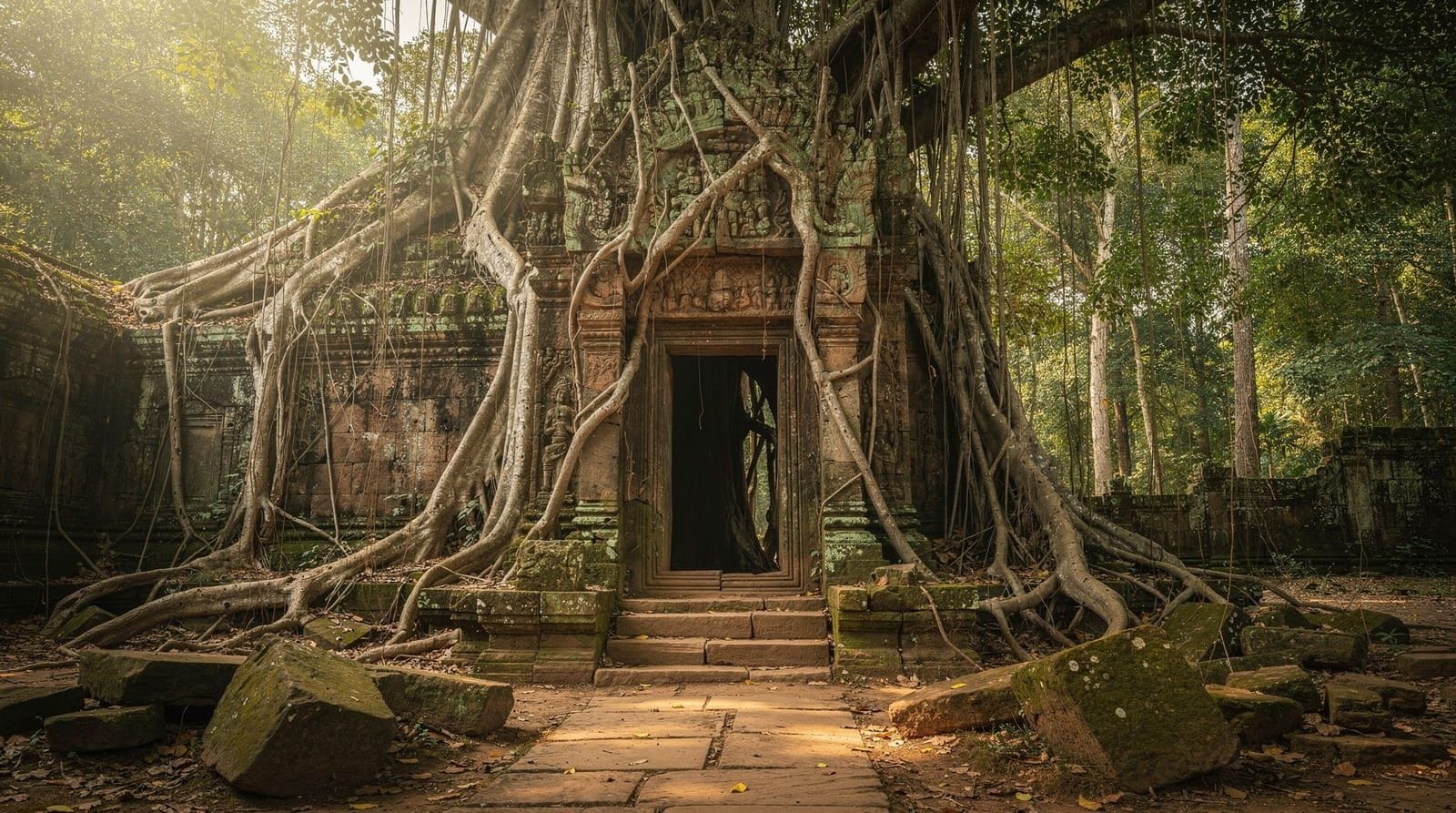
The centuries between Angkor’s political decline and its 19th-century rediscovery left a lasting mark on how the temples look now, not just on the historical narrative behind them. Structures abandoned by the state lost their maintenance almost entirely, allowing the jungle to reclaim sites like Ta Prohm and Beng Mealea over roughly four centuries — the very quality that now draws visitors specifically to see trees growing through stonework was, from a preservation standpoint, centuries of neglect.
Angkor Wat itself is the notable exception: because it remained an active, maintained Buddhist religious site continuously rather than being fully abandoned like the more purely political monuments, it avoided the worst of this jungle reclamation, which is part of why it survives in comparatively better structural condition than many of its contemporaries despite being older than several of them.
Where to go deeper
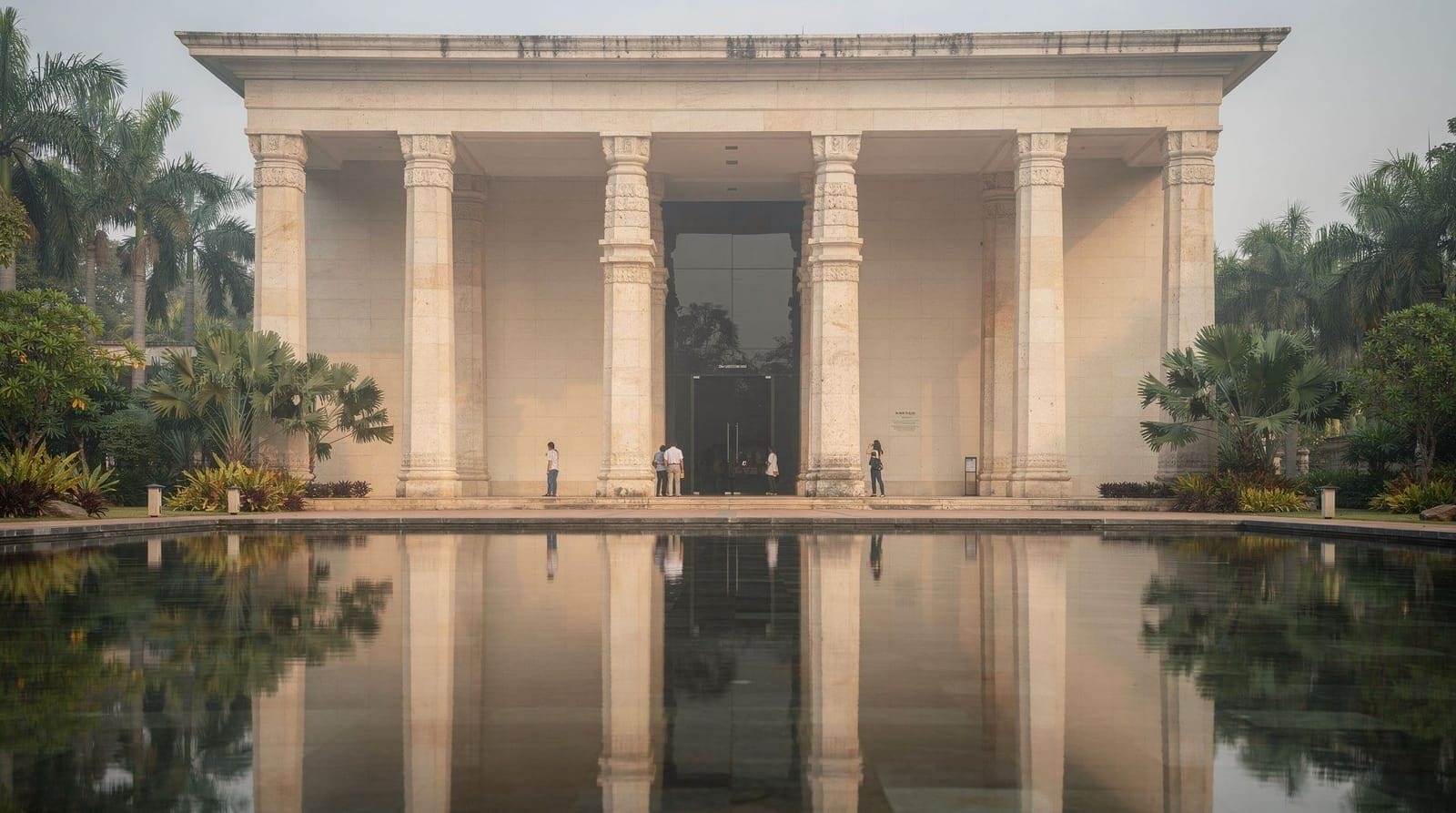
The Angkor National Museum in Siem Reap town offers a more in-depth, air-conditioned introduction to this history before or after your temple visits, with a museum admission ticket covering galleries on Khmer religion, kingship and the temples’ original context. For the temples themselves, a guided full-day tour pairs this historical background with live commentary in front of the actual carvings — see our guide vs. no guide breakdown for whether that’s worth arranging for your visit.
Frequently asked questions about Angkor temple history
Why does Angkor Wat face west instead of east like most temples?
The reason is debated among scholars — the leading theory ties it to Angkor Wat's association with Vishnu, a deity connected with the west in Hindu cosmology, and possibly with the temple's function as Suryavarman II's eventual funerary monument, since west is traditionally associated with death in Khmer and broader Southeast Asian symbolism.Who built Angkor Wat and when?
Angkor Wat was built in the early-to-mid 12th century under King Suryavarman II as a state temple dedicated to the Hindu god Vishnu, and later evolved into a Buddhist site as Cambodia's dominant religion shifted over subsequent centuries — it remains an active Buddhist site today.Why did the Khmer Empire shift between Hindu and Buddhist temples?
Different kings favored different state religions, and each major king typically built temples reflecting his own religious commitment — Suryavarman II's Hindu Angkor Wat gave way to Jayavarman VII's Buddhist building program (Bayon, Ta Prohm, Preah Khan) roughly half a century later, followed by further religious shifts and even periods of deliberate defacement of earlier religious imagery.Why was Angkor abandoned?
The decline was gradual rather than a single event, likely driven by a combination of factors debated among historians: prolonged drought and flood cycles straining the empire's elaborate water management system, shifting trade routes, military pressure from neighboring Ayutthaya (Thailand), and a broader religious and political shift toward Buddhism that reduced the state's investment in monumental Hindu temple-building.What does 'Angkor' actually mean?
Angkor derives from the Khmer word for 'capital city' or 'holy city,' reflecting the site's role as the political and religious center of the Khmer Empire across several centuries and multiple relocated capitals within the broader Angkor region.How was Angkor rediscovered by the West?
Angkor was never truly 'lost' — Khmer and regional visitors continued to know of and visit the site through the centuries after its decline as a capital. French naturalist Henri Mouhot's widely circulated 1860s account brought international attention and sparked the colonial-era conservation and restoration efforts that shaped much of what visitors see today.
Top experiences
Bookable activities with verified prices and instant confirmation on GetYourGuide.


More tours on Viator
Top-rated experiences with verified reviews, bookable on Viator (a Tripadvisor company).