Angkor Thom and the Bayon
How to visit Angkor Thom's South Gate and the Bayon's face towers from Siem Reap: distances, ticket, timing and what to skip.
Angkor Wat: Sunrise Visit to Ta Prohm and Bayon Temples
Quick facts
- Distance from Old Market
- ~8 km to South Gate, 20-25 min by tuk-tuk
- Ticket needed
- Angkor Pass (same pass as Angkor Wat)
- Time to allow
- 2-3 hours for South Gate, Bayon and central terraces
- Best light
- Mid-morning (8:00-10:00 AM) for the Bayon faces
- Dress code
- Shoulders and knees covered inside Bayon's central sanctuary
A walled city, not a single temple
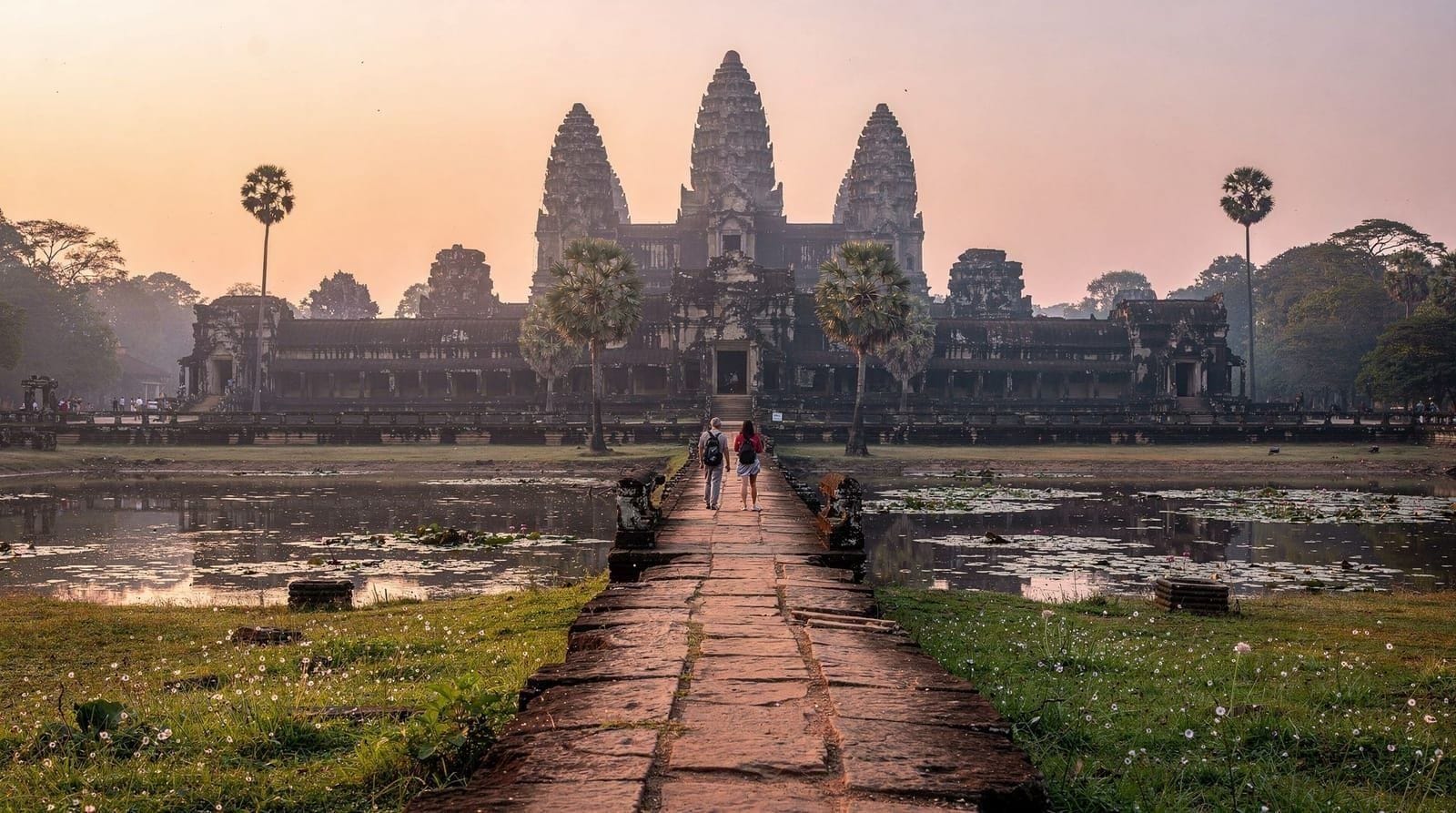
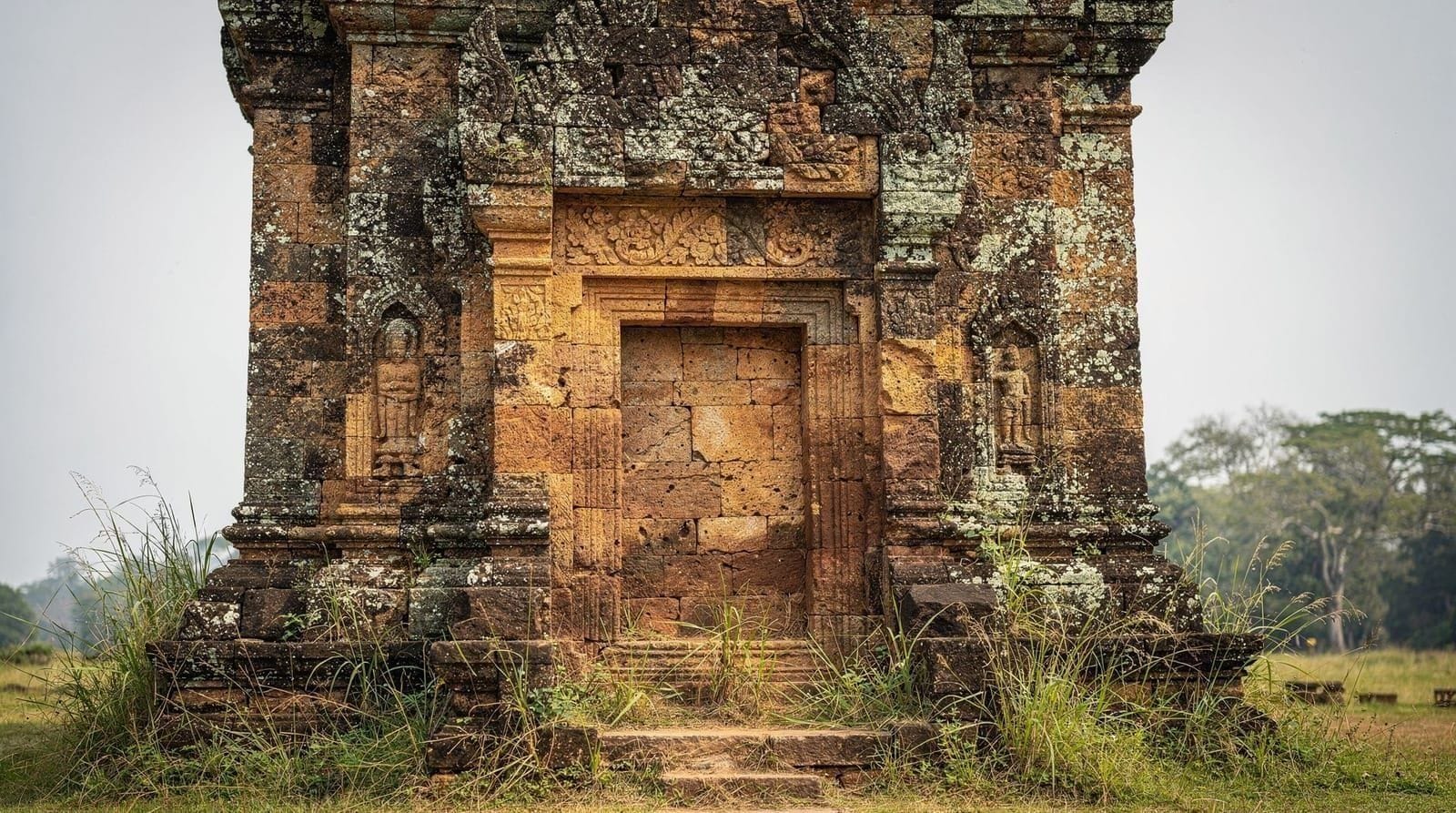
Angkor Thom (“Great City”) is the last and largest of the Khmer Empire’s capitals, built by Jayavarman VII at the end of the 12th century after he drove out Cham invaders who had sacked the previous capital. It’s a 3 sq km walled and moated city with five monumental gates, and the Bayon — the temple with 216 giant serene stone faces, generally read as the king’s face merged with the bodhisattva Avalokiteshvara — sits at its exact center. Visitors often say “we’re going to Bayon” and “we’re going to Angkor Thom” interchangeably; technically Bayon is one structure inside the much larger Angkor Thom complex, which also includes the Terrace of the Elephants, the Terrace of the Leper King, Baphuon and the royal palace ruins at Phimeanakas.
It’s roughly 8 km from central Siem Reap to the South Gate — about 20-25 minutes by tuk-tuk, a few minutes further north from Angkor Wat, which most visitors see first. Both sit on the standard Small Circuit.
Ticket and pass logic
Angkor Thom and everything inside it — Bayon, Baphuon, the terraces, Phimeanakas — is fully covered by the standard Angkor Pass, the same one used for Angkor Wat. There’s no separate charge to enter the walled city or any structure inside it. See our Angkor Pass guide for the 1/3/7-day pricing ($37/$62/$72) and where to buy it (Angkor Enterprise only — never through a tour platform).
The South Gate — worth stopping at, not just driving through
Most tuk-tuks and tour vehicles slow down or stop briefly at the South Gate, flanked by 54 stone gods on one side and 54 demons on the other — a physical rendering of the Churning of the Sea of Milk myth also depicted on Angkor Wat’s bas-reliefs, and topped with four giant faces looking in the cardinal directions. It’s a genuinely good photo stop and takes 10-15 minutes; skipping it to save time is a common regret among first-timers who only realize afterward what it depicts.
The Bayon — timing matters for the faces
The Bayon’s 216 faces are carved across 54 towers at multiple heights, and photographing them well depends heavily on the sun’s angle. Direct overhead midday light flattens the carvings; early morning or late afternoon side-light brings out the features far better. Sunrise crowds at Angkor Wat mean the Bayon is often near-empty right at opening (5:00 AM) if you reverse the usual order — worth considering if you specifically want photos without other tourists in frame. Otherwise, mid-morning (8:00-10:00 AM), after the pure sunrise crowd has moved on but before the midday heat and tour-bus surge, is the practical sweet spot for most visitors.
The upper terrace, where you walk face-to-face with the towers, has narrow uneven steps and can bottleneck badly when large groups converge — another reason mid-morning beats the 9:30-11:00 AM window when big-bus tours typically arrive.
Terrace of the Elephants and Terrace of the Leper King
North of Bayon, the 350-metre Terrace of the Elephants was the base for royal reviewing stands and ceremonial platforms, carved with life-size elephant reliefs along its retaining wall. Adjacent, the Terrace of the Leper King is a smaller platform with dense carvings of nāgas, garudas and celestial figures — the “leper king” name comes from a moss-covered statue once found there, now a replica (the original is in the National Museum in Phnom Penh). Both terraces are a 10-15 minute walk from Bayon and rarely take more than 20-30 minutes combined, but they’re frequently skipped by rushed itineraries — a mistake, since the Elephants terrace carvings are some of the best-preserved in the whole park.
Baphuon and Phimeanakas
Baphuon, a 10-century pyramid temple predating Angkor Thom itself, was restored using the anastylosis method after being nearly lost during the Khmer Rouge era (the original restoration records were destroyed, forcing archaeologists to essentially solve a 300,000-piece stone puzzle from photographs). It’s a genuine climb with steep stairs and rewards visitors willing to do it with a good elevated view — routinely skipped by tour groups on a tight schedule, which makes it one of the quieter spots inside Angkor Thom. Phimeanakas, the former royal palace’s central pyramid, sits just north and is smaller but similarly underexplored by group tours.
Jayavarman VII, and why the faces look the way they do
Understanding the Bayon’s faces requires understanding the king who built them. Jayavarman VII came to power after the Khmer Empire’s lowest point in generations — the previous capital had just been sacked and briefly occupied by Cham naval forces in 1177, a humiliation depicted in vivid battle-scene bas-reliefs on the Bayon’s outer gallery walls, alongside more everyday scenes of Angkorian life: markets, cockfights, women giving birth, people playing games. Jayavarman VII responded by rebuilding on a scale unmatched by any predecessor — not just Angkor Thom and the Bayon, but Ta Prohm, Preah Khan, Banteay Kdei, hundreds of rest-houses and hospitals across the empire, and a network of roads connecting them.
He was also a committed Mahayana Buddhist in an empire whose state religion had previously alternated between Hindu Shaivism and Vishnu worship, and the Bayon’s face towers are generally interpreted as merging the king’s own likeness with Avalokiteshvara, the bodhisattva of compassion — a political and religious statement made in stone at the exact center of his new capital, visible in every direction across the city. Scholars still debate the precise identification, and some art historians read the faces as representing regional guardian deities rather than the king specifically, but the common thread across interpretations is that this was meant to project the king’s watchful presence over the entire empire simultaneously.
The outer gallery’s overlooked bas-reliefs
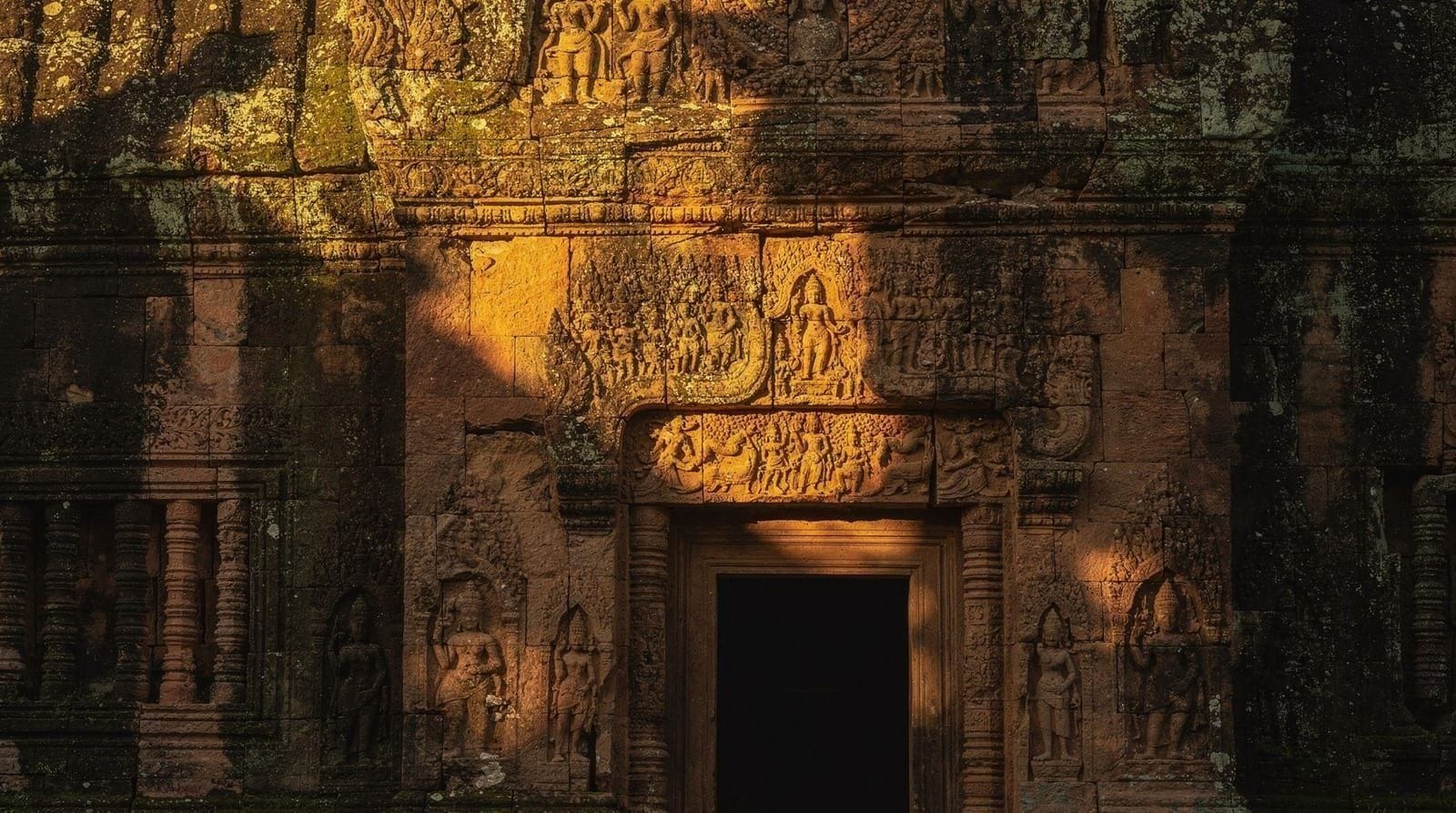
While the face towers get almost all the photographic attention, the Bayon’s outer gallery carries roughly 1.2 km of bas-relief carving depicting a mix of historical battle scenes (the Cham naval battle in particular, shown in remarkable nautical detail with fish visible beneath the boats) and genre scenes of daily 12th-century Khmer life that appear nowhere else in the Angkor temple network — a woman giving birth attended by midwives, a chess-like game being played, a cockfight, market stalls. Most tour groups walk past this gallery entirely on their way to photograph the faces above; it rewards a dedicated 15-20 minutes on its own, ideally with a guide who can point out the specific panels, since there’s minimal on-site signage.
What’s overrated, what’s underrated
The South Gate photo is genuinely worth the stop; treating it as a drive-through is the main mistake. Inside, the Bayon faces themselves are the highlight and deserve unhurried time — but Baphuon and the Elephants terrace, both included in the same ticket and a short walk away, get skipped constantly by time-pressured group tours and are consistently underrated relative to how empty and rewarding they are.
How to combine it with the rest of your day
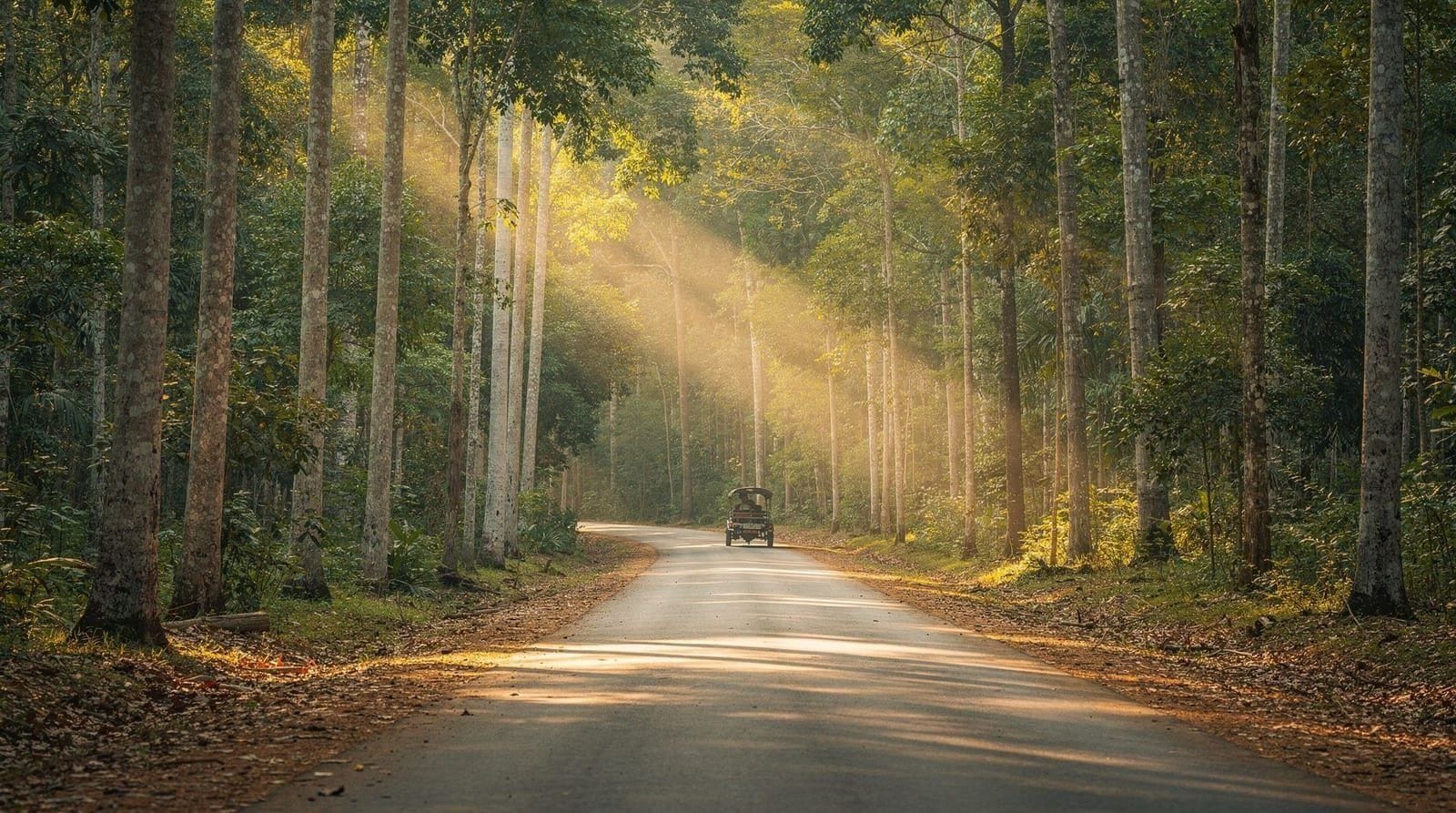
Angkor Thom sits between Angkor Wat and Ta Prohm on the standard Small Circuit loop — see our Small Circuit destination page for the full sequencing logic. A tuk-tuk driver hired for the day will handle the loop for roughly $15-20 (negotiate first — see tuk-tuk pricing).
If you’d rather have context on the reliefs and face towers explained on the spot, our sunrise tour covering Ta Prohm and Bayon or the broader one-day Small Circuit tour both include Bayon with a guide.
Travelers wanting a private pace rather than a shared group can book the private one-day Angkor Wat, Angkor Thom and Ta Prohm tour, which allows lingering at Baphuon or the terraces without holding up a group.
Comparing Angkor Thom to the rest of the Small Circuit
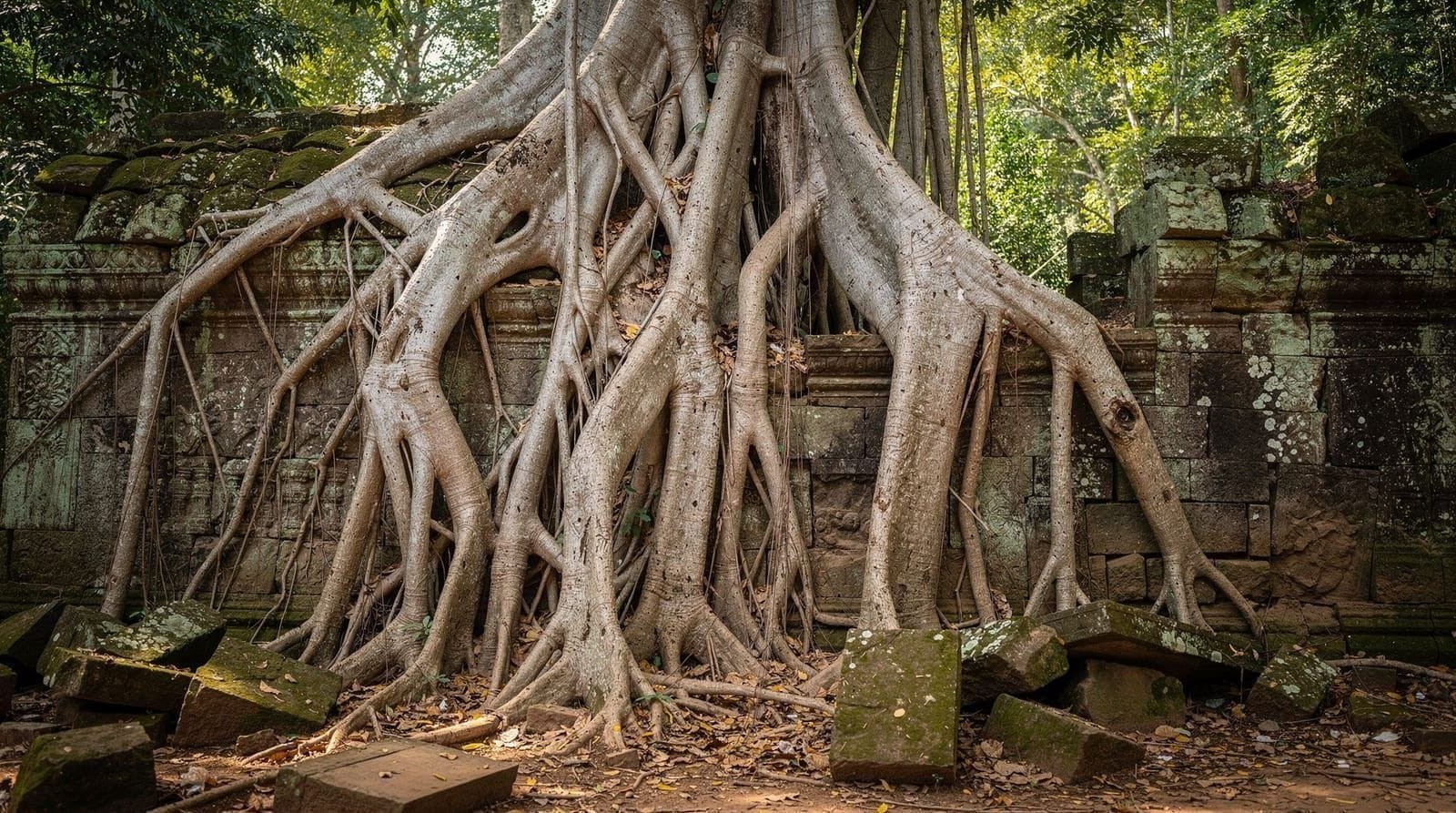
Visitors often ask how to weight their time across the Small Circuit’s three big stops. Angkor Wat rewards slow, careful gallery-reading and a single climb; Ta Prohm rewards a shorter, more visual visit centered on the tree-root formations; Angkor Thom sits between the two — genuinely large enough to spend a full 2-3 hours, but with a mix of quick photo stops (South Gate, Bayon faces) and slower, less-visited sections (Baphuon, the terraces) that reward visitors willing to walk further from the parking area.
If you’re building your own pacing rather than following a tour’s fixed schedule, Angkor Thom is the stop where extra time pays off the most in terms of what you’ll actually see, since so much of it — Baphuon in particular — gets skipped by rushed group itineraries.
Accessibility and mobility considerations
Angkor Thom is more accessible for visitors with mobility limitations than Ta Prohm or Baphuon specifically — the South Gate, the main Bayon courtyard, and the Terrace of the Elephants are all reachable via relatively flat, paved or packed-earth paths, unlike Ta Prohm’s uneven rubble-strewn walkways. The Bayon’s upper terrace, however, involves genuinely steep, narrow, uneven stone steps with no consistent handrail, and Baphuon’s climb is steeper still — both are reasonable to skip without missing the site’s core value if stairs are a concern. Vehicles can generally get close to the main Bayon parking area, minimizing the walking distance required just to reach the site.
Practical notes
Dress code (shoulders and knees covered) is enforced at Bayon’s central sanctuary specifically, less strictly on the open terraces, but it’s simplest to just dress compliant for the whole day — see our dress code guide. Water and shade are limited between the South Gate and Bayon; bring a bottle, ideally more than you’d carry for an equivalent walk elsewhere in town, since the distances between Angkor Thom’s individual sights are longer than they first appear on a map. Small vendor stalls cluster near the Bayon parking area selling drinks, scarves and snacks at slightly inflated but not outrageous prices.
Best photo spots, ranked by how crowded they get
The South Gate causeway, shot from ground level looking up at the four faces, is the single most reliable shot and rarely has a serious crowd problem even mid-morning, since most vehicles only pause here briefly. The Bayon’s upper terrace face-to-face shots are the most crowded, particularly the specific angle where multiple faces line up in a single frame — patience and a few minutes of waiting for a gap is normal here in peak season.
The Terrace of the Elephants, shot along its length to capture the full carved retaining wall, is consistently uncrowded and one of the better-value photo stops relative to effort. Baphuon’s summit view, looking back across the Angkor Thom complex, is arguably the most underrated vantage point on this entire page — few visitors make the climb, so it’s rarely crowded regardless of time of day.
Frequently asked questions about Angkor Thom and the Bayon
Is the Bayon the same thing as Angkor Thom?
No — Angkor Thom is the entire 3 sq km walled royal city; the Bayon is the central state temple within it, famous for its 216 carved faces. Angkor Thom also includes the Terrace of the Elephants, Terrace of the Leper King, Baphuon and Phimeanakas, all inside the same walls and the same ticket.
Do I need a separate ticket for Angkor Thom?
No. It’s covered by the standard Angkor Pass used for Angkor Wat and nearly every other temple in the main park.
What’s the best time to photograph the Bayon faces?
Early morning or late afternoon, when low-angle sunlight brings out the carved features. Overhead midday sun flattens them. If you want the faces without crowds, arriving right at the 5:00 AM opening (before the standard Angkor Wat sunrise crowd redirects here) works well.
How much time should I budget for Angkor Thom?
2-3 hours covers the South Gate, Bayon, Baphuon and the two terraces at an unhurried pace. Groups on a tight schedule often compress this to under an hour and skip Baphuon and the terraces entirely — worth avoiding if you have the time.
Is Baphuon worth the climb?
Yes, if you’re reasonably fit — the stairs are steep and there’s little shade, but it’s one of the least crowded major structures in the park and has a genuine engineering story (it was rebuilt almost entirely from scratch after its restoration records were destroyed during the Khmer Rouge period).
Can I visit Angkor Thom without a guide?
Yes, but the South Gate mythology, the Bayon face symbolism and the Elephants terrace carvings are far more meaningful with context. A guide is more valuable here than at almost any other single stop in the park.
Who built Angkor Thom and why?
Jayavarman VII, at the end of the 12th century, after his predecessor’s capital was sacked by Cham naval forces in 1177. He rebuilt on an unprecedented scale — Angkor Thom, the Bayon, Ta Prohm, Preah Khan and hundreds of hospitals and rest-houses across the empire — partly as a demonstration of restored Khmer power.
Are the Bayon faces really the king’s face?
That’s the leading interpretation — a merging of Jayavarman VII’s likeness with Avalokiteshvara, the bodhisattva of compassion — though some scholars argue certain faces represent regional guardian deities rather than the king specifically. The debate is unresolved, and most on-site guides will present the “king as bodhisattva” reading as the primary theory.
Is there an entry fee for the South Gate separately from Angkor Thom?
No — the South Gate is simply the entrance to the walled city of Angkor Thom and is covered by the same Angkor Pass as everything inside it.
What’s the walking distance between the main stops inside Angkor Thom?
Roughly 10-15 minutes on foot between Bayon and the Terrace of the Elephants, and a similar distance to Baphuon — most visitors drive or tuk-tuk between these clusters rather than walking the full loop, since the complex spans a genuinely large area (3 sq km within the walls).
Top experiences
Bookable activities with verified prices and instant confirmation on GetYourGuide.

Angkor Wat: Sunrise Visit to Ta Prohm and Bayon Temples
Angkor: One-Day Small Circuit Tour, Angkor Wat, Bayon and Ta Prohm

Siem Reap: Angkor Wat, Angkor Thom and Banteay Srei Tour

Angkor: Private One-Day Tour of Angkor Wat, Angkor Thom and Ta Prohm

Siem Reap: Angkor Wat, Angkor Thom and Ta Prohm by Tuk-Tuk
More tours on Viator
Top-rated experiences with verified reviews, bookable on Viator (a Tripadvisor company).