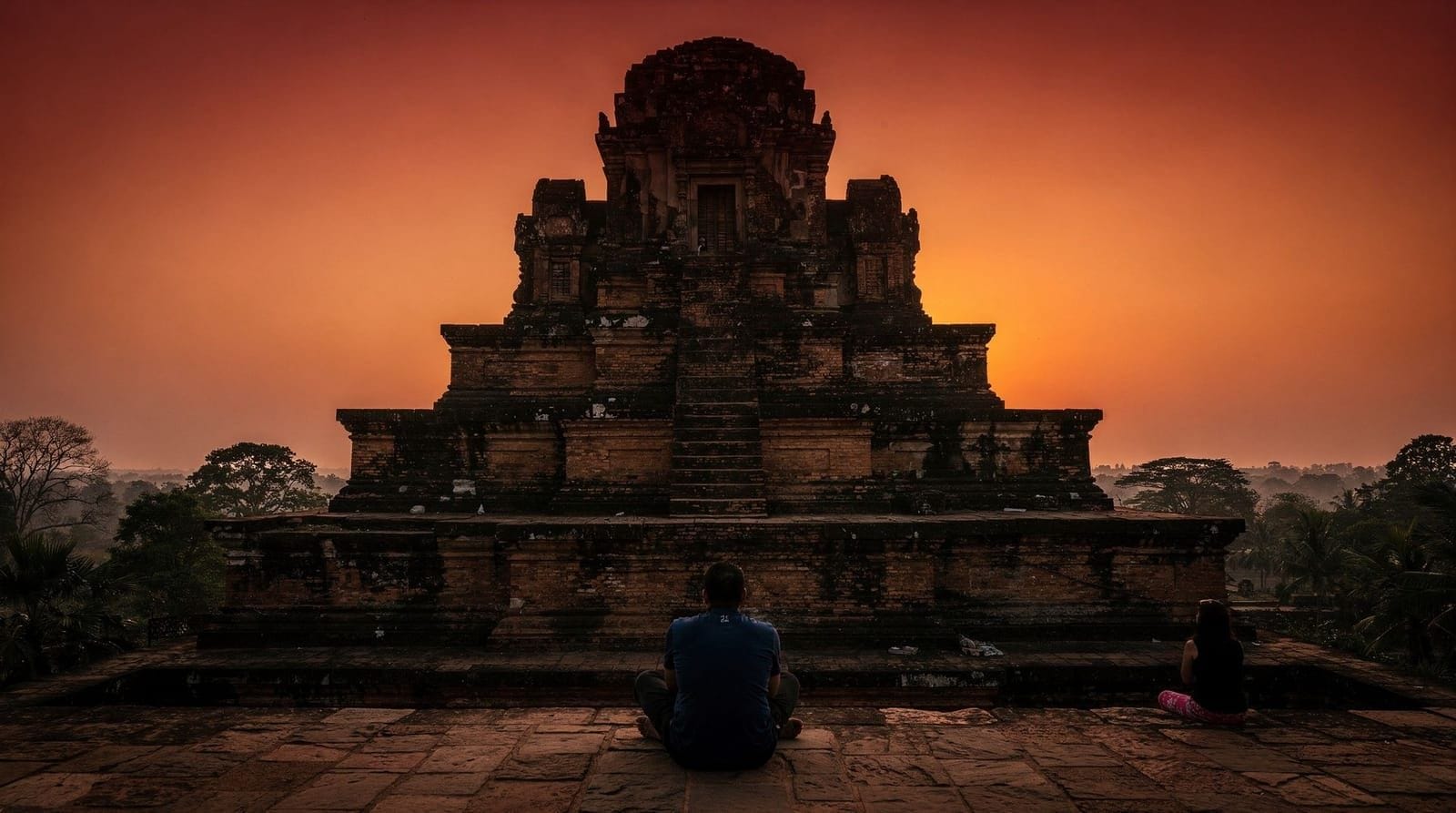
Ta Keo and Pre Rup
Ta Keo's unfinished pyramid and Pre Rup's sunset views: distances, ticket, and why these two temple-mountains reward a slower Angkor trip.
Phnom Bakheng: Sunset Tour with Pre Rup, Neak Pean and Preah Khan
Quick facts
- Distance from Old Market
- ~9 km to Ta Keo (Small Circuit), ~16 km to Pre Rup (Grand Circuit)
- Ticket needed
- Angkor Pass (same pass as Angkor Wat)
- Time to allow
- 20-30 min each
- Circuit
- Ta Keo on the Small Circuit, Pre Rup on the Grand Circuit — not adjacent
- Best for
- Sunset (Pre Rup) or a quiet climb (Ta Keo)
Two temple-mountains, two different circuits
Ta Keo and Pre Rup are grouped on this site because they’re both textbook examples of the Angkorian “temple-mountain” form — stepped pyramids representing Mount Meru, the cosmic center of the Hindu universe — but it’s worth being upfront that they’re not next to each other. Ta Keo sits on the Small Circuit, near Ta Prohm; Pre Rup sits on the Grand Circuit, near East Mebon. You’ll typically see them on different days unless you’re doing a longer, custom-routed itinerary.
Ta Keo — the temple that was never finished
Built around 1000 AD under Jayavarman V, Ta Keo is unusual in the Angkor canon: it was never decorated. Construction stopped partway through, reportedly after the temple was struck by lightning (read by the Khmer as a bad omen), leaving its five towers and steep sandstone tiers completely bare of the carved reliefs that cover almost every other major Angkor structure. The effect is a raw, almost brutalist temple-mountain — stark stepped tiers of plain grey sandstone rising sharply, genuinely striking precisely because it lacks ornamentation.
It’s about 9 km from central Siem Reap, close to Ta Prohm on the Small Circuit route, and the climb to the top — steep, narrow stone steps with no railing on some sides — offers one of the best unobstructed elevated views in the park, largely because so few visitors bother to climb it. Budget 20-30 minutes; longer if you’re going to the summit.
Jayavarman V came to the throne as a child following his father Rajendravarman II’s death, and Ta Keo was intended as his state temple — the personal dynastic monument each Angkorian king built to mark his reign, a tradition that continued through Suryavarman II’s Angkor Wat over a century later.
Because Ta Keo’s construction stalled early, it offers a rare, unintended glimpse of Khmer temple-building method: you can see the massive sandstone blocks stacked and roughly dressed, but never carved with the mythological reliefs, deity images, and decorative borders that would normally have covered every visible surface. Some art historians treat this as valuable precisely for that reason — it’s effectively a cross-section of the construction process, frozen mid-build, that no finished temple can show.
The five towers at the summit — one central tower flanked by four corner towers, the standard Angkorian quincunx layout representing Mount Meru’s five peaks — are more visible and legible from a distance at Ta Keo than at more heavily decorated temples, since there’s no carved ornamentation to distract from the pure geometric form. Photographers who specifically want to understand or capture the underlying architectural logic of a Khmer temple-mountain, stripped of decoration, tend to find Ta Keo more useful for that purpose than any other stop on the Small Circuit.
Pre Rup — a sunset alternative that isn’t Phnom Bakheng
Built in 961 AD under Rajendravarman as a state temple, Pre Rup is a five-tower pyramid on the Grand Circuit whose reddish laterite and brick construction genuinely glows at sunset — a serious alternative to the far more crowded Phnom Bakheng sunset spot inside the Small Circuit area. Its name translates roughly to “turn the body,” referring to a later folk belief about a cremation ritual supposedly performed there, though there’s no strong evidence the temple was originally built for that purpose.
Pre Rup’s upper terrace is broad enough to spread out on, unlike Phnom Bakheng’s genuinely capacity-limited summit (which the park now regulates with a numbered-ticket system due to past overcrowding and structural damage concerns). For a sunset that doesn’t involve a queue, Pre Rup is one of the better-kept alternatives — see our Angkor sunset spots guide for the full comparison.
Rajendravarman built Pre Rup a few years after East Mebon, another five-tower pyramid a short distance away on the same Grand Circuit route, and the two temples are close enough architecturally that historians read Pre Rup as a refinement of the East Mebon design rather than an unrelated project — slightly taller, slightly more developed, using the same brick-core-with-laterite-and-sandstone-facing construction technique. Visiting both on the same day (they’re only a few minutes apart by tuk-tuk) gives a useful, compact lesson in how a single king’s architectural style matured over a short span of years, without needing to cross the whole park to see the comparison.
The material itself is part of what makes Pre Rup’s sunset color work: laterite is a naturally iron-rich, porous stone that oxidizes to a deep reddish-brown, and the combination of laterite facing with brick cores (rather than the more uniformly grey sandstone of later temples like Angkor Wat) means Pre Rup’s towers pick up warmer tones in low-angle light than most other Grand Circuit stops.
When to visit each one
Ta Keo has no real “best time” the way sunrise or sunset spots do — it rarely draws a crowd at any hour, so timing here is more about heat than light. Mid-morning, after the Angkor Wat sunrise crowd has dispersed elsewhere on the Small Circuit, tends to be quiet and cooler than a midday climb. Pre Rup is different: its whole appeal is the sunset light on its laterite towers, so timing matters much more. Arrive by 5:00 PM in the dry season (November-March) to claim a spot on the upper terrace before the small but real gathering of sunset-watchers builds; in the rainy season, sunset comes slightly earlier and cloud cover can mute the color, so check a sunset time table rather than assuming a fixed clock time works year-round.
What’s overrated, what’s underrated
Neither Ta Keo nor Pre Rup is overrated — both are consistently under-visited relative to how rewarding they are, mostly because they don’t have a single “iconic” marketing image the way Angkor Wat or Ta Prohm do. If you’re building a Grand Circuit day and want a sunset finish without Phnom Bakheng’s crowd management queue, Pre Rup is the better-kept secret.
What you’ll actually notice on the ground
At Ta Keo, the first thing most visitors register is scale before detail — the sheer mass of undecorated sandstone reads almost industrial compared to the intricately carved surfaces at Ta Prohm or Angkor Wat just minutes away. The steps narrow noticeably as you climb, and the summit platform is smaller than it looks from the base, so it doesn’t comfortably hold a large group at once — another reason it stays uncrowded even during Small Circuit peak hours.
At Pre Rup, the texture is the story: laterite’s naturally pitted, porous surface looks almost sponge-like up close, in visible contrast to the smoother dressed sandstone used for decorative elements and door frames. The lion statues flanking the entrance stairways, though worn, are still identifiable, and the eastern-facing orientation of the main stairway is precisely why sunset viewing works so well here — you’re looking back toward the temple with the light behind you, rather than into it.
How to combine them with the rest of your day
Ta Keo pairs naturally with Ta Prohm and Angkor Thom on a standard Small Circuit day — see the Small Circuit destination page. Pre Rup fits at the end of a Grand Circuit loop that includes Preah Khan and Neak Pean — our Grand Circuit sunset tour sequences exactly this, ending at Pre Rup (or Phnom Bakheng, depending on the day’s schedule) for sunset.
For a 2-day pass itinerary that separates the two circuits cleanly, the 2-day Angkor Wat and Grand Circuit tour is a reasonable structure — Small Circuit day one, Grand Circuit day two including Pre Rup. If you’re combining the Roluos Group with a Grand Circuit day, the Roluos Group, Banteay Samre and Pre Rup tour covers Pre Rup alongside the older 9th-century temples.
Accessibility
Neither temple is easy going for visitors with mobility limitations. Ta Keo’s summit climb is genuinely one of the steeper, more exposed ascents in the park — narrow stone steps, minimal or no handrails on several faces, and a summit with no shade cover. Pre Rup’s climb is comparable in steepness though shorter overall, with slightly better-maintained steps on the main approach. At both temples, the lower terraces and base-level structures are fully viewable without climbing, so travelers who’d rather not attempt the ascent still get a meaningful visit — just not the elevated view that’s the main draw for each site.
Where to eat nearby
Neither Ta Keo nor Pre Rup has developed food infrastructure on site — a handful of drink and snack vendors operate near the parking areas at both, selling water, coconuts, and grilled corn, but nothing resembling a sit-down meal. Ta Keo’s proximity to Ta Prohm means most visitors fold it into a Small Circuit day that includes a proper lunch stop back toward town or at one of the restaurants near the Angkor Wat area. For a Pre Rup sunset finish on the Grand Circuit, plan to eat afterward back in Siem Reap — most Grand Circuit tours end near dusk specifically because Pre Rup (or Phnom Bakheng) is the last stop before the drive back to town.
Practical notes
Both are fully covered by the standard Angkor Pass — see the Angkor Pass guide for pricing (1-day $37 / 3-day $62 / 7-day $72). Ta Keo’s climb has no handrail on some faces — sturdy shoes and caution matter more here than at most Angkor sites. Pre Rup at sunset draws a moderate crowd in peak season (November-March) but nowhere near Phnom Bakheng’s numbers; arrive by 5:00 PM for a good spot on the upper terrace.
Ta Keo and Pre Rup compared to other temple-mountains on the pass
Angkor’s pass covers several temple-mountain pyramids beyond these two — Bakong at the Roluos Group (881 AD, the earliest), Phnom Bakheng (late 9th century, inside the Small Circuit area), and Angkor Wat itself in its most refined form (12th century). Seen together across a multi-day pass, Ta Keo and Pre Rup sit at a useful midpoint in that architectural timeline — later and more structurally ambitious than Bakong, but built decades before Angkor Wat’s five-tower design reached full maturity.
Visitors doing a 3-day or 7-day pass who want to actually trace this evolution, rather than just tick off famous names, get more out of deliberately sequencing a visit that includes Bakong, then Pre Rup or Ta Keo, then Angkor Wat — in roughly that chronological order — than from following the standard circuit-based routing alone.
Frequently asked questions about Ta Keo and Pre Rup
Are Ta Keo and Pre Rup near each other?
No — Ta Keo is on the Small Circuit near Ta Prohm, and Pre Rup is on the Grand Circuit near East Mebon. They’re grouped here because both are temple-mountain pyramids, not because they’re geographically close.
Why does Ta Keo look so plain compared to other Angkor temples?
Construction was abandoned before the carving and decoration phase, reportedly after a lightning strike was interpreted as a bad omen. It’s one of the only major Angkor temples left undecorated.
Is Pre Rup a good sunset alternative to Phnom Bakheng?
Yes — Pre Rup’s broad summit terrace doesn’t have the same capacity-limited ticketing system Phnom Bakheng now uses, and its reddish brick and laterite genuinely catch the sunset light well.
Do I need a separate ticket for either temple?
No, both are covered by the standard Angkor Pass used at Angkor Wat.
Is climbing Ta Keo safe?
The steps are steep and narrow with limited or no handrails on some sides — manageable for most reasonably fit visitors with caution, but not ideal for anyone with mobility concerns or young children.
How much time should I set aside?
20-30 minutes at each is typical; neither warrants a dedicated half-day the way Angkor Wat or the floating villages do.
Is Pre Rup related to East Mebon?
Yes — both are five-tower pyramids built by Rajendravarman within a few years of each other, using the same brick-core-with-laterite-facing construction. Pre Rup is generally read as a refinement of the East Mebon design, and the two are close enough to visit back-to-back.
Is there anywhere to eat near Ta Keo or Pre Rup?
No proper restaurants at either site — only scattered snack and drink vendors near the parking areas. Plan meals in town or fold a stop into a circuit day that passes closer to the Angkor Wat area or ends back in Siem Reap.
Which temple-mountain should I prioritize if I only have time for one?
Pre Rup, mainly for the sunset payoff and its broader, less crowded summit terrace compared to Phnom Bakheng. Ta Keo is the better pick specifically for visitors interested in unfinished construction and raw architectural form over decoration.
Are Ta Keo and Pre Rup suitable for visitors who dislike crowds?
Yes, more so than most other Angkor Pass stops — neither draws anything like the volume of visitors that Angkor Wat, Ta Prohm, or even Phnom Bakheng’s sunset crowd see, which is part of why both are worth the modest detour from the standard circuit stops for crowd-averse travelers.
Top experiences
Bookable activities with verified prices and instant confirmation on GetYourGuide.


More tours on Viator
Top-rated experiences with verified reviews, bookable on Viator (a Tripadvisor company).