Angkor Wat
How to visit Angkor Wat from Siem Reap: real ticket prices, sunrise timing, crowd patterns and what's actually worth your time.
Siem Reap: Angkor Wat Sunrise Small-Group Tour
Quick facts
- Distance from Old Market
- ~6 km, 15-20 min by tuk-tuk
- Ticket needed
- Angkor Pass (1-day $37 / 3-day $62 / 7-day $72)
- Gates open
- 5:00 AM daily
- Time to allow
- 2.5-4 hours
- Dress code
- Shoulders and knees covered, enforced at the door
Why it’s the reason most people fly to Siem Reap
Angkor Wat is a single temple, not a synonym for the whole park — a distinction the SERP blurs constantly. Built under King Suryavarman II in the early 12th century as a Hindu temple to Vishnu, later adapted for Buddhist worship, it’s the largest religious monument on earth by land area (162.6 hectares, moat included) and the only major Angkorian temple that has been in continuous use since it was built. That continuity is why the five central towers, the 800-metre bas-relief galleries and the wide moat all read as strikingly intact next to the jungle-swallowed ruins elsewhere in the park.
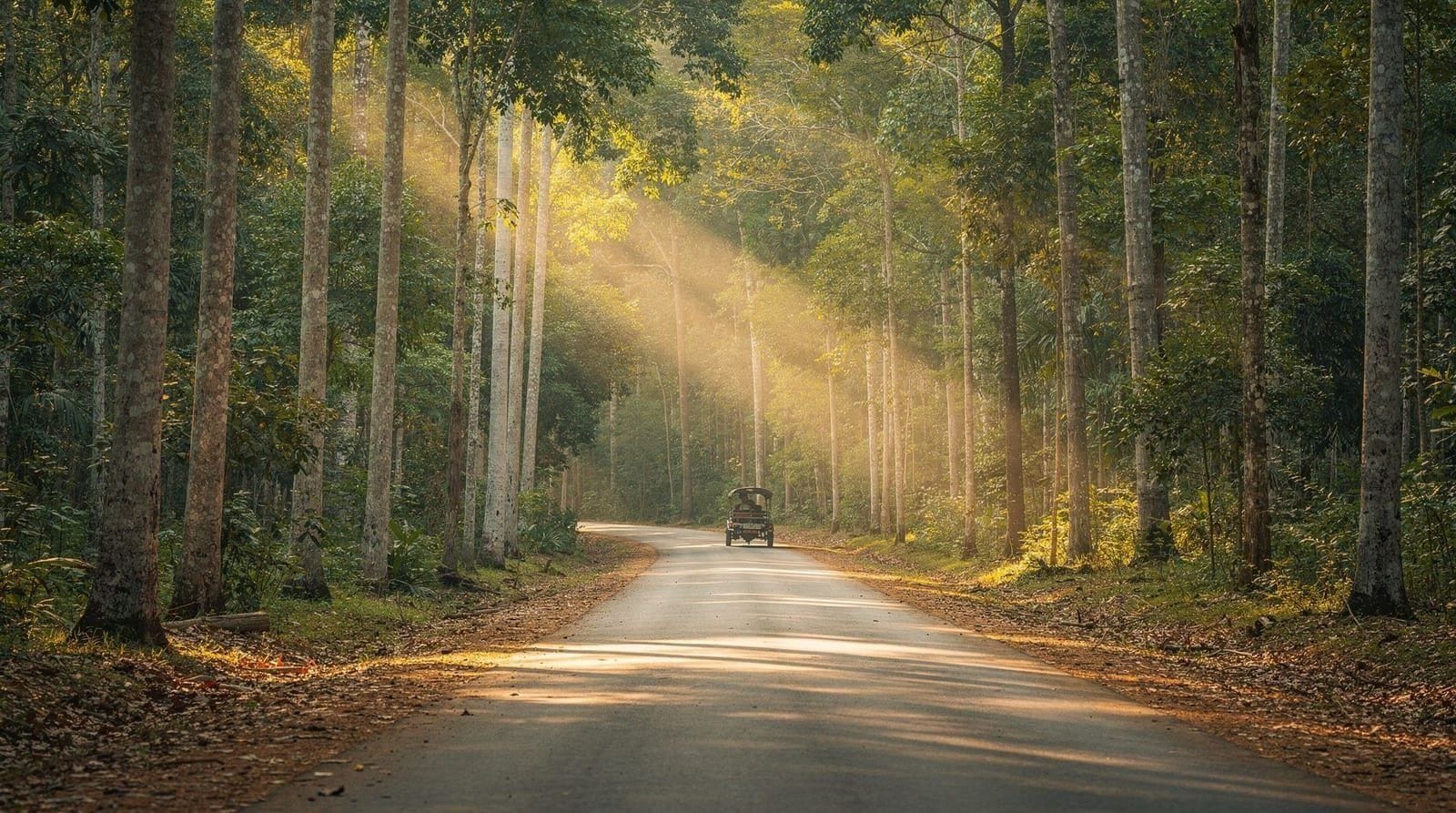
It sits inside the Angkor Archaeological Park, about 6 km north of central Siem Reap — a 15-20 minute tuk-tuk ride from the Old Market area, longer from hotels further out on National Road 6. It’s the first stop on almost every Small Circuit route (see our Angkor Small Circuit guide for how it fits with Angkor Thom and Ta Prohm), and it’s the one temple where arriving at the wrong hour genuinely ruins the experience.
Ticket: it’s on the Angkor Pass, never a separate purchase
Angkor Wat is covered by the standard Angkor Pass sold exclusively by Angkor Enterprise, the state authority — either at the official ticket checkpoint on Vithei Charles de Gaulle (open from 5:00 AM, and from about 4:30 PM for a next-day pass) or online at angkorenterprise.gov.kh. Pricing hasn’t changed for 2026:
- 1-day pass: $37 — usable on the day of your choice within 5 days of purchase
- 3-day pass: $62 — usable on any 3 days within 10 days of purchase
- 7-day pass: $72 — usable on any 7 days within 30 days of purchase
Children under 12 enter free with a passport for age verification. $2 of every ticket funds a children’s hospital in Siem Reap. For the full ticket logic — including why the 3-day pass is the better deal for most itineraries — see our Angkor Pass guide and our Angkor Pass calculator.
The one thing worth repeating because so many first-timers get confused: when you book a tour through GetYourGuide or Viator, you are buying transport and a guide, not the entrance ticket. No booking platform sells the Angkor Pass itself — you buy that separately at the Angkor Enterprise checkpoint, and most tuk-tuk drivers and guided tours will swing by there first thing so you can purchase it in person (bring your passport; they photograph you on-site for the pass photo).
Sunrise, and why the hour you arrive matters more here than anywhere else in the park
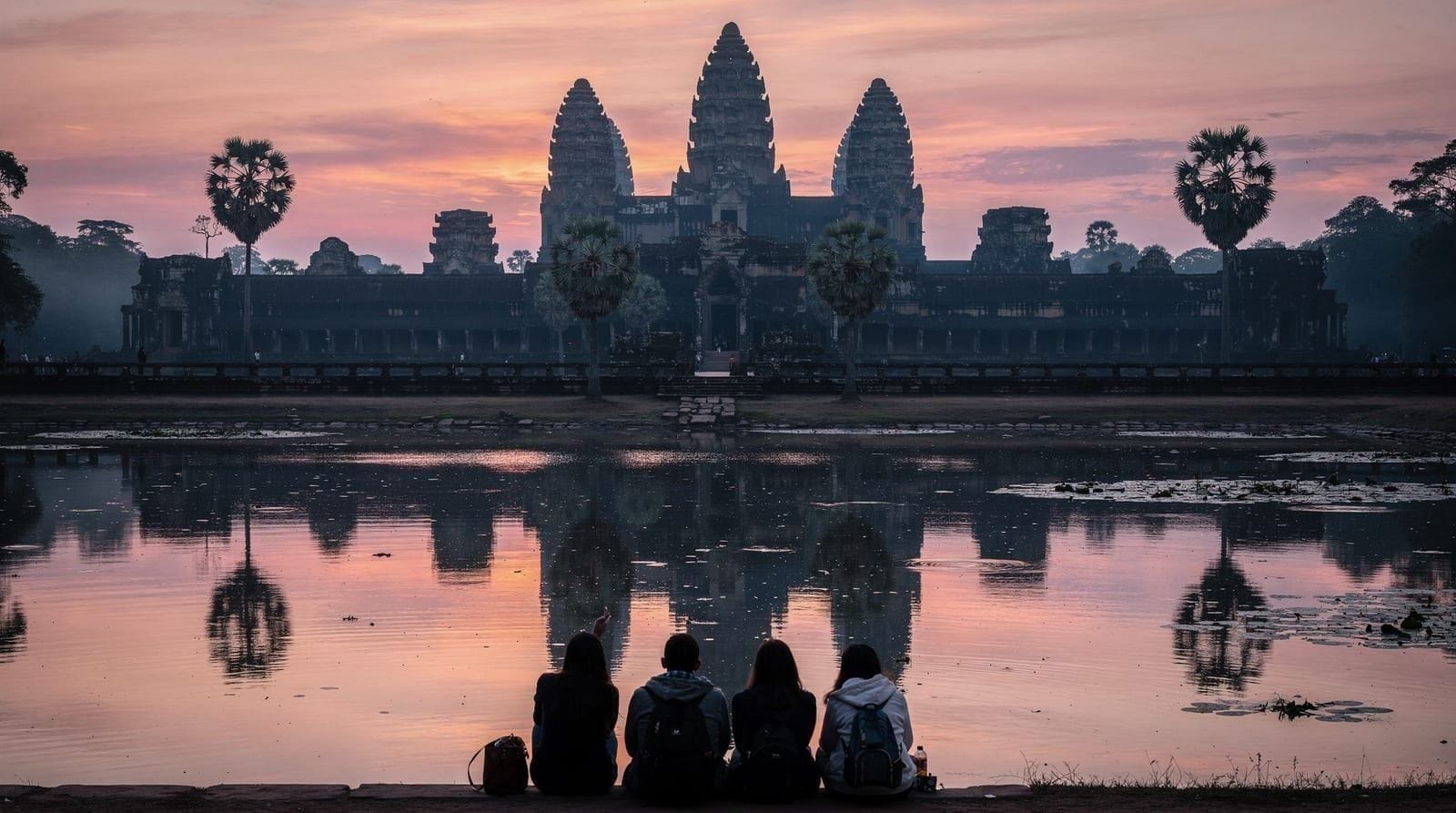
Angkor Wat faces west — unusual for a Hindu temple, tied to its function as Suryavarman II’s funerary temple — which means the classic shot is the five towers silhouetted against the sky as the sun rises behind them, reflected in one of the two ponds in front of the west entrance. Gates open at 5:00 AM; sunrise itself lands between roughly 5:35 AM (June) and 6:20 AM (December), so check the month before you set an alarm. Our sunrise small-group tour times pickup precisely for this, which matters if you’re not confident booking a driver at 4:15 AM on your own.
Reality check worth having before you go: the reflecting pond directly in front of the causeway gets crowded — tripods and shoulder-to-shoulder crowds by 5:20 AM in peak season (December-January). The smaller pond to the left (south) of the main pond is quieter and gives nearly the same shot. If crowds bother you more than the sunrise itself, consider skipping sunrise here and instead doing it at Angkor Thom’s Bayon or on the small circuit’s quieter stops, then returning to Angkor Wat mid-morning when the tour buses have moved on to Ta Prohm.
Afternoon light (after 3:30 PM) is genuinely underrated: softer, fewer people, and the causeway crossing is far more pleasant without a crush of pre-dawn crowds. If you’re staying multiple days, splitting the visit — sunrise for the photo, a late-afternoon return for the interior — beats trying to do both in one long, hot morning.
What to actually see once you’re inside
The outer gallery’s bas-reliefs are the reason to bring more than 30 minutes. The 800-metre gallery wraps the temple’s first level and depicts, panel by panel, the Battle of Kurukshetra, the Churning of the Sea of Milk (the most photographed panel, showing gods and demons pulling a serpent to churn the cosmic ocean), and Suryavarman II’s own army on the march. A guide earns their fee here — the reliefs are illegible without context, and self-guided visitors routinely walk past the most significant panels without knowing what they’re looking at.
Climbing to the top tier (Bakan sanctuary) requires a separate short queue and a strict dress code check — shoulders and knees covered, no exceptions, and a maximum number of visitors allowed on the upper level at once, so expect a wait in peak season. The upper level closes around 5:30 PM and sometimes earlier during Buddhist holidays. If climbing isn’t essential to you, skip the queue and spend that time on the ground-level galleries instead, which are less rushed.
From Hindu state temple to living Buddhist site
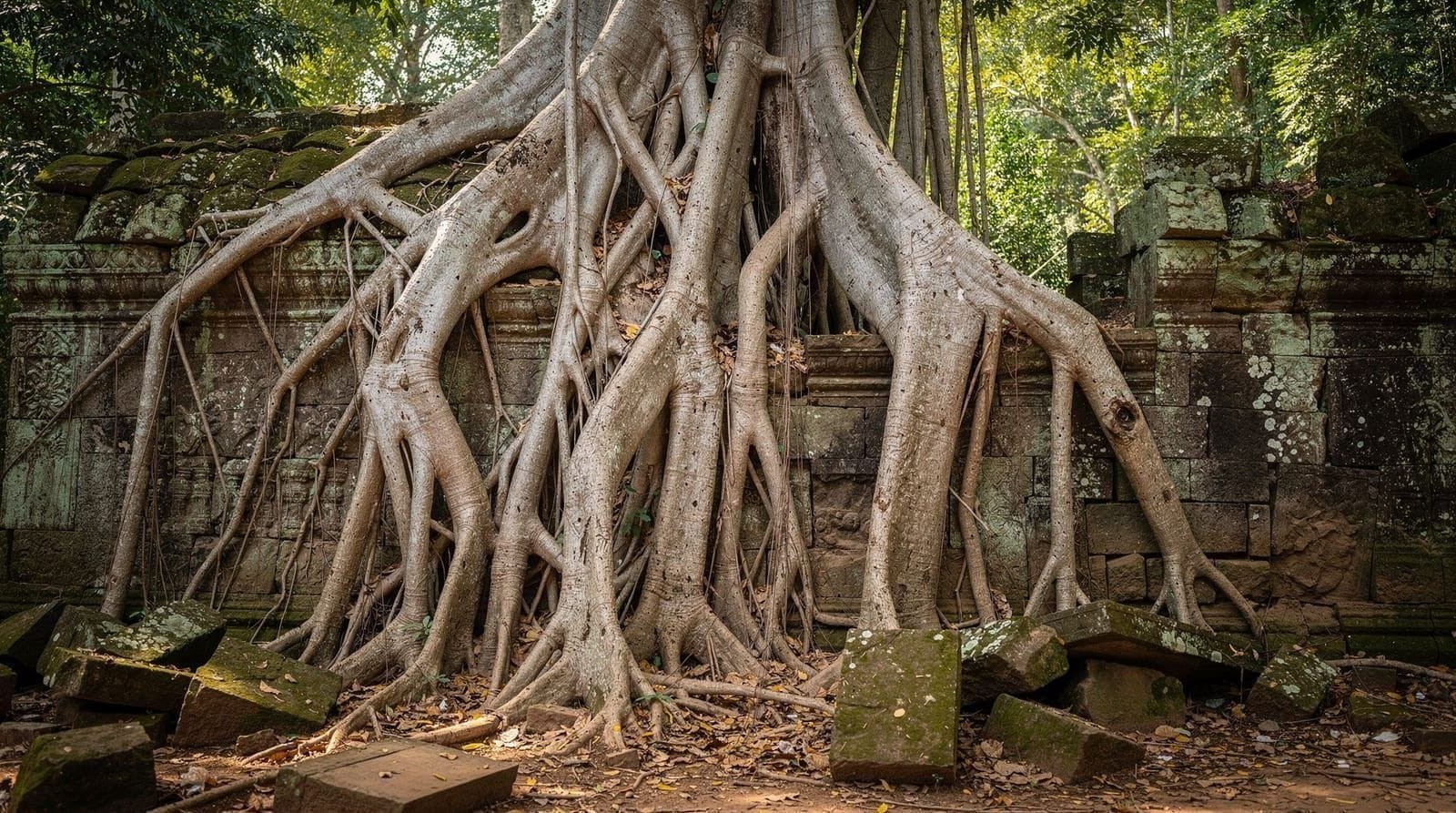
Angkor Wat’s history doesn’t stop at its 12th-century construction. Within a few decades of Suryavarman II’s death, the Khmer Empire’s state religion shifted toward Buddhism, and Angkor Wat was gradually adapted for Buddhist worship rather than abandoned — a conversion visible today in some of the carved figures that were altered or added over subsequent centuries. Unlike Ta Prohm, Preah Khan or Beng Mealea, it was never fully lost to jungle: a community of Buddhist monks maintained a presence here more or less continuously, which is the direct reason the structure survived in far better condition than temples that were left unattended for centuries.
The temple’s “rediscovery” by the West is often mis-told as if French naturalist Henri Mouhot found an unknown lost city in 1860 — in reality, Angkor Wat was well known to Khmer Buddhists, to Portuguese and Japanese visitors centuries earlier, and to Cambodian court records throughout. What Mouhot’s widely circulated writings did was introduce it to a European audience, kicking off the wave of French colonial-era study, mapping and eventually restoration (much of it under the École française d’Extrême-Orient) that shaped how the site is presented today, including the anastylosis restoration technique later used more extensively at Baphuon inside Angkor Thom.
Reading the layout before you go in
Angkor Wat’s plan is a nested set of rectangular galleries and moats, oriented on an east-west axis, with the five central towers arranged in a quincunx (four corner towers plus one center) representing the five peaks of Mount Meru, the cosmic mountain at the center of Hindu and Buddhist cosmology. The surrounding moat, roughly 190 metres wide, represents the cosmic ocean; the outer wall represents the mountains ringing the world. None of this is obvious walking in cold, which is a large part of why a guide or at least a pre-read genuinely changes what you get out of the visit — without the framework, the temple reads as “big and impressive” rather than as a coherent religious diagram you’re walking through.
The main entrance causeway crosses the moat from the west — itself unusual, since most Hindu temples of this style face east, a choice generally linked to Angkor Wat’s secondary function as Suryavarman II’s funerary temple (west being associated with death and the setting sun in Hindu cosmology). Visitors sometimes fixate on the five towers without registering that the causeway crossing, the naga (serpent) balustrades lining it, and the two libraries flanking the approach are all part of the same deliberate symbolic sequence, not just a long walk to the “real” temple.
Common mistakes first-time visitors make
Treating sunrise as the only visit. A meaningful share of visitors do the 5:00 AM crowd, get their photo, and leave within 90 minutes without ever properly walking the outer galleries — the single biggest missed opportunity at this temple. Skipping water and food planning. There’s no substantial food inside the temple complex itself, and the walk from parking to the towers and back, plus gallery walking, adds up to real distance in real heat.
Assuming a guide is optional context rather than a real upgrade. Given how symbolically dense the site is, this is the one Angkor stop where a guide changes the experience more than almost anywhere else on this list. Underestimating the upper-level queue in peak season. Visitors budgeting “quickly climb to the top” as a five-minute add-on are often surprised by a genuine 30-40 minute wait in December-January.
What’s overrated here
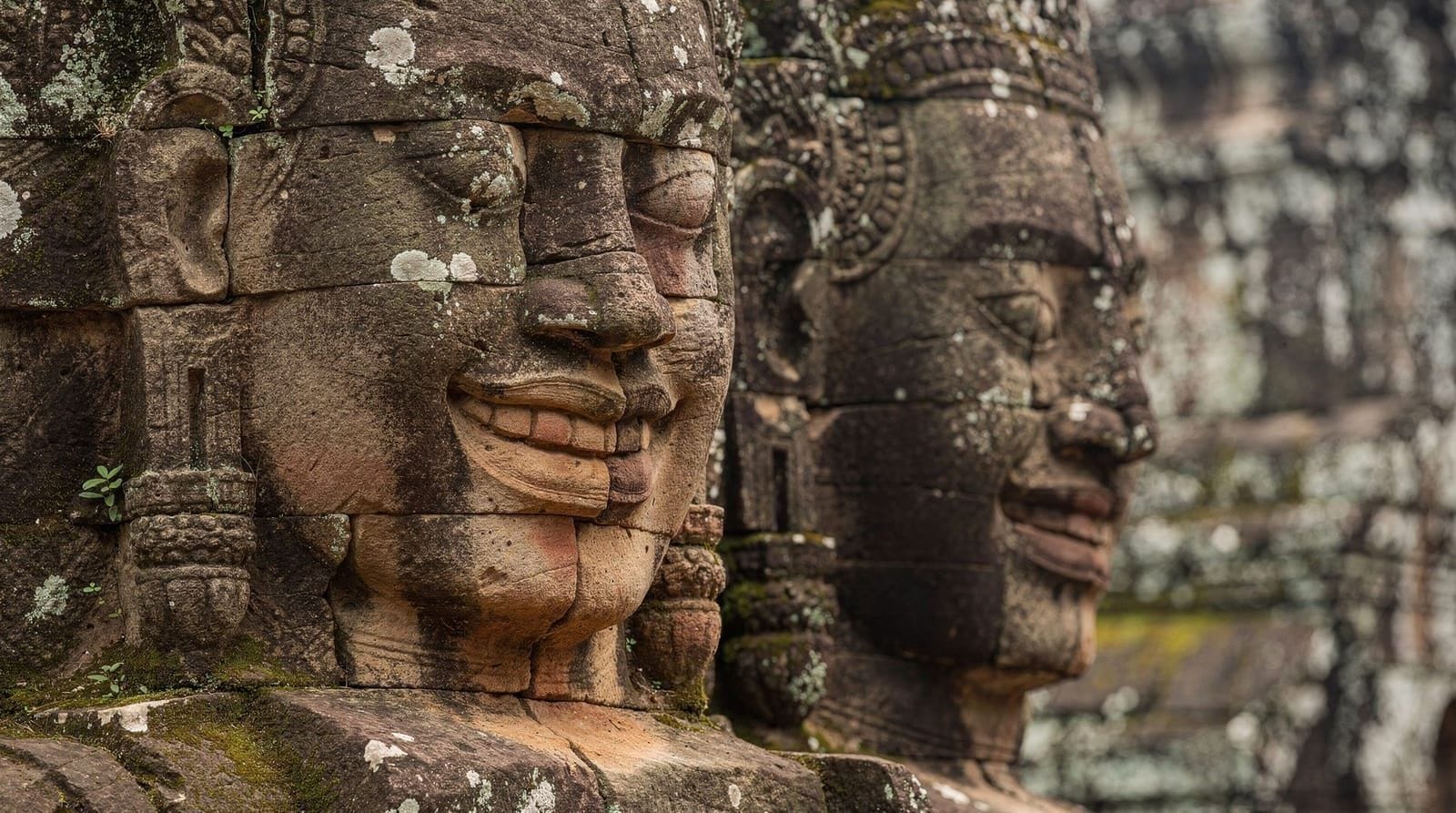
The “reflection selfie” spot at the main pond by sunrise is worth seeing once, not worth the elbow-to-elbow scrum some visitors put up with for 45 minutes. Similarly, paying extra for a “skip-the-line” temple guide inside Angkor Wat itself is rarely necessary — the bottleneck is the upper-level stairs, which no guide can bypass. Where a guide genuinely adds value is context on the bas-reliefs and Angkor Thom’s Bayon faces, not queue-skipping.
Dress code, heat and practical logistics
Shoulders and knees must be covered to enter the temple; this is enforced by guards at the entrance, and being turned away is common for visitors in shorts or tank tops. Bring a light scarf or sarong even if you’re dressed appropriately elsewhere in town — temperatures inside the temple can be 5-8°C hotter than outside with midday sun. There’s minimal shade on the causeway crossing the moat, so a hat and water are non-negotiable, especially April-May when highs hit 35-39°C. Toilets and small drink stalls sit just outside the main entrance area, not inside the temple grounds.
Tap water in Cambodia isn’t potable — bring a reusable bottle and refill from your hotel or buy bottled water from the stalls (about $0.50-1). See our dress code guide for photos of what does and doesn’t pass inspection.
How to combine it with the rest of your day
Angkor Wat is the first stop on the standard Small Circuit, followed by Angkor Thom and the Bayon, then Ta Prohm. A tuk-tuk driver hired for the day (roughly $15-20, negotiate the price before you get in — see tuk-tuk pricing) will handle the whole loop. If you’d rather not manage logistics on your first morning, a guided option like our 2-day sunrise-to-sunset tour covers Angkor Wat plus the wider circuit with a driver and English-speaking guide included.
For travelers who want the temple without the 4:15 AM wake-up, a private 3-hour visit booked for mid-morning or late afternoon covers the same ground with a fraction of the crowd stress — worth considering if you’re not a morning person or you’re visiting with young kids (see our Siem Reap with kids guide).
If you only have one full day for temples, our Angkor in one day guide sequences Angkor Wat with the rest of the Small Circuit realistically, including where most one-day itineraries run out of time.
When to come by season
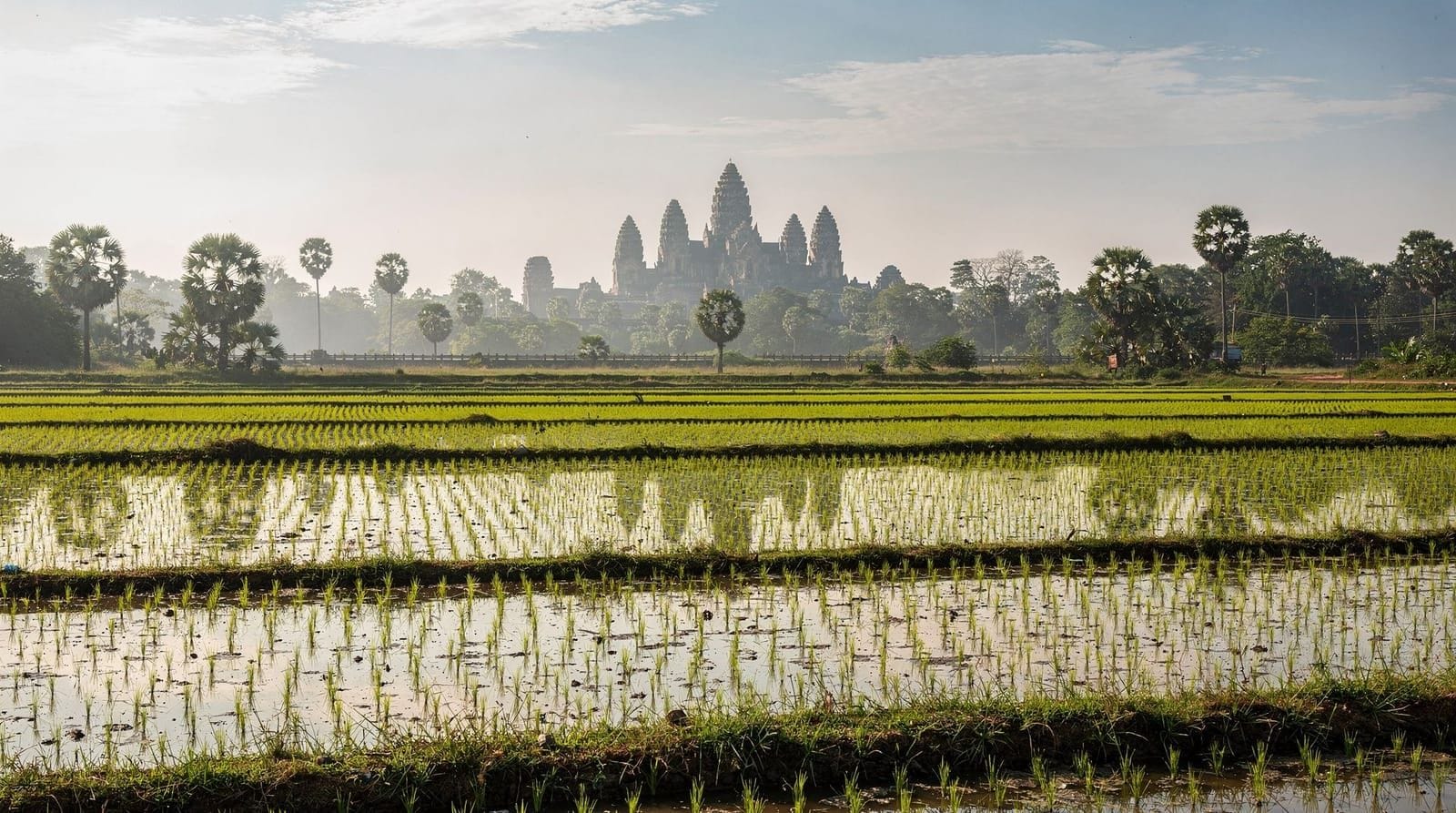
November-March is the dry, cooler window (25-31°C) and the busiest — December-January hotel prices peak and sunrise crowds are thickest. April-May is hottest (35-39°C+) but noticeably quieter mid-morning onward. The rainy season (June-October) brings afternoon downpours but a nearly empty causeway most mornings and a full moat, which photographers generally prefer for the reflection shot. Full month-by-month detail is in our best time to visit guide and the weather by month breakdown.
Frequently asked questions about visiting Angkor Wat
Do I need a separate ticket for Angkor Wat, or does the Angkor Pass cover it?
The standard Angkor Pass (1/3/7-day, $37/$62/$72) covers Angkor Wat along with virtually every temple inside the main park — Angkor Thom, Ta Prohm, Banteay Srei, the Roluos Group and more. It does not cover Beng Mealea, Koh Ker, Phnom Kulen or Preah Vihear, which require separate tickets because they’re managed by different authorities.
What time should I arrive for sunrise?
Gates open at 5:00 AM. Arrive by then to get a spot at either reflecting pond before the crowd peaks around 5:30-5:45 AM. Sunrise itself is later than most visitors expect — check the month, since it shifts from around 5:35 AM in June to 6:20 AM in December.
Can I buy the Angkor Pass at Angkor Wat itself?
No. The Angkor Pass is sold only at the dedicated Angkor Enterprise ticket checkpoint on Vithei Charles de Gaulle, a few kilometers before the temple entrance, or online in advance at angkorenterprise.gov.kh. There is no ticket booth at Angkor Wat.
Is a guide worth it at Angkor Wat specifically?
For the bas-relief galleries, yes — the 800-metre carved gallery is close to unreadable without narration. For the temple as a photo stop, no. Many visitors do a guided visit for Angkor Wat and Angkor Thom, then self-guide the quieter Grand Circuit stops.
How long does the climb to the top level take?
Expect 20-40 minutes including queueing in peak season, less outside December-January. The upper sanctuary has a capacity limit and closes earlier than the rest of the temple, typically around 5:30 PM.
Is Angkor Wat worth visiting if I’ve seen photos of it already?
The photos rarely convey the scale of the outer gallery or the moat crossing. Most repeat visitors say the second and third visits — away from sunrise, with time to actually read the bas-reliefs — are more rewarding than the first rushed pre-dawn stop.
What should I skip if I’m short on time?
If you have under two hours total for the whole park, prioritize the outer galleries and one climb to the upper level over trying to also fit in Angkor Thom the same morning — see our Angkor in one day guide for a realistic single-day sequence.
Why does Angkor Wat face west instead of east like most Hindu temples?
Most Angkorian state temples face east, but Angkor Wat faces west, a choice most historians link to its secondary role as Suryavarman II’s funerary temple — west is associated with death and the setting sun in Hindu cosmology. This is also why sunrise photography works so well here: the sun rises behind the east-facing back of the temple as seen from the west entrance causeway.
Is Angkor Wat still an active religious site?
Yes — unlike several other major Angkor temples, Angkor Wat has maintained an active Buddhist monastic presence for centuries, which is part of why it survived in comparatively good condition. You may encounter monks and active shrines inside; treat these areas with the same respect you would any working temple.
How crowded is Angkor Wat outside of sunrise?
Noticeably less crowded than the 5:00-6:30 AM window, though still busy with Small Circuit tour groups through mid-morning. Late afternoon (after 3:30 PM) is consistently the quietest well-lit window during opening hours.
Can I re-enter Angkor Wat later the same day on the same pass scan?
Angkor Pass entry is generally checked by scanning at each temple, not limited to a single entry per site per day, though practices can vary — check with your ticket or guide if you’re planning a split-visit (sunrise, then a later return) on the same day.
Top experiences
Bookable activities with verified prices and instant confirmation on GetYourGuide.
Siem Reap: Angkor Wat Sunrise Small-Group Tour

Siem Reap: Angkor Wat 2-Day Tour, Sunrise to Sunset

Siem Reap: Sunrise at Angkor Wat Temple

Siem Reap: Angkor Wat Sunrise Tour by Tuk-Tuk with Breakfast

Siem Reap: Angkor Wat Small-Group Sunrise or Sunset Tour
More tours on Viator
Top-rated experiences with verified reviews, bookable on Viator (a Tripadvisor company).