Siem Reap tuk-tuk prices: what's fair, what's a scam
Siem Reap: Angkor Wat Private Tuk-Tuk Tour
How much should a tuk-tuk cost in Siem Reap?
A full day covering the standard Angkor small or grand circuit runs roughly $15-20. Farther outlier temples (Banteay Srei, Beng Mealea) push this to $20-30+ given the extra distance and time. Short in-town hops (Old Market to a nearby hotel) cost $1-3. Always agree the price and route before boarding — after-the-fact negotiation is the main source of disputes.
The real numbers, upfront
A private tuk-tuk for a full day covering the standard Angkor small or grand circuit runs roughly $15-20. Farther outlier temples — Banteay Srei, Beng Mealea, and especially Koh Ker or Phnom Kulen — push this to $20-30+, reflecting the extra distance and driving time rather than a different pricing structure. Short in-town trips (Old Market to a nearby hotel, for example) run $1-3. These figures are consistent across reputable drivers and hotel-arranged bookings; anything wildly outside this range in either direction is worth a second look — too low often signals commission-shop pressure later in the day, too high is simply an opening negotiation position worth countering.
Standard day rates by route
| Route | Typical price | Notes |
|---|---|---|
| Sunrise round trip (Angkor Wat only) | $10-15 | Often extended into a full day at Bayon/Ta Prohm |
| Small circuit (Angkor Wat, Bayon, Ta Prohm) | $15-20 | The most common full-day booking |
| Grand circuit | $15-20 | Similar range, slightly more driving distance |
| Banteay Srei / Beng Mealea | $20-30+ | Extra 1-1.5 hours each way from town |
| Koh Ker | $25-35+ | Roughly 2 hours each way, longer day |
| Phnom Kulen | $25-35+ | Steep final ascent, longer route |
| In-town short hop | $1-3 | Old Market to nearby hotels/restaurants |
Negotiate before you board — not after
The single most important rule for a fair tuk-tuk experience: agree the full route and total price before getting in, not partway through the day or at drop-off. Cambodian tuk-tuk pricing operates on a negotiated basis rather than a metered system, and this is entirely normal and expected practice, not an uncomfortable haggling ritual to avoid. State your planned temples, ask for the driver’s day rate, and compare it against the standard ranges above — if a driver quotes noticeably above the going rate, a polite counter-offer referencing the standard range is completely normal.
A pre-booked private tuk-tuk tour or a full-day private tuk-tuk booking through GetYourGuide fixes the price in advance, removing the on-the-ground negotiation step entirely — useful for travelers who’d rather not negotiate at all, at a modest premium over arranging one independently.
The commission-shop scam — the most common issue
By far the most frequent tuk-tuk-related complaint from Siem Reap visitors isn’t overcharging on the base fare — it’s drivers who offer an unusually cheap day rate, then insist on stops at silk farms, tailors, gem shops or “cultural centers” along the route. These stops earn the driver a commission from the shop, regardless of whether the passenger buys anything, and a driver working this way often becomes pushy about extending or repeating these stops through the day.
How to avoid it: be explicit before departure that your day is temples-only, with no shop stops. If a rate seems notably below the standard $15-20 range, that’s often exactly why — a driver undercutting the market rate expects to make up the difference in shop commissions. Paying the standard fair rate upfront, rather than chasing the cheapest possible quote, is a more reliable way to get a straightforward temples-only day than hunting for a bargain that turns out to have hidden strings attached.
Other common issues to watch for
Unclear “extra” charges added after the fact — waiting time at temples, a route that goes slightly further than planned, or fuel surcharges are sometimes tacked on at drop-off despite not being part of the original agreement. Waiting time between temple stops is standard practice and should already be included in the agreed day rate — a driver raising it as a separate charge afterward is not standard, and worth pushing back on.
Drivers claiming a temple is “closed” or suggesting an alternative, less-relevant stop — occasionally used to redirect toward a commission-paying location instead of the temple you asked for. If a claimed closure seems suspicious, it’s reasonable to ask to verify at the actual gate rather than accepting the driver’s word and rerouting immediately.
Being asked to pay the full day’s fare upfront, before any driving has happened. Paying a portion upfront (or agreeing to pay at the end of the day, as most reputable drivers expect) is more standard than a full advance payment from a driver you’ve just met — full upfront payment removes your leverage if the day doesn’t go as agreed.
For the fuller picture of scam patterns beyond just tuk-tuks — fake guides, currency tricks, and other common tourist-targeted issues — see tuk-tuk and money scams.
Tuk-tuk vs. remorque vs. car — pricing differences
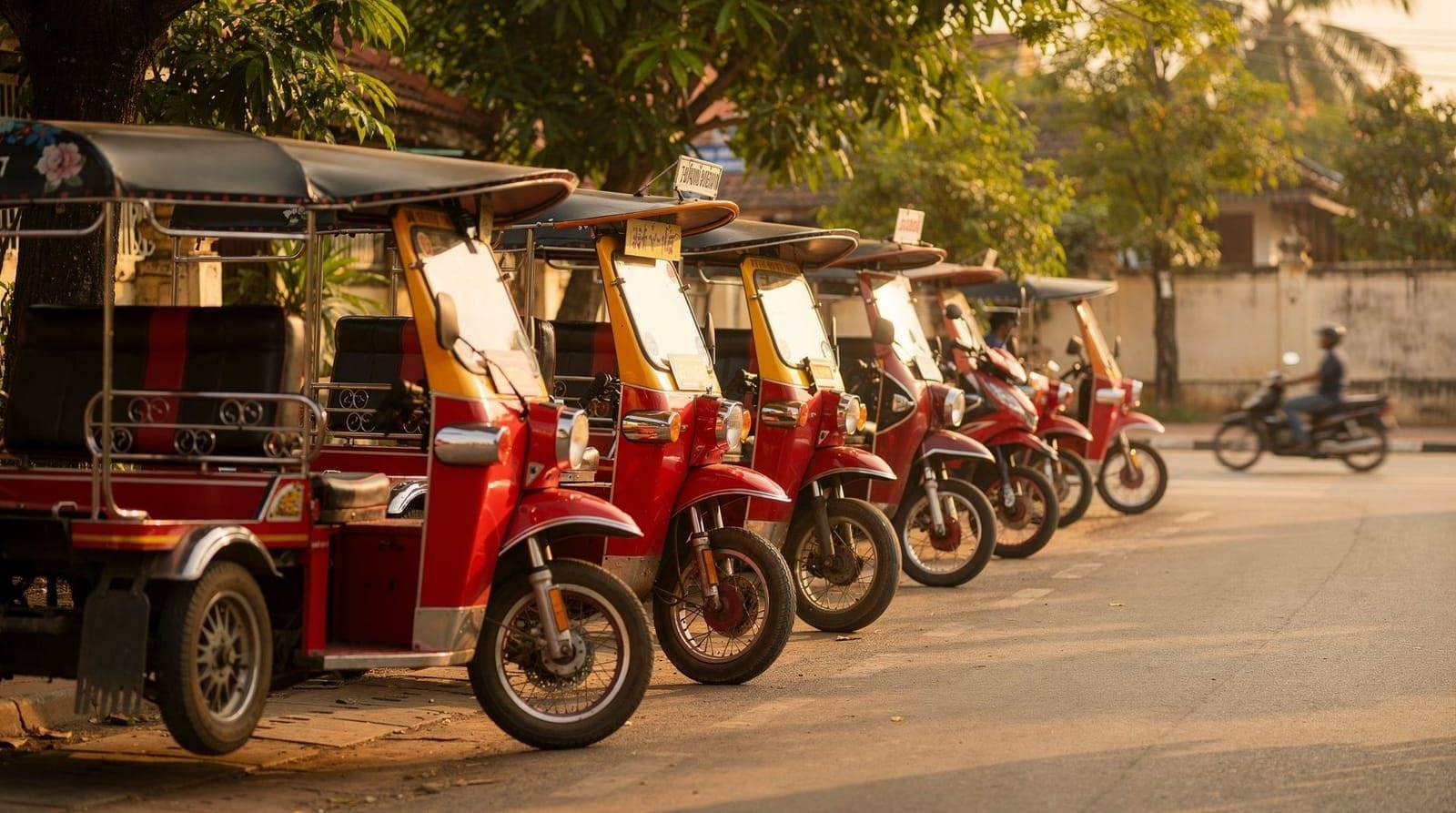
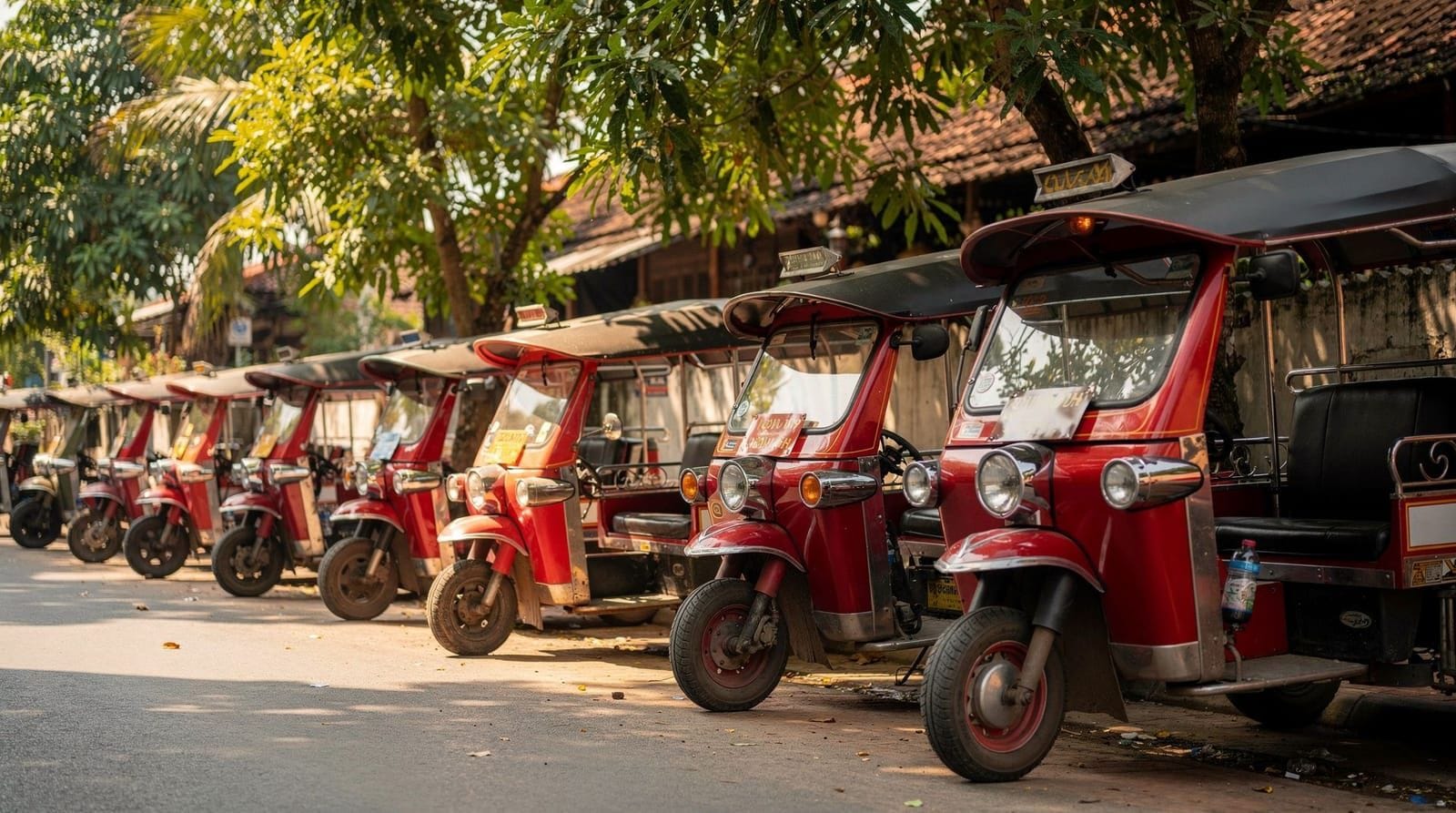
“Tuk-tuk” in Siem Reap almost always refers to the remorque style — an open-air trailer cab towed behind a motorbike — and it’s priced distinctly cheaper than an enclosed, air-conditioned car or van, which typically runs $40-80+/day depending on vehicle size. The remorque is the default for most temple-day bookings; a car makes sense specifically for hot-season comfort, families, or longer drives to farther outlier temples, as covered in the full getting-around guide.
Tipping norms
Tipping isn’t traditional in Cambodia but is increasingly expected within the tourism economy specifically. $2-5 for a full-day driver is a reasonable range, toward the higher end if the driver went beyond the agreed plan — waiting extra time without complaint, suggesting a genuinely useful stop, or handling an unexpected situation (a closed road, a change of plan) smoothly. This is separate from and in addition to the agreed day rate, not a substitute for a fair base price.
How to find a reliable driver
Most hotels and guesthouses maintain a small network of trusted regular drivers and will arrange one on request — this is the simplest default for first-time visitors, since the hotel has an ongoing interest in maintaining the relationship and won’t want complaints about a driver they recommended. Drivers recommended directly by other travelers (through hotel staff, online reviews, or word of mouth) are the other reliable path. Street-flagged drivers outside the Old Market are common and often perfectly fine, but the trust-building and rate negotiation start from zero each time rather than through an established relationship a hotel referral provides.
Splitting the cost across a group
A private tuk-tuk typically seats up to 3-4 passengers comfortably (sometimes squeezing a fifth for shorter distances), which makes splitting a $15-20 day rate across a small group a genuinely economical option — often working out to $4-7 per person for the standard circuit, cheaper than most alternative transport per person even before factoring in the convenience of a waiting driver. Solo travelers can often join a shared arrangement through their guesthouse, connecting with other travelers heading to the same temples on the same day, bringing per-person costs down without sacrificing the private-vehicle convenience.
Does price change by season?
Base tuk-tuk day rates stay relatively stable across the year — the standard $15-20 range doesn’t swing dramatically the way hotel pricing does between peak and low season. What can change is availability and driver flexibility: during peak season (December-January), the most in-demand and highly-rated drivers may be booked further in advance, and last-minute arrangements on the busiest sunrise mornings can be slightly harder to secure at short notice.
In the rainy season, some drivers charge a small premium for genuinely bad-weather days given the added difficulty and reduced visibility of driving an open-air vehicle in heavy rain — a reasonable ask if it comes up, though it should still be discussed and agreed before departure rather than added afterward.
What a good driver adds beyond transport
Beyond simply getting from temple to temple, an experienced tuk-tuk driver often functions as an informal guide for pacing and logistics — many know which temples are least crowded at which time of day, can suggest a sensible order to visit sites that minimizes backtracking, and are generally attentive to whether passengers are struggling with heat and need a break or an early return. This isn’t the same as a licensed guide’s historical and cultural commentary (a separate service, typically arranged and paid for separately if wanted), but a good driver’s practical trip-management value is genuinely underrated by first-time visitors who think of the role as purely “getting me from A to B.”
Frequently asked questions about Siem Reap tuk-tuk prices
How much does a tuk-tuk cost for the Angkor Wat sunrise trip specifically?
A sunrise-only round trip (hotel to Angkor Wat and back, without a full day of additional temples) typically runs $10-15, sometimes bundled into a full-day rate if you're continuing on to Bayon and Ta Prohm afterward, which is the more common arrangement.Should I tip my tuk-tuk driver?
Not mandatory but appreciated and increasingly standard in the tourism economy — $2-5 for a full-day driver is a reasonable range, more if the driver went beyond the agreed plan (waited extra time, suggested a genuinely useful detour, handled an unexpected situation well).What's the most common tuk-tuk scam in Siem Reap?
Drivers offering an unusually cheap day rate, then pressuring or insisting on stops at commission-paying shops, tailors or 'silk farms' along the route — the driver earns a commission for bringing tourists in, regardless of whether you buy anything. A rate that seems too low relative to the standard $15-20 is the clearest warning sign; agree explicitly upfront that the day is temples-only with no shop stops.Do I need to pay for a tuk-tuk driver's waiting time at each temple?
No — waiting time between temple stops is standard and included in the agreed day rate; a driver is expected to wait while you explore each site, not charge separately per stop. If a driver tries to add waiting fees not discussed upfront, that's a sign to renegotiate or find a different driver for future days.Is it better to book a tuk-tuk through my hotel or find one on the street?
Hotel-arranged drivers carry some accountability the hotel has an interest in maintaining, and are generally a safer default for first-time visitors. Street-flagged drivers can be perfectly reliable too, particularly ones recommended by other travelers, but the negotiation and trust-building starts from zero each time rather than through an established relationship.How do I negotiate a fair price without being rude?
State your planned route and ask for their day rate, then compare it to the standard $15-20 (or $20-30+ for outliers) range — if it's notably higher, a polite 'I've been told the usual rate for this route is around $X, does that work?' is normal and expected, not confrontational. Cambodian tuk-tuk pricing culture generally expects some negotiation, unlike a metered taxi system.
Top experiences
Bookable activities with verified prices and instant confirmation on GetYourGuide.

More tours on Viator
Top-rated experiences with verified reviews, bookable on Viator (a Tripadvisor company).