Angkor Wat sunrise: the complete planning guide
Siem Reap: Angkor Wat Sunrise Tour by Tuk-Tuk with Breakfast
What time do I need to arrive for Angkor Wat sunrise?
The park opens at 5:00am. To get a spot at the north reflecting pool with an unobstructed view, arrive by 5:15-5:20am — sunrise itself is typically 5:45-6:15am depending on the season. Buy your Angkor Pass the afternoon or evening before so you aren't queuing for a ticket in the dark.
Why sunrise at Angkor Wat draws a crowd like nowhere else in the park
Angkor Wat faces west, which is unusual for a Khmer state temple — most face east — and the practical result is that its five iconic towers are silhouetted against the sky as the sun rises behind them, reflected in two ornamental pools flanking the main causeway. That combination of orientation, symmetry and water reflection is what built Angkor Wat’s reputation as Southeast Asia’s most photographed sunrise, and it’s also exactly why the same 50-meter stretch of pool edge fills with several hundred people every clear morning in peak season. Understanding the mechanics — opening time, pool choice, seasonal light — is what separates a sunrise visit you’ll remember for the view from one you’ll remember mostly for the crowd.
Park opening time and the realistic arrival window
The Angkor Archaeological Park opens its gates at 5:00am, and the checkpoint nearest Angkor Wat’s causeway is typically the first to see a queue form. Sunrise itself lands anywhere from roughly 5:45am in the coolest, driest months to just past 6:15am during the rainier stretch of the year, so there’s a genuine window between opening and first light — but that window shrinks fast once you account for the walk from the parking and drop-off area to the pools, which takes 10-15 minutes at an unhurried pace along the causeway.
For a front-row spot at the more popular north pool, aim to be walking through the gate by 5:00-5:05am and settled at the water’s edge by 5:15-5:20am. Arriving at 5:30am in high season (December-January especially) often means a second- or third-row view, still perfectly good but with heads and phone screens in the foreground of your shot. If pool position matters less to you than simply being present for the moment, a 5:30-5:40am arrival still gets you the experience, just with more company between you and the water.
North pool vs. south pool
Two ornamental pools sit on either side of the main causeway, and picking the right one is the single most consequential sunrise decision after arrival time.
| North pool | South pool | |
|---|---|---|
| Crowd level | Highest — the “classic” shot draws the biggest crowd | Noticeably lighter, sometimes half the density |
| Reflection quality | Slightly better symmetry with the main towers | Very similar reflection, marginally less centered |
| Best for | First-time visitors who want the iconic postcard angle | Repeat visitors, or anyone prioritizing elbow room over the exact classic frame |
| Getting there | Left of the causeway as you face the temple | Right of the causeway as you face the temple |
If this is your first and only Angkor Wat sunrise, the north pool’s slightly better-known composition is worth the crowd. If you’re staying multiple days and can return, try the south pool on a second visit for a calmer version of essentially the same view — or skip the pools entirely and watch from the causeway itself, which offers a straight-on view of the towers without needing water reflection at all.
Alternatives to the main pools
Two other spots inside the park deliver a genuinely different sunrise experience with far fewer people:
- Srah Srang: a large ancient reservoir near Banteay Kdei on the Small Circuit, facing east. Rather than silhouetting temple towers, Srah Srang gives you an open-water sunrise with a small viewing terrace, popular with photographers who’ve already done the Angkor Wat pools once and want something quieter.
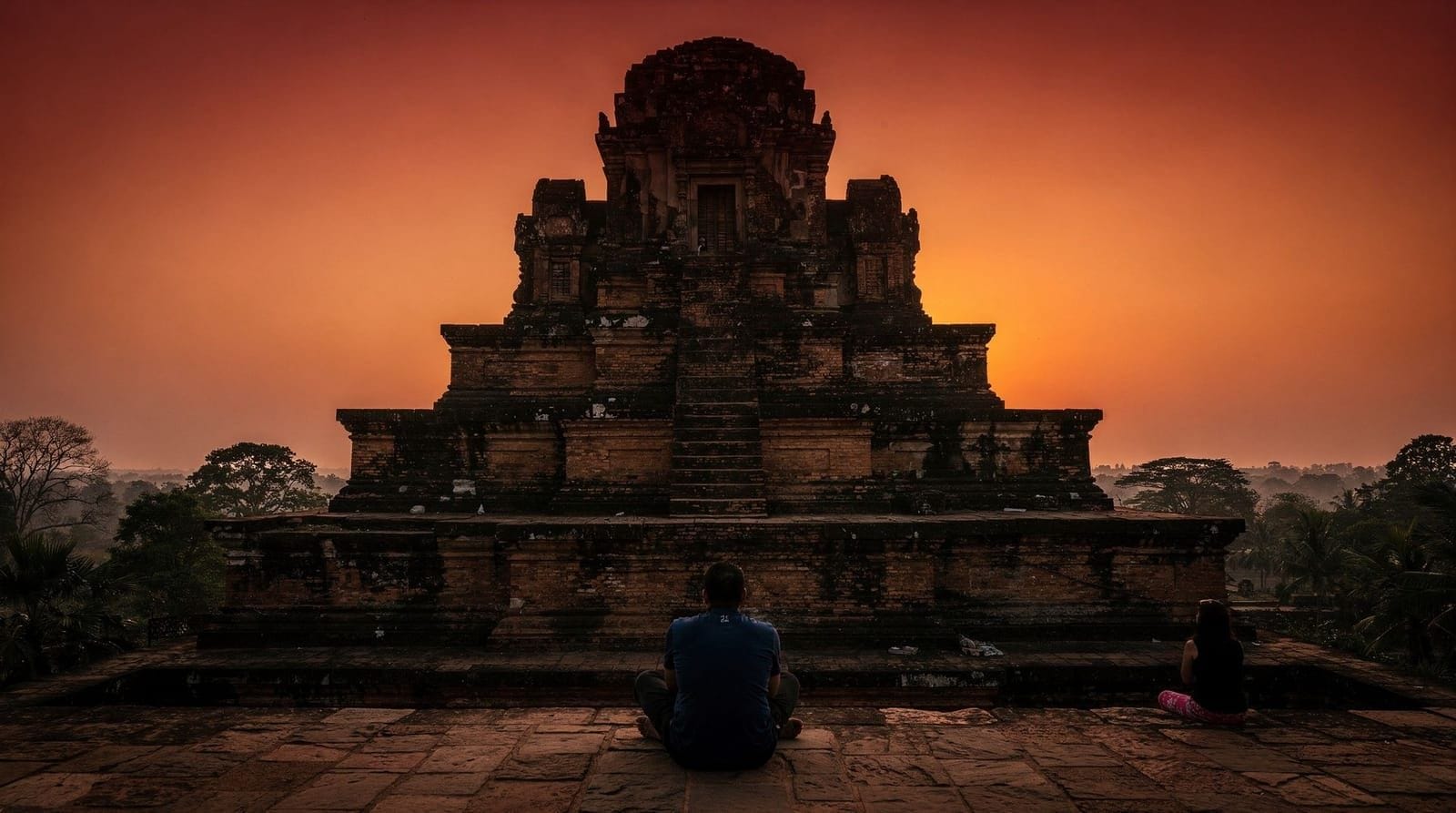
- Pre Rup: a 10th-century temple-mountain on the Grand Circuit known more commonly as a sunset spot, but its stepped pyramid structure and elevated views work almost as well at sunrise, with a fraction of the Angkor Wat crowd.
Neither replaces the specific visual of Angkor Wat’s towers reflected in still water, but both are worth knowing about if you want a second, calmer sunrise during a longer stay — or if cloud cover ruins one morning at Angkor Wat and you want a different bet the next day.
The equinox alignment
Around the spring equinox (roughly 20-21 March) and autumn equinox (roughly 22-23 September), the sun rises close to directly behind Angkor Wat’s central tower when viewed from the causeway — an alignment many researchers believe was deliberate in the temple’s original 12th-century orientation, tied to the site’s broader astronomical symbolism. Outside those few days a year, the sun still rises in roughly the same eastern arc but noticeably to one side of the towers rather than dead-center behind them. If your travel dates happen to fall near an equinox, it’s worth knowing — but don’t build an entire trip around chasing the exact alignment; the sunrise is striking on any clear morning of the year, equinox or not.
Weather and season
Dry season (November-March) gives you the best odds of a clear, colorful sunrise with minimal cloud interference — December and January are statistically the most reliable months for a dramatic sky. Rainy season (May-October) doesn’t rule out sunrise entirely; a break in the clouds after overnight rain can produce some of the most dramatic skies of the year, but you’re gambling more on any given morning. If your itinerary includes multiple mornings in Siem Reap, building in a second sunrise attempt as a weather backup is worth the extra 4:30am wake-up, especially since a multi-day Angkor Pass lets you revisit at no added ticket cost.
Buying your pass the day before
Because the ticket office runs standard daytime hours rather than a 24-hour counter, the single biggest planning mistake for sunrise visitors is showing up at 4:45am without a pass already purchased. Buy your Angkor Pass the afternoon or evening before your first sunrise, either at the Angkor Enterprise counter or via angkorenterprise.gov.kh — a pass bought at 5pm the day before is valid for entry the next morning without losing a day of its window. Arriving with the pass already in hand and your driver briefed on the plan is what actually buys you the extra 10-15 minutes that separate a front-row pool spot from a third-row one.
What to actually pack in your bag
Beyond the basics already mentioned, a few specific items make a real difference at a 5am temple visit: a portable phone charger, since many visitors end up taking far more photos and video than expected and battery drain in the dark with a screen at full brightness is faster than usual; a small towel or bandana, since even dry-season mornings can leave you sweaty by the time full sun arrives around 7am; and cash in small denominations for the coffee and snack vendors who set up near the main causeway before dawn — a hot Cambodian coffee while waiting for first light is a small but genuinely welcome ritual for many repeat visitors.
Insect repellent is worth applying before you leave your hotel, since the pre-dawn hour along the moat and pools is when mosquito activity tends to be highest.
Cost comparison: independent vs. guided sunrise
Arranging your own tuk-tuk for a sunrise run typically costs $15-20 for the round trip and wait time, agreed the evening before with your driver — the cheapest option, but it puts the full logistics burden (waking on time, directing the driver, finding parking, navigating to the right pool in the dark) on you.
A sunrise tuk-tuk tour with breakfast included runs modestly higher but removes the planning overhead and typically adds a simple breakfast stop after the crowd disperses — a reasonable middle-ground option. A full guided small-group or private sunrise tour costs more again but bundles pickup timing, pool positioning advice from someone who does this daily, and often a seamless transition into Small Circuit sightseeing once the sunrise crowd thins.
Tour vs. DIY sunrise
A guided small-group sunrise tour handles pickup timing, parking logistics and pool positioning for you, plus usually rolls straight into a Small Circuit visit once the crowd disperses — useful if you’d rather not negotiate a 4:15am tuk-tuk pickup yourself.
A private sunrise tour gives more flexibility on exact timing and pool choice if you’re traveling as a couple or small family and don’t want to be tied to a group’s pace. Either way, confirm your pickup time the night before — Siem Reap’s 4:00-4:30am tuk-tuk traffic to the park is genuinely heavy in peak season, and a late pickup compounds directly into a worse pool position.
For those doing sunrise independently by tuk-tuk, negotiate the fare the evening before rather than at 4am when you have less leverage, and agree explicitly on whether the driver waits through sunrise or returns later — the standard arrangement is a wait-and-return within the same booking.
After sunrise: what to do next
Most sunrise visitors continue straight into the Small Circuit while light is still soft, starting with Angkor Wat’s inner galleries once the crowd around the pools thins around 6:30-7:00am, before moving on to Angkor Thom and Ta Prohm later in the morning. See our Small Circuit vs. Grand Circuit breakdown for how to sequence the rest of the day, or our avoiding the crowds guide for timing the rest of your visit around the tour-bus rush that follows sunrise.
What the crowd actually feels like
It’s worth setting honest expectations before your first sunrise: in peak season (December-January especially), the strip of ground along both reflecting pools fills with several hundred people standing shoulder to shoulder in near-total darkness, phone screens and the occasional flash lighting up the crowd more than the sky does for the first 20-30 minutes.
Conversation hums at a low murmur, vendors sometimes circulate selling coffee and snacks, and the atmosphere is more “shared event” than “quiet contemplation.” Some visitors find this collective anticipation part of the experience; others find it undercuts the moment. Knowing this in advance — rather than expecting a serene, solitary vigil — makes the actual experience land better regardless of which camp you fall into.
Weekday vs weekend and shoulder-season timing
Crowd density at sunrise varies less by day of the week than by season and school-holiday timing in visitors’ home countries — European and North American summer holidays (July-August) and the Christmas-New Year window both push numbers up regardless of which weekday they fall on. Shoulder months like October-November and February-March tend to see a noticeably thinner sunrise crowd than the December-January peak while still offering good dry or transitioning weather, making them a reasonable compromise for visitors who want good sunrise odds without the absolute peak-season crush.
What happens if clouds ruin your view
Cloud cover is the one variable no amount of planning controls, and a heavily overcast sunrise can mean a gradual lightening of the sky rather than the dramatic color and silhouette most visitors picture. If your schedule includes multiple mornings in Siem Reap, checking a basic weather forecast the evening before and shifting a flexible sunrise attempt to the clearer-looking morning is worth the small effort — and because a multi-day Angkor Pass already covers repeat entry at no extra ticket cost, a second sunrise attempt after a cloudy first one costs you only the lost sleep, not additional money.
Sunrise with children or mobility considerations
Families with young children should weigh the very early wake-up and the extended standing-and-waiting period against a child’s actual tolerance for both — a cranky, overtired child at 5:30am can undercut the experience for the whole group. A later, less crowded mid-morning visit (see our avoiding the crowds guide) often suits families better than the sunrise rush, while still delivering good light and a real sense of the temple’s scale.
For visitors with mobility considerations, the causeway walk from the drop-off point to the pools is flat and manageable, but the crowd density itself can make navigating with a cane, stroller or wheelchair more difficult specifically during the peak 15 minutes around first light — arriving slightly later, once the crowd has thinned but before full daylight, is a reasonable compromise.
Drop-off, parking and the walk in
Tuk-tuks and cars drop passengers at a designated parking and drop-off area a short walk from the main causeway, not directly at the pools themselves — factor an additional 5-10 minutes into your timing beyond the walk from the park gate. In peak season, this drop-off zone itself gets congested with dozens of vehicles arriving in the same 15-minute window around 4:45-5:00am, and drivers sometimes need a few extra minutes to find parking before you can start walking.
Agreeing with your driver in advance on a specific meeting point and time for the return journey — rather than assuming you’ll simply find each other in a lot filled with hundreds of near-identical tuk-tuks — avoids a frustrating post-sunrise search when you’re tired and ready for breakfast.
Combining sunrise with a floating village or countryside morning
A small number of visitors skip the Angkor Wat sunrise crowd entirely and instead spend an early morning on a Tonlé Sap floating village boat trip, timed for the lake’s own calm early light rather than a temple silhouette — see our floating villages guide for how that alternative morning compares. It’s a legitimate trade for visitors who’ve already experienced Angkor Wat sunrise once, or who simply prioritize a quieter morning over the specific temple-silhouette shot.
Frequently asked questions about Angkor Wat sunrise
Is Angkor Wat sunrise worth the early wake-up?
For most first-time visitors, yes — the five towers silhouetted against a lightening sky over the reflecting pools is a genuinely different experience from seeing the temple at midday. That said, it comes with the single largest, most tightly packed crowd of any moment at Angkor, standing shoulder to shoulder in the dark for 30-45 minutes. If crowds bother you more than the visual payoff appeals, a mid-morning or late-afternoon visit sees the same towers with a tenth of the people.Which pool is better for photos, north or south?
The north pool (to your left as you face the temple from the main causeway) is the classic, most-photographed reflection angle and consequently the most crowded — expect a dense human wall by 5:15am in high season. The south pool gives a similar reflection with noticeably fewer people, at the cost of a slightly less symmetrical angle. For a first visit, the north pool's iconic shot is worth the crowd; for a calmer experience or a second visit, go south.Do I need to buy the Angkor Pass before sunrise morning?
Buy it the afternoon or evening before if at all possible. The Angkor Enterprise ticket office keeps daytime hours and is not set up for a 4:30am rush, so arriving at the park without a pass already in hand means losing precious minutes — and pool position — to the ticket process. See our full Angkor Pass guide for buying options.What is the solar alignment everyone talks about at Angkor Wat?
Around the spring and autumn equinoxes (late March and late September), the sun rises close to directly behind the central tower when viewed from the main causeway, an alignment believed to be intentional in the temple's 12th-century design. Outside those windows the sun rises further to the side of the towers — still a striking sunrise, just not the exact behind-the-tower alignment.Can I skip the sunrise crowd and still see Angkor Wat at its best?
Yes — visiting an hour or two after sunrise, once the initial crowd disperses toward Angkor Thom, gives you good early light with a fraction of the people. Alternatively, sunset at Angkor Wat itself (rather than the more famous Phnom Bakheng sunset spot) is far less crowded than sunrise and still delivers strong light on the towers.What should I bring for an Angkor Wat sunrise visit?
A headlamp or phone flashlight for the walk in while it's still dark, a light layer (mornings can be cool even in hot season), water, your Angkor Pass, and a passport if you're traveling with a child under 12 who needs free entry verified. Skip a tripod unless you've confirmed it's allowed that day — dense crowds make tripods impractical and occasionally unwelcome at the main pools regardless of official rules.
Top experiences
Bookable activities with verified prices and instant confirmation on GetYourGuide.


More tours on Viator
Top-rated experiences with verified reviews, bookable on Viator (a Tripadvisor company).