Siem Reap tuk-tuk and money scams: what to actually watch for
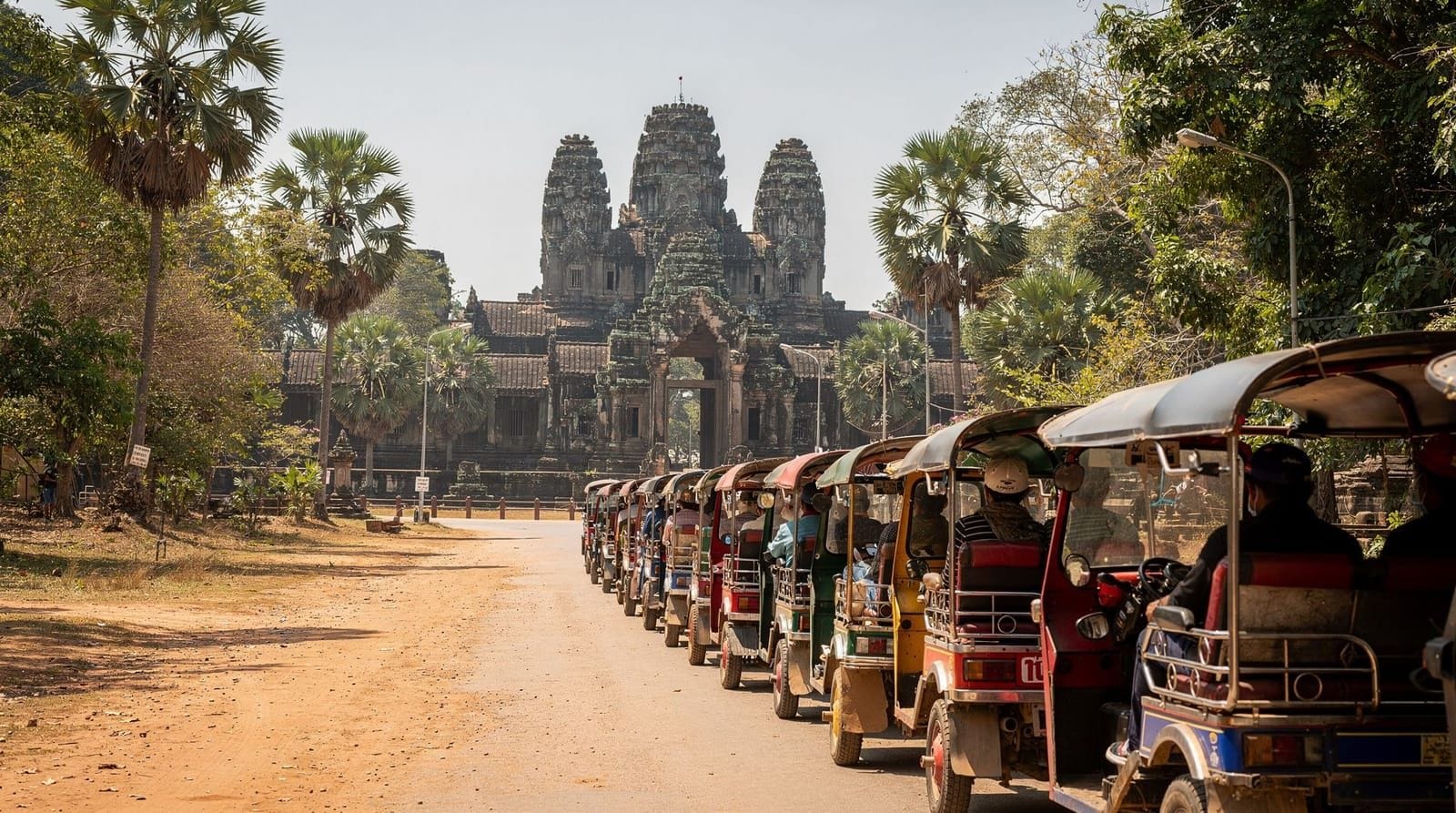
Siem Reap: Angkor Wat Private Tuk-Tuk Tour
What are the most common money scams in Siem Reap?
Inflated tuk-tuk fares for tourists who don't negotiate upfront, torn or damaged USD bills refused by vendors and taxis, street currency exchange offering worse rates than banks or ATMs, and ride-hailing app drivers claiming 'no network' to demand a higher cash fare after pickup. None require sophisticated awareness to avoid — mostly agreeing prices upfront and carrying clean bills.
Most of this is about agreeing prices upfront, not spotting con artists
Siem Reap doesn’t have a particularly dangerous scam scene by international standards — the issues visitors most commonly run into are opportunistic price inflation and currency friction, not sophisticated fraud. Nearly everything on this list is avoidable by asking a direct question or agreeing a price before a transaction happens, rather than after. This guide covers the money-specific version of Siem Reap’s rough edges; for attraction-level tourist traps like Chong Kneas and orphanage tours, see our companion guide.
Tuk-tuk fare inflation
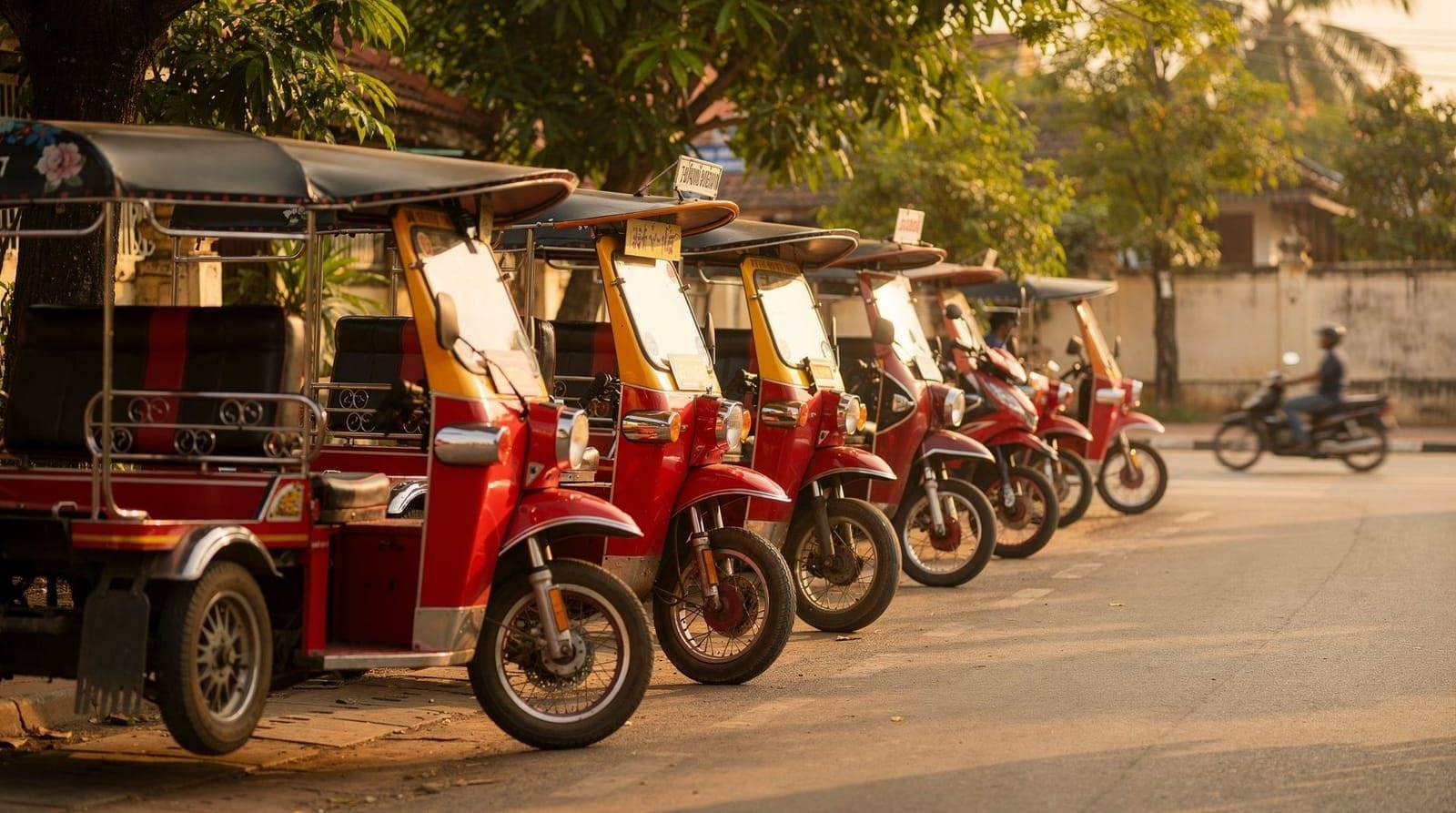
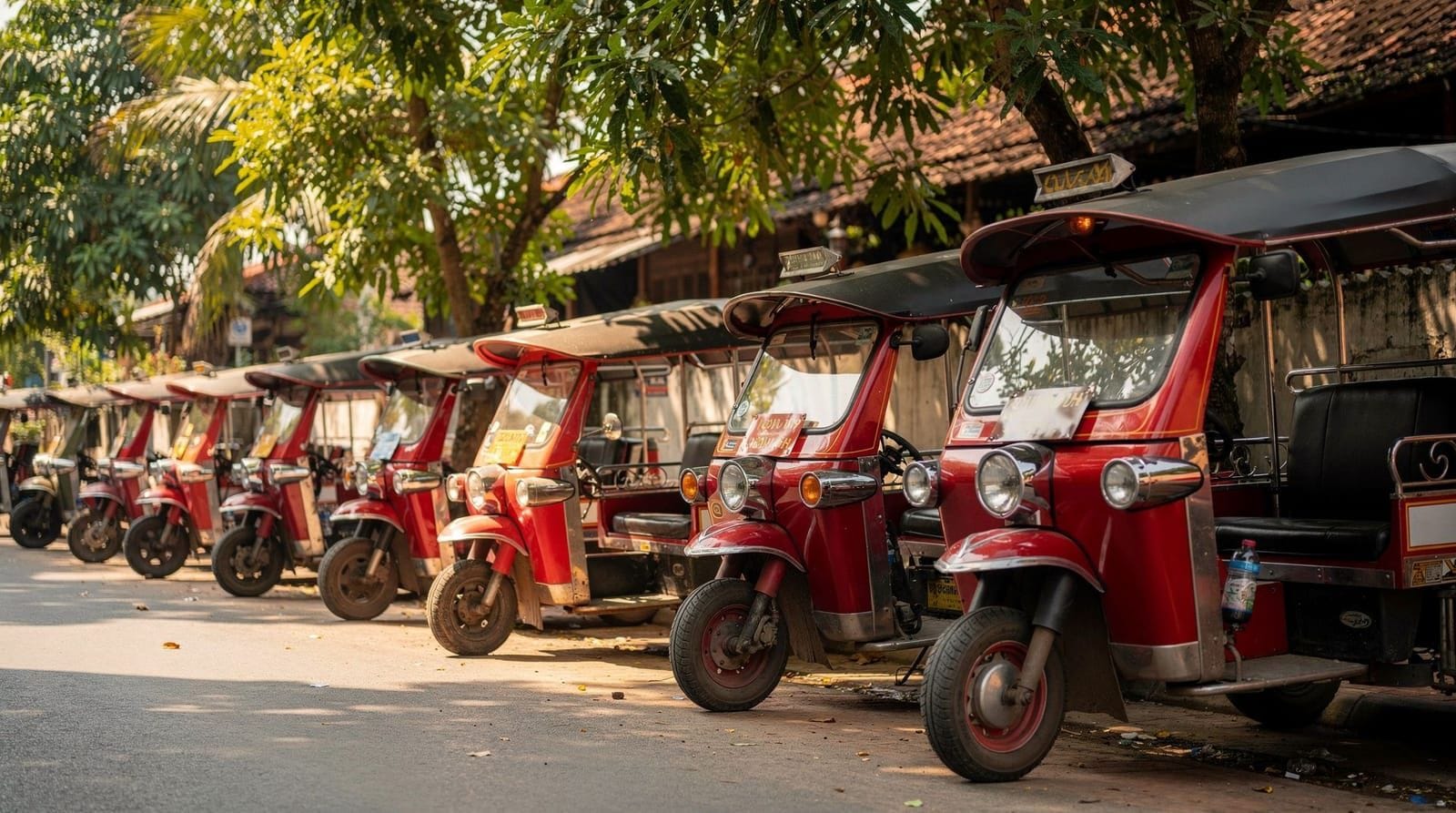
The single most common friction point for visitors is a tuk-tuk driver quoting — or simply expecting to be paid — well above the going rate, particularly for airport transfers or unplanned rides hailed on the street rather than arranged through a hotel. Realistic benchmarks: roughly $15-20 for a full day covering the Small Circuit or Grand Circuit within the park, rising to $20-30+ for farther destinations like Banteay Srei or Beng Mealea given the extra distance and fuel. For a single short ride around town, a few dollars is typical.
The fix is simple and non-confrontational: agree the price before getting in, every time, even for a driver recommended by your hotel. If a quoted price feels high relative to these benchmarks, it’s reasonable to negotiate or simply try a different driver — competition among tuk-tuk drivers in Siem Reap is high enough that walking away rarely means losing your only option. A pre-booked private tuk-tuk tour removes this negotiation entirely by fixing the price before you arrive, useful if you’d rather not haggle at all.
Damaged or torn US dollar bills refused
Cambodia runs on US dollars for most tourist-facing transactions, but there’s a real and consistent local practice worth knowing about: vendors, taxi drivers, and even some hotels will refuse bills that are torn, heavily creased, written on, or otherwise visibly damaged — a standard that’s considerably stricter than what you’d encounter in the US itself. This isn’t a scam so much as a genuinely inconvenient local norm, but it catches visitors off guard often enough to be worth flagging. Bring clean, ideally newer US bills for this trip specifically, and inspect any USD change you receive before putting it away — a damaged bill handed back to you as change becomes your problem the next time you try to spend it.
Street currency exchange
Currency exchange happens informally throughout tourist areas, at rates that can range from fair to noticeably worse than a bank or licensed exchange counter offers. Phsar Leu market and the licensed exchange shops around Old Market are generally reliable, transparent options. If you use an informal street exchange, count the money handed to you carefully and immediately, in front of the person exchanging it — shortchanging on the count, rather than the headline rate itself, is the more common issue with informal exchange.
ATM withdrawal fees
Most ATMs in Cambodia charge a local withdrawal fee, commonly $4-6 per transaction, in addition to whatever fee your home bank applies for foreign withdrawals. This adds up fast with frequent small withdrawals — a better strategy is fewer, larger withdrawals to spread the fixed local fee across more cash. A fee-free or low-fee international debit card (Wise and similar providers are commonly used by travelers specifically for this reason) can meaningfully reduce total costs over a week or more in Cambodia.
Riel change — normal, not a scam, but worth understanding
Cambodian riel (KHR) functions as small-denomination change for USD transactions, at an approximate rate of 4,000 KHR to $1. Vendors routinely give change under $1 in riel rather than US coins, which simply aren’t in circulation here. This is standard, expected practice — not a shortchange attempt — but it’s worth knowing the rough exchange rate so you can quickly sanity-check whether the riel handed back to you is in the right ballpark, rather than accepting an unfamiliar currency’s change without any reference point.
KHQR and card payments
KHQR, Cambodia’s national mobile QR payment standard, works widely at Siem Reap restaurants, cafés, and many shops, and is a genuinely reliable, scam-resistant way to pay when available since the amount is fixed and displayed before you confirm. It doesn’t extend to tuk-tuks, small stalls, or rural areas, where cash remains necessary. Card payments follow a similar pattern — accepted at larger hotels and restaurants, unreliable everywhere else — so plan to carry cash as your primary payment method outside your hotel and a handful of central restaurants.
Tipping expectations and how they get exploited
Tipping isn’t traditional in Cambodia but is genuinely expected in tourism-facing roles now: a few dollars for a full-day tuk-tuk driver, $10-20 for a full-day guide, small amounts for housekeeping. A rarer but reported issue: a driver or guide implying a specific, inflated tip amount is standard or expected, when it isn’t. Round up or tip in the $2-5 range for a driver, USD above $2 (riel for smaller amounts), and treat any specific dollar figure presented as “the normal tip” with mild skepticism if it feels high relative to these benchmarks.
The “no network” ride-hailing tactic
A specific pattern reported with some PassApp and Grab drivers: after accepting a ride at the app’s quoted price and picking up the passenger, the driver claims a connectivity or app malfunction prevents completing the trip as booked, then asks for a higher cash fare instead. If this happens, you’re within your rights to end the ride and rebook through the app, or to insist on the originally quoted fare before continuing — most drivers relying on this tactic back down once a passenger pushes back calmly rather than simply paying the higher demand.
What to do if a dispute actually escalates
The overwhelming majority of Siem Reap’s money and tuk-tuk friction resolves through calm negotiation or simply walking away, but if a dispute escalates — a driver refusing to accept an agreed price, raised voices, or a sense that a situation is becoming genuinely uncomfortable rather than just an awkward haggling moment — a few de-escalation steps help.
Paying the originally agreed amount clearly and firmly while stating you’re ending the interaction, moving toward a public, populated area (a hotel lobby, a busy street, a shop entrance) rather than remaining isolated with the other party, and involving hotel staff or, if genuinely necessary, tourist police are all reasonable escalation steps in roughly that order. In practice, the large majority of Siem Reap’s money friction never approaches this level — most disputes are resolved by simply restating an agreed price calmly.
Tourist police and where to report a serious issue
Cambodia maintains a dedicated tourist police presence in Siem Reap specifically to handle tourist-related disputes and complaints, a resource worth knowing about even though most visitors never need it. For a genuinely serious overcharge dispute, a suspected scam involving a larger sum, or any safety concern, tourist police are generally more responsive to tourism-specific issues than a general police station would be, and most hotels can provide current contact information or assist in making contact if a language barrier is a concern.
For routine, low-stakes disputes — the kind covered throughout most of this guide — resolving the situation directly through calm negotiation or simply declining and moving on is faster and more proportionate than escalating to a formal report.
A quick reference: realistic price benchmarks
| Item | Realistic price | Where inflation typically happens |
|---|---|---|
| Tuk-tuk, in-town day (Small/Grand Circuit) | $15-20 | Unnegotiated on-street pickups |
| Tuk-tuk, outlier temple day (Banteay Srei, Beng Mealea) | $20-30+ | Distance-based, but sometimes padded further |
| Short in-town tuk-tuk ride | $1-3 | Late-night or airport-adjacent pickups |
| Airport private transfer | ~$30-35 | Unlicensed drivers at arrivals |
| ATM withdrawal fee | $4-6 per transaction | N/A — a fixed local fee, not a scam |
| SIM/eSIM data package | $5-20 | Informal street resale away from official kiosks |
| Full-day guide | $10-20 tip on top of guide fee | Inflated “standard tip” claims |
Keeping a rough mental version of this table handy — even just the tuk-tuk day-rate range — resolves the large majority of pricing friction before it becomes a real disagreement.
Fake or counterfeit bills
Counterfeit US dollar bills circulate occasionally in Cambodia as in many cash-heavy economies; the practical defense is the same as anywhere — check larger bills (especially $50s and $100s) for standard security features (watermark, security thread, color-shifting ink) when receiving change from an ATM withdrawal or a larger cash exchange, and prefer ATM withdrawals over informal cash exchange where possible, since ATM-dispensed cash carries a lower counterfeit risk than informally exchanged bills.
The general pattern
Nearly every item on this list resolves the same way: agree prices before a transaction, not after; carry clean bills; use ATMs or licensed exchange over informal street exchange where the amounts matter; and treat any pressure to decide immediately — a driver, a money changer, anyone — as a reason to slow down rather than speed up. None of this requires unusual vigilance, just the habit of asking the price first.
The exact phrases to recognize, and what to say back
Certain phrases recur often enough across Siem Reap’s tuk-tuk and money friction points that recognizing them in the moment helps you respond calmly rather than being caught off guard:
- “Special price for you, my friend” — usually precedes a quote above the standard $15-20 daily rate. A calm “what’s the normal price for this route?” or simply naming the benchmark rate yourself resets the conversation without confrontation.
- “No meter, but I give you good price” — common with unlicensed or informal drivers avoiding a fixed, checkable fare. Agreeing the total price before getting in removes the ambiguity regardless of whether a meter is used.
- “Sorry, no small change” — sometimes a genuine issue, sometimes a soft pressure tactic to round a price up in the seller’s favor. Having smaller bills on hand for exactly this situation avoids the issue entirely.
- “App says no network, I take you but you pay cash, more expensive” — the ride-hailing “no network” tactic described below. Ending the ride and rebooking, or firmly restating the app’s original quoted price, is a reasonable and effective response.
- “This price includes everything, no more pay” — worth verifying explicitly what “everything” covers (fuel, waiting time, multiple stops) before agreeing, since vague reassurance isn’t the same as a specific, itemized understanding.
Negotiating a fair tuk-tuk price without conflict
Negotiation in Siem Reap’s tuk-tuk market is normal and expected, not confrontational, and a few habits make it smoother. Starting with a specific number based on the standard benchmarks (roughly $15-20 for an in-town circuit day, $20-30+ for outlier temples) rather than an open-ended “how much” question anchors the conversation to a realistic range from the start.
If a driver’s initial quote is meaningfully above that range, a polite counter-offer close to the benchmark, rather than an aggressive lowball, tends to reach agreement faster — most Siem Reap tuk-tuk drivers negotiate routinely and aren’t offended by a reasonable counter. If a specific driver won’t move toward a fair price, simply thanking them and walking to the next available tuk-tuk (rarely more than a short walk away in any tourist-adjacent area) is a normal, low-friction resolution rather than an escalation.
What a fair day rate actually buys you
Understanding what’s reasonably included in a standard day-rate tuk-tuk booking helps you judge whether a quoted price is fair. A typical $15-20 in-town day rate covers the driver’s time and fuel for a Small or Grand Circuit loop with multiple stops and waiting time at each temple while you explore — it does not typically include the Angkor Pass (a separate purchase), meals, or bottled water beyond what the driver might informally offer.
For farther destinations (Banteay Srei, Beng Mealea), the higher $20-30+ rate reflects genuinely more fuel and driving time, not a markup for the same service — a useful distinction to keep in mind so you’re evaluating the price against the actual distance rather than assuming any price increase is automatically unfair.
SIM cards and eSIM pricing, and where inflated pricing shows up
While not strictly a money scam, SIM and eSIM pricing is another area where tourist-facing markups appear: kiosks at Siem Reap–Angkor International Airport sell SIM/eSIM data packages from major providers (Metfone, Smart, Cellcard) at $5-20 depending on data allowance, generally at a fair, posted price given the airport-kiosk convenience factor, but some informal street vendors elsewhere in town occasionally quote inflated prices for the same product to travelers who don’t have a reference point. Buying at the airport kiosk on arrival, or activating an eSIM (Airalo and similar providers support Cambodia’s Smart network) before you even land, sidesteps this specific friction point entirely.
Hotel and guesthouse deposit practices
Some budget guesthouses request a cash deposit or passport hold at check-in, a standard and generally legitimate practice in Cambodia’s budget accommodation sector rather than a scam in itself — but it’s worth confirming the deposit amount and return process explicitly at check-in, and getting a receipt for any cash deposit, to avoid a dispute at checkout over an amount that was never clearly documented. A passport hold specifically is worth question if requested at a hotel above budget tier, where photocopying rather than holding the physical document is the more standard, less risky practice.
Frequently asked questions about Siem Reap tuk-tuk and money scams
How much should a tuk-tuk cost per day in Siem Reap?
Roughly $15-20 for a full day covering the in-town Angkor circuits, rising to $20-30+ for farther outlier temples like Banteay Srei or Beng Mealea given the extra distance. Always agree the fare before getting in, not after the ride.Why do some vendors refuse my US dollar bills?
Cambodia runs on US dollars for most tourist transactions, but vendors and taxis are notably strict about bill condition — torn, heavily creased, or written-on bills are commonly refused outright, even though the same bill would be accepted without question in the US. Bring clean, undamaged bills, ideally newer notes, and check any change you receive before pocketing it.Is it better to exchange money at a bank, ATM, or street exchange?
ATMs and licensed exchange counters (including those at Phsar Leu market and around Old Market) generally offer more transparent, competitive rates than informal street exchange, which can quote a worse rate than posted or shortchange the count. If a street rate looks unusually good, verify the actual amount handed over carefully before walking away.What should I know about ATM fees in Cambodia?
Most ATMs charge a local withdrawal fee (commonly $4-6) on top of whatever your home bank charges for foreign transactions, so fewer, larger withdrawals reduce total fees compared to frequent small ones. A fee-free travel card (Wise and similar) can meaningfully reduce this cost over a longer trip.What's the 'no network' ride-hailing scam?
Some PassApp or Grab drivers, after picking up a passenger at the app's quoted fare, claim a connectivity issue prevents completing the trip in-app and ask for a higher cash fare instead. If this happens, it's reasonable to end the ride and rebook, or to insist on the originally quoted price before proceeding.Do I need small riel for anything?
Yes, for change under $1 — vendors typically give change in Cambodian riel at roughly 4,000 KHR to $1 rather than in US coins, which aren't in circulation. This is standard practice, not a scam, but it's worth knowing the approximate exchange rate so you can sanity-check the riel change you receive.
Top experiences
Bookable activities with verified prices and instant confirmation on GetYourGuide.

More tours on Viator
Top-rated experiences with verified reviews, bookable on Viator (a Tripadvisor company).