Siem Reap Angkor International Airport (SAI): full transfer guide
Siem Reap: Angkor International Airport (SAI) Private or Shared Transfer
How far is Siem Reap's airport from the city center?
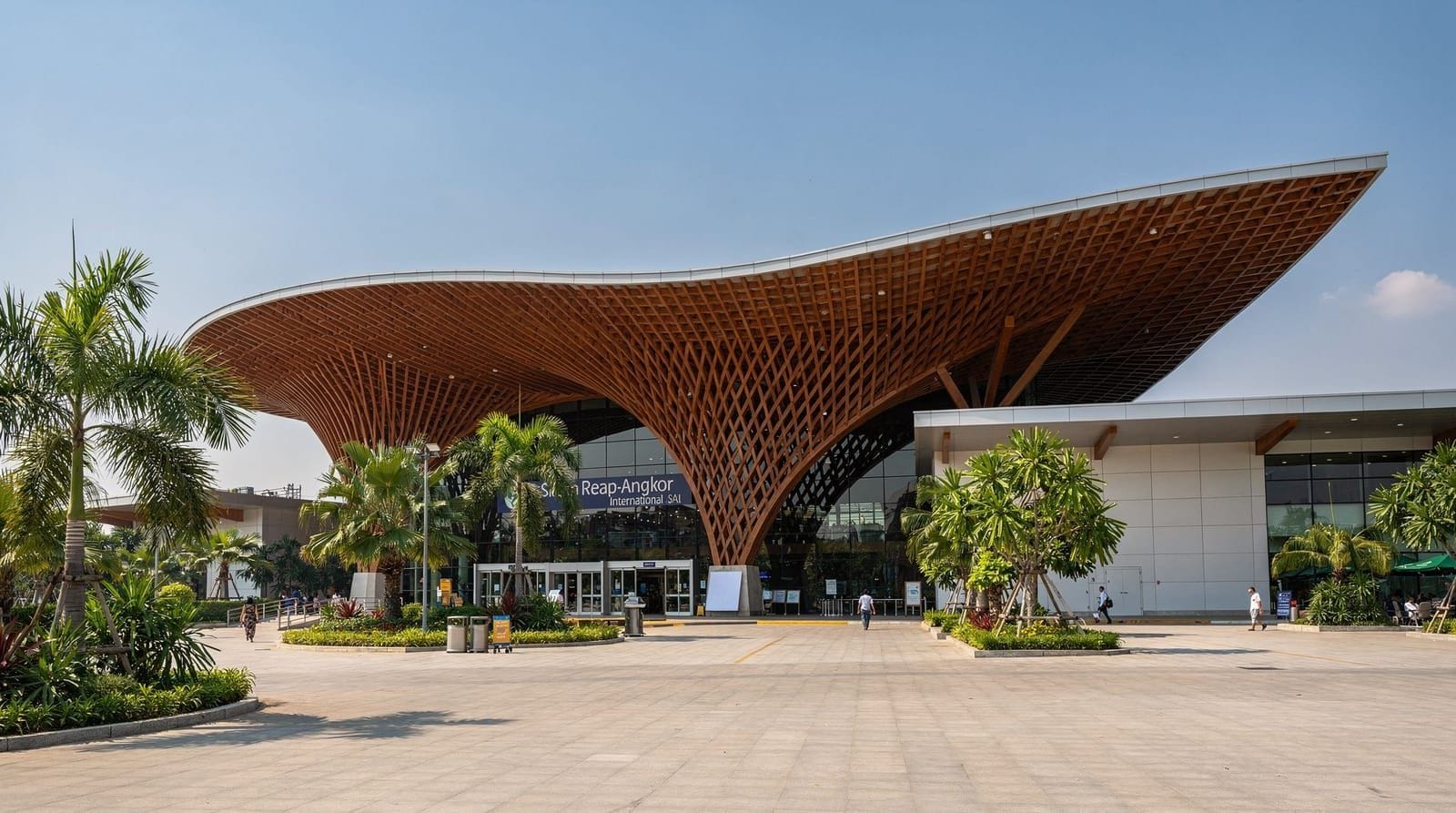
Siem Reap–Angkor International Airport (SAI) opened in October 2023 and sits roughly 40-50 km east of downtown Siem Reap, about 45-60 minutes by road. This replaced the old in-town airport, which is now closed to commercial traffic — any guide or listing still referencing a short 'in-town' airport transfer is describing a location that no longer operates.
The single most important fact: the old airport is closed
If you’ve read older Siem Reap travel content that describes a short, 10-15 minute drive from the airport to downtown, that’s describing the old in-town Siem Reap International Airport, which closed to commercial traffic when Siem Reap–Angkor International Airport (SAI) opened in October 2023.
SAI sits in Sotr Nikum district, roughly 40-50 km east of downtown Siem Reap — sources vary between 40, 45 and 50 km depending on the exact measuring point — and the drive to the city center or the Angkor Wat west gate takes about 45-60 minutes. This is one of the most common sources of outdated information across Siem Reap trip-planning content, and it directly affects your transfer time and cost planning, so it’s worth stating clearly up front: there is no “quick, cheap in-town airport” option anymore.
Why this changed, briefly
The old airport’s in-town location — long a point of local and environmental concern given its proximity to the Angkor World Heritage site — was replaced by the newer, larger SAI to handle growing international traffic away from the temple complex and city center. The result is a better long-term airport for a growing destination, but a real added logistics step for every arriving visitor: what used to be a short hop into town is now a genuine 45-60 minute transfer that needs planning, not an afterthought.
Transfer option 1: the airport shuttle bus
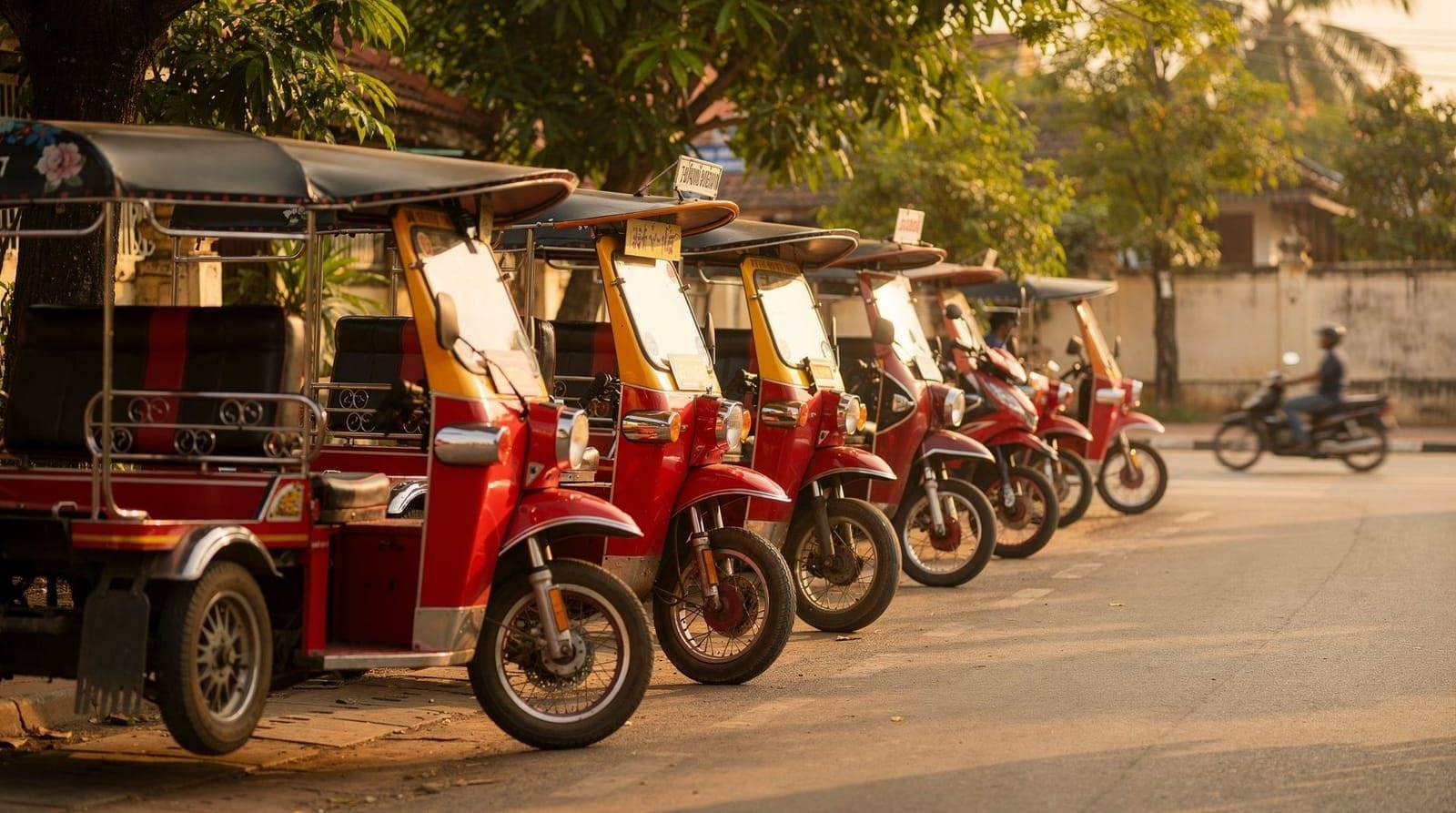
The lowest-cost way to reach downtown. Roughly 10 scheduled departures daily run from SAI to CDF Angkor Duty Free in the Wat Bo area — not directly to your hotel. From there, a short, inexpensive tuk-tuk covers the final stretch to most accommodation in town.
Pros: cheapest option by a clear margin, straightforward once you know the drop-off point.
Cons: fixed schedule rather than on-demand, requires a second short transfer (tuk-tuk) from the drop-off point to your actual hotel, and can mean waiting if your flight lands between scheduled departures.
Best for: budget travelers, those without heavy luggage, and anyone comfortable managing a two-leg journey rather than a single door-to-door transfer.
Transfer option 2: metered or fixed-rate taxi
Taxis are available at the arrivals hall, typically running close to $1/km, working out to roughly $35 to the city center given the 40-50 km distance.
Pros: widely available without advance booking, straightforward on-demand pricing.
Cons: roughly comparable in price to a pre-booked private transfer, without the certainty of a driver already assigned and waiting with your name — arrival-hall queuing and price confirmation take a little longer.
Best for: travelers who prefer to arrange transport on arrival rather than book in advance, or whose flight times are uncertain enough that a fixed-schedule shuttle or a pre-booked slot feels risky.
Transfer option 3: private transfer (recommended for most visitors)
A pre-booked private transfer from SAI starts around $30 for a car and includes a driver waiting at arrivals with your name, direct door-to-door service to your hotel, and a fixed price agreed before you fly.
Pros: no negotiation after a long flight, no risk of arriving to find no transport available at odd hours, predictable total cost.
Cons: modest premium over the cheapest options, though often comparable to or only slightly above a metered taxi once you factor in the certainty and door-to-door convenience.
Best for: first-time visitors, late-night or early-morning arrivals, families or groups with luggage, and anyone who’d rather have this logistic settled before landing. A private airport pickup and hotel drop-off or an SAI-specific transfer booking both cover this door-to-door option.
Transfer option 4: ride-hailing apps (Grab, PassApp)
Grab and PassApp both operate at SAI, offering an on-demand alternative similar to using rideshare apps elsewhere in Southeast Asia.
Pros: familiar app-based booking and pricing for travelers used to rideshare platforms elsewhere.
Cons: pricing can vary with demand, and availability at the airport specifically can be less consistent than in town — some visitors find matching with a driver takes longer directly at arrivals than it would from a hotel.
Best for: travelers already comfortable with these apps who want on-demand flexibility without a pre-arranged pickup.
Cost comparison at a glance
| Option | Typical cost | Convenience | Best for |
|---|---|---|---|
| Shuttle bus | Lowest | Fixed schedule, 2-leg journey | Budget travelers, light luggage |
| Metered taxi | ~$35, ~$1/km | On-demand, some queuing | Flexible arrival plans |
| Private transfer | From ~$30 | Door-to-door, pre-booked | Most first-time visitors |
| Grab/PassApp | Variable | On-demand, app-based | Rideshare-app users |
What to do before you land
- Book a private transfer in advance if arriving late at night, with a group, or on a first visit — it removes one variable from a long travel day. An arrival-day transfer paired with a next-day Angkor Wat tour is a common way to combine the logistics into one booking.
- Confirm your e-visa and E-Arrival Card are complete before departure — see the full e-visa guide; immigration processing happens before baggage claim, and having both ready avoids delay at the counter.
- Get local currency or confirm your USD cash is in good condition — Cambodia runs on USD for most tourist transactions, and worn or torn notes are often refused, including for a taxi or transfer payment on arrival.
- Pick up a SIM/eSIM at the arrivals hall kiosks (Metfone, Smart, Cellcard — $5-20, passport required) or activate a pre-purchased eSIM before boarding, so you have data working the moment you land for maps, messaging your driver, or confirming your transfer.
Departing SAI: the return trip
The same 45-60 minute drive applies in reverse — build it into your departure planning with real buffer, not the 15-20 minutes a stale mental model of the old in-town airport might suggest. For an international flight, arriving at SAI at least 2.5-3 hours before departure is a reasonable buffer once you account for the drive from town, standard check-in, and security. Traffic on the SAI access road is generally light compared to a major city airport route, but building in the full transfer time rather than assuming a quick trip avoids unnecessary pre-flight stress.
Old airport vs. SAI: what actually changed
| Old in-town airport (closed) | SAI (current, since Oct 2023) | |
|---|---|---|
| Distance to downtown | ~2-3 km | 40-50 km |
| Transfer time | ~10-15 min | 45-60 min |
| Status | Closed to commercial traffic | Fully operational |
| Location | Within city limits | Sotr Nikum district, east of town |
This table exists because a genuinely large share of Siem Reap trip-planning content online — older blog posts, some hotel listings, occasionally even outdated taxi-app defaults — still describes the old airport’s short transfer time as current fact. If a source doesn’t explicitly mention SAI, October 2023, or a 40-50 km/45-60 minute transfer, treat its airport information as potentially stale and verify independently before relying on it for arrival planning.
Airport facilities at SAI
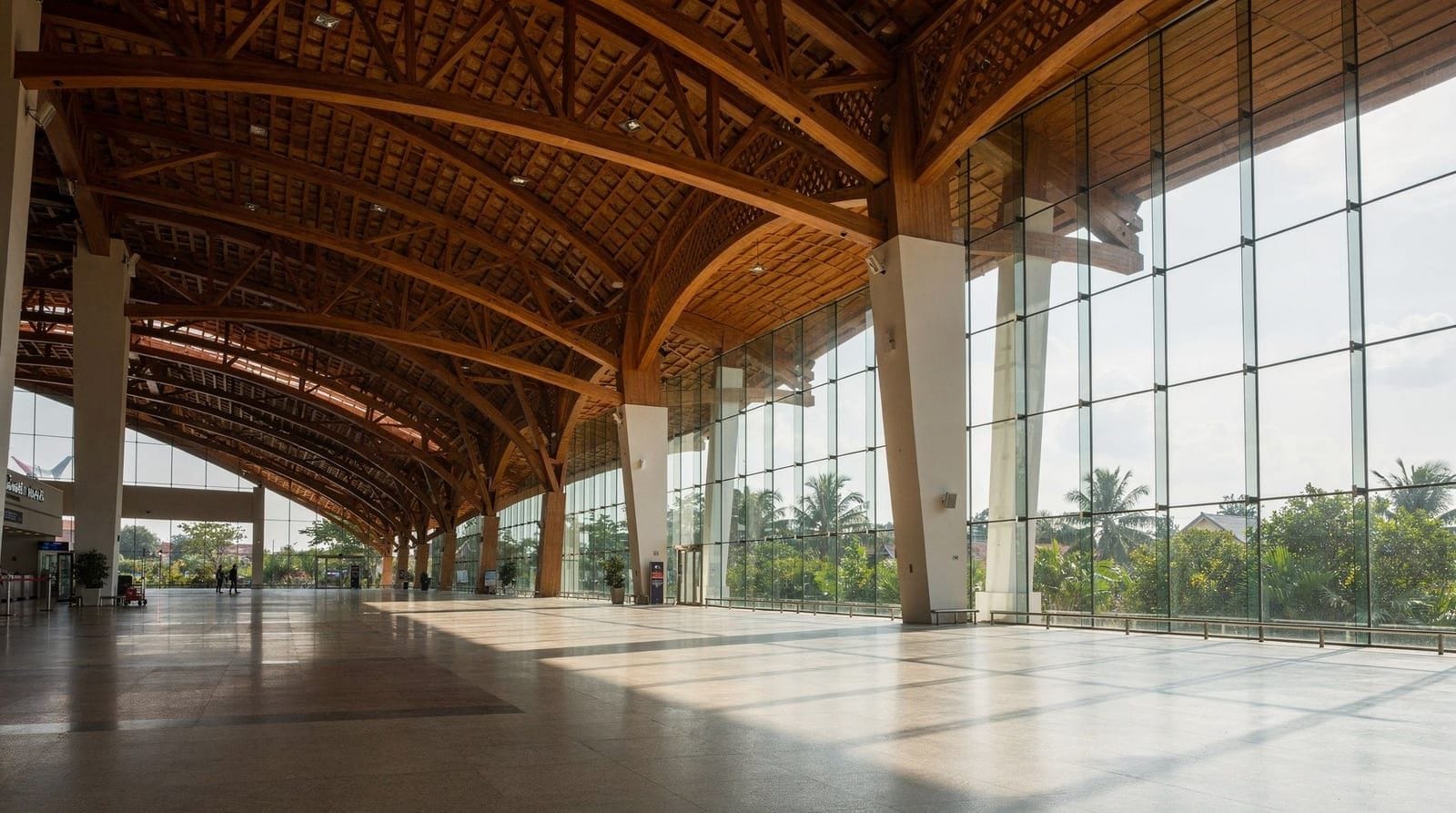
SAI is a considerably larger, more modern facility than its predecessor, built with international passenger volume growth in mind. On arrival, expect standard immigration counters (with e-visa or visa-on-arrival processing), baggage claim, SIM/eSIM kiosks (Metfone, Smart, Cellcard) in the arrivals hall, currency exchange counters, and a range of transfer/taxi/private-driver counters near the exit. ATMs dispensing USD are available for travelers who didn’t bring enough cash or need a top-up before their transfer. The terminal’s greater distance from town is the trade-off for a facility built to handle Siem Reap’s continued growth as an international destination without the space constraints of the old in-town site.
Combining your arrival with the first day
Given the 45-60 minute transfer, most first-time visitors treat arrival day as a settling-in day rather than a temple day — checking into accommodation, adjusting to the heat and time zone, and getting oriented in town before an early Angkor Wat start the following morning.
Some visitors instead book an arrival transfer bundled with a next-day Angkor Wat tour, which fixes both logistics pieces (the transfer and the first temple day’s guide/transport) in a single advance booking — useful for travelers who prefer minimizing on-the-ground coordination during the first 24 hours in an unfamiliar destination. If you land early enough in the day and feel up to it after the transfer, a gentle orientation walk around the Old Market area on arrival evening is a lower-effort alternative to jumping straight into temple sightseeing.
Why this page matters more than it might seem
The shift from a 10-15 minute in-town transfer to a genuine 45-60 minute journey isn’t just a minor logistics detail — it changes how arrival day should be planned, what time buffer to leave for departure flights, and even which neighborhoods make sense for accommodation (none of them meaningfully shorten this specific leg of the journey, as covered in the where to stay guide). Getting this one fact right — SAI, 40-50 km, 45-60 minutes, opened October 2023 — is worth more to a smooth first day in Siem Reap than most other single pieces of trip-planning information, precisely because it’s the piece most likely to be wrong in older or generic content.
Where to stay relative to SAI
Because SAI sits well outside town with no meaningful hotel cluster nearby, there’s no advantage to booking accommodation “near the airport” — every visitor should stay in Siem Reap town itself and treat the transfer as a fixed cost regardless of neighborhood. See the full where to stay guide for how the town’s neighborhoods compare; none of them meaningfully shortens the airport transfer, since the last stretch of driving through town is a small fraction of the overall 40-50 km trip.
Frequently asked questions about Siem Reap Angkor International Airport (SAI)
Is the old Siem Reap airport still open?
No. The old in-town Siem Reap International Airport closed to commercial flights when SAI opened in October 2023. Some older travel content, hotel listings and even a few taxi apps still reference the old airport's location or distance figures — always confirm you're planning around SAI (Sotr Nikum district, 40-50 km from downtown), not the closed in-town facility.What is the cheapest way to get from SAI to downtown?
The scheduled airport shuttle bus, with roughly 10 daily departures to CDF Angkor Duty Free in the Wat Bo area, is the lowest-cost option. From there, a short tuk-tuk covers the last stretch to most hotels. It's meaningfully cheaper than a taxi or private transfer but runs on a fixed schedule rather than on-demand.How much does a private transfer from SAI cost?
Private transfers typically start around $30 for a car, booked in advance through a hotel, a local operator, or GetYourGuide/Viator. Metered or fixed-rate taxis run roughly $35 to the city center, close to $1/km given the 40-50 km distance. Ride-hailing apps (Grab, PassApp) are also available at the airport.Should I book an airport transfer in advance or arrange one on arrival?
Booking in advance is worth it for most visitors, particularly on late-night arrivals or first-time visits — it fixes the price, guarantees a driver is waiting with your name, and removes the need to negotiate immediately after a long flight. Arranging on arrival works fine for shorter waits and generally similar pricing, but with less certainty around availability at odd hours.Can I get a SIM card or eSIM at the airport?
Yes — SIM/eSIM kiosks from Metfone, Smart and Cellcard operate in the arrivals hall, with data packages typically $5-20 and a passport required for registration. Alternatively, activate an eSIM (such as Airalo on the Smart network) before you fly, letting you connect the moment you land without visiting a kiosk.Does the Angkor Pass or e-visa affect anything at the airport?
No — the Angkor Pass is bought separately in town or online at angkorenterprise.gov.kh, not at the airport. The e-visa (or visa on arrival, if you haven't pre-applied) is handled at the immigration counter before baggage claim; make sure you've completed the separate E-Arrival Card online in advance regardless of which visa route you use.
Top experiences
Bookable activities with verified prices and instant confirmation on GetYourGuide.


More tours on Viator
Top-rated experiences with verified reviews, bookable on Viator (a Tripadvisor company).