Cambodia e-visa guide: apply the right way
How do I get a Cambodia e-visa?
Apply only at the official government site, evisa.gov.kh — the price is a fixed $30, processing takes roughly 3 business days, and the visa is valid for 3 months from issue, allowing a single 30-day stay. Many other sites offering Cambodia e-visas are third-party resellers charging a markup on top of the same $30 government fee; there is no service or speed advantage to using them.
The one fact that matters most: evisa.gov.kh only
The single most important thing to know before applying for a Cambodia tourist visa online: the official government e-visa portal is evisa.gov.kh, and the fee is a fixed $30. There is no legitimate reason to pay more, and the search results for “Cambodia e-visa” are genuinely saturated with third-party reseller sites — some clearly marked as agency services, others designed to look nearly identical to the official government portal. This guide exists specifically because that confusion is common and costly.
If you remember nothing else from this page: type evisa.gov.kh directly into your browser rather than clicking a search ad, a sponsored listing, or a link from an unfamiliar travel-visa aggregator site.
What the official e-visa actually costs and covers
| Detail | Value |
|---|---|
| Official fee | $30 (reduced from $36 as of 1 January 2025) |
| Processing time | ~3 business days |
| Validity from issue | 3 months |
| Stay allowed | 30 days, single entry |
| Where to apply | evisa.gov.kh only |
That $30 is the complete government cost. Any site quoting a materially different figure — commonly $45, $55, or higher — is either a reseller adding a service markup, or in rarer cases, not a legitimate visa service at all. Neither situation benefits you: the visa itself is identical regardless of which site you used to apply, since it’s the same government-issued document either way.
Step-by-step: applying at evisa.gov.kh
- Go directly to evisa.gov.kh — do not search “Cambodia visa” and click the first result; search ads on this exact term are frequently reseller sites.
- Complete the online application form — passport details, travel dates, a digital passport photo, and a scan of your passport’s photo page.
- Pay the $30 fee by card through the official portal’s payment system.
- Wait roughly 3 business days for processing. Apply at least a week before departure to leave a buffer in case of delays.
- Download and print the approved e-visa (or save a digital copy) — you’ll present this alongside your passport on arrival at the airport or land border.
The whole process, done correctly on the official site, typically takes 15-20 minutes of active form-filling plus the multi-day wait for approval — no faster on a reseller site, since resellers still submit the same application to the same government system behind the scenes.
How to spot a reseller site
Reseller “visa service” sites for Cambodia are not necessarily scams in the fraudulent sense — many genuinely do process your visa through the correct government channel — but they charge a markup for a service that takes a traveler 15 minutes to do directly. Signs you’re on a reseller rather than the official portal:
- The domain isn’t evisa.gov.kh. This is the single reliable test. Official government visa portals use a country-code government domain (.gov.kh for Cambodia); resellers use .com, .org, or similar commercial domains, sometimes with “official,” “gov,” or “cambodia-visa” in the name to sound authoritative.
- The price is noticeably above $30 for a standard single-entry tourist e-visa, sometimes with tiered “express” or “rush” pricing that implies the official process is slow (it generally isn’t, at ~3 business days).
- Aggressive upsells — travel insurance bundles, “visa protection,” or SMS update services added by default at checkout.
- It appears as a paid search ad rather than an organic result — resellers frequently outbid the low-competition organic ranking for exact-match “Cambodia e-visa” searches.
None of this means every non-.gov.kh visa site is disreputable — some are legitimate concierge services for travelers who prefer paying for convenience — but it does mean the $15-40 premium they charge buys you nothing beyond what a 15-minute DIY application on the official site accomplishes for free.
Visa on arrival: the alternative
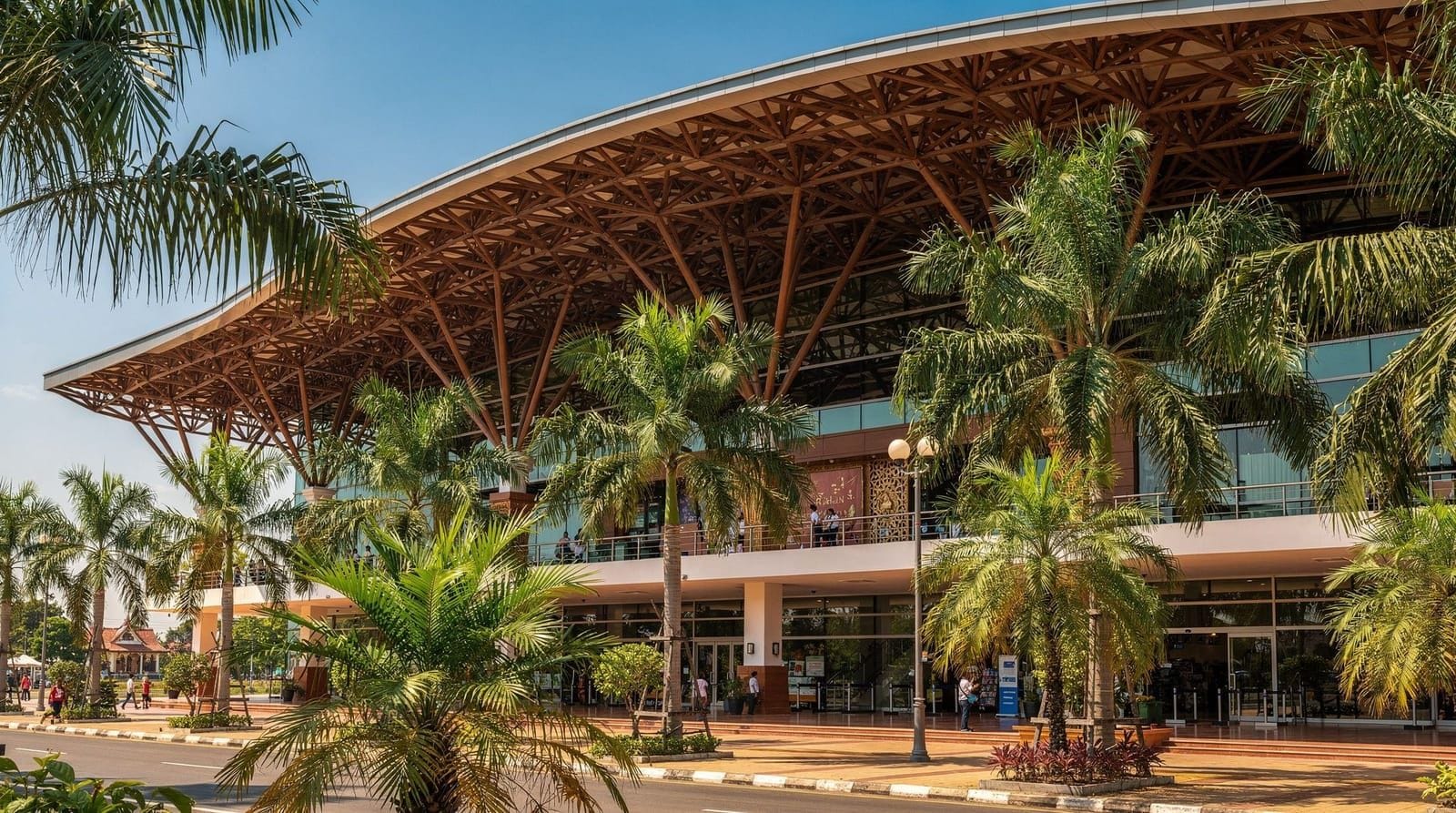
Visa on arrival remains available for most nationalities at Siem Reap–Angkor International Airport and Cambodia’s land borders — $30 for a tourist visa (business visa runs $35), 30-day stay, paid in cash USD with a passport photo required. This skips the online application step entirely but means queuing at the airport counter on arrival, which can add 20-40 minutes during busy periods.
The e-visa’s main advantage isn’t cost (identical $30 fee) — it’s arriving with approval already secured, letting you skip the on-arrival visa queue and go straight to immigration. For travelers connecting through SAI on a tight schedule, or arriving late at night when queues can be slower to process, the e-visa’s pre-approval is worth the modest advance planning.
ASEAN visa-free exemptions
Citizens of several ASEAN member states don’t need either visa option:
- Visa-free up to 30 days: Malaysia, Philippines, Singapore, Indonesia, Vietnam, Laos
- Visa-free up to 14 days: Thailand, Brunei, Myanmar
Check current status against the Cambodia Ministry of Foreign Affairs and International Cooperation (MFAIC) visa exemption list before travel, since exemption lists can change; this guide reflects the standard exemptions as of 2026.
The E-Arrival Card — a separate, mandatory step
Since January 2025, Cambodia requires a mandatory E-Arrival Card, submitted online within 7 days before arrival — in addition to, not instead of, whichever visa route you use. This is a newer requirement that some older visa guides online don’t mention, so don’t assume the e-visa alone covers everything. Your passport must also be valid for at least 6 months from your arrival date with at least one blank visa page; airlines can deny boarding for passports that don’t meet this threshold even with an approved e-visa in hand.
Common application mistakes
Uploading a low-quality passport photo. The digital photo must meet standard visa photo specifications (plain background, forward-facing, no glasses glare) — a casual selfie or cropped vacation photo is a common cause of rejection or delay. Use a proper passport-photo app or a physical photo booth and scan it if needed.
Passport photo page scan cropped or blurry. The scanned passport page needs to be fully legible, including the machine-readable code at the bottom — photograph it flat, in good light, with no glare across the laminated surface.
Applying too close to the travel date. While 3 business days is typical, occasional delays happen, particularly around regional public holidays when processing volume increases. A week’s buffer avoids the stress of an unresolved application the night before a flight.
Confusing the e-visa with travel insurance. Some reseller sites bundle a mandatory-sounding “travel insurance” add-on at checkout. Cambodia’s e-visa does not require travel insurance as a condition of entry — this is an upsell, not a government requirement, regardless of how it’s presented on a reseller checkout page.
Assuming the e-visa covers land border crossings identically to the airport. The e-visa is accepted at Cambodia’s main international entry points, but always double-check your specific planned border or airport against the current list on evisa.gov.kh before finalizing overland travel plans, since acceptance can vary by specific crossing point.
Business visas and extensions
Travelers arriving for business rather than tourism should apply for the business (E-class) visa rather than the tourist (T-class) e-visa — $35 rather than $30, and unlike the tourist e-visa, it can typically be extended multiple times without leaving the country, which matters for anyone planning a longer working stay. Tourist e-visas are generally not extendable in the same way; if you need more than 30 days as a tourist, plan for either a visa run to a neighboring border or apply for a fresh visa on a later date, rather than assuming an in-country extension will be straightforward.
How Cambodia’s e-visa compares to neighboring countries
Travelers combining Cambodia with Thailand or Vietnam on the same trip will notice some differences worth planning around: Thailand offers visa-free entry to many more nationalities than Cambodia for shorter stays, and Vietnam’s e-visa system (also officially government-run, at evisa.xuatnhapcanh.gov.vn) follows a broadly similar online-application pattern to Cambodia’s, with its own reseller-markup problem on search results. The lesson carries across all three: for any Southeast Asian e-visa, go directly to the country’s official .gov domain rather than the first search result, since the reseller-markup pattern described above for Cambodia is common across the region, not unique to it.
Timing your application around your trip
Apply for the e-visa at least a week before departure, ideally 2-3 weeks ahead if your schedule allows — this gives comfortable buffer for the roughly 3-business-day processing window plus any unexpected delay, and avoids the stress of applying the night before a flight. Pair this with the airport transfer planning for your arrival at SAI, and make sure your packing checklist includes a printed copy of the approved e-visa alongside your passport — some arrival counters still prefer a physical printout over a phone screen, even though digital copies are generally accepted.
If your application is rejected or delayed
Rejections are uncommon when the form is filled out correctly and the photo/passport scan meet spec, but they do happen — most often for a poor-quality passport scan, a mismatched name spelling versus the passport, or an expired passport that doesn’t meet the 6-month validity rule. If rejected, the official portal typically explains the reason and allows reapplication; there’s no separate fee for correcting and resubmitting a rejected application through the same system, though timelines reset. If your travel date is close and you haven’t received approval, visa on arrival remains the fallback — $30 cash at the airport counter, no online application needed, though it does mean queuing rather than walking straight to immigration.
A pre-departure visa checklist
Before you fly, confirm each of the following:
- E-visa applied for at evisa.gov.kh (not a reseller site), at least a week before departure
- $30 fee paid, approval received and saved (digital and printed copy)
- Passport valid 6+ months from arrival date, with at least one blank page
- E-Arrival Card submitted online within 7 days before arrival (separate from the e-visa)
- Printed or digital copy of both the e-visa approval and E-Arrival Card confirmation packed alongside your passport
Skipping any one of these — particularly the E-Arrival Card, which is newer and less widely known than the e-visa itself — can cause delays or complications at the immigration counter even with a valid, approved e-visa in hand.
Frequently asked questions about Cambodia e-visa guide
What is the real cost of a Cambodia e-visa?
The official government fee is $30, reduced from $36 as of 1 January 2025. This is the total cost when applying directly at evisa.gov.kh. Third-party visa-service websites often charge $45-70+ for the identical visa, adding a markup for a service you can do yourself in about 15 minutes.How do I know if a visa website is official or a reseller?
The only official Cambodian government e-visa portal is evisa.gov.kh — a .gov.kh domain. Any site with a different domain (.com, .org, or a country-specific-sounding name) offering a 'Cambodia e-visa service' is a third-party reseller, even if it looks professional and uses official-sounding language or government imagery. Always type evisa.gov.kh directly rather than clicking a search ad or sponsored result.How long does the Cambodia e-visa take to process?
Typically around 3 business days from the official site, though it can occasionally take longer during high-demand periods. Apply at least a week before departure to have a comfortable buffer, and print or save a digital copy of the approved e-visa to present on arrival.Do I still need to do anything else before arriving, besides the e-visa?
Yes — since January 2025, Cambodia also requires a mandatory E-Arrival Card, submitted online within 7 days before arrival, in addition to (not instead of) the e-visa. Your passport must be valid for at least 6 months from your arrival date with at least one blank page.Is visa-on-arrival simpler than the e-visa?
Visa on arrival is available at Siem Reap–Angkor International Airport and land borders for most nationalities — $30 for a tourist visa, cash (USD) and a passport photo required, processed at the airport counter. It avoids the online application step but means queuing on arrival; the e-visa lets you skip that queue since approval is already in hand. Neither is meaningfully 'simpler' — the e-visa trades a short online form for a shorter airport line.Which nationalities don't need a visa at all?
ASEAN member citizens get visa-free entry: Malaysia, Philippines, Singapore, Indonesia, Vietnam and Laos citizens for up to 30 days; Thailand, Brunei and Myanmar citizens for up to 14 days. Everyone else should plan for either the e-visa or visa on arrival, both priced at $30 for the standard tourist visa.
Top experiences
Bookable activities with verified prices and instant confirmation on GetYourGuide.

More tours on Viator
Top-rated experiences with verified reviews, bookable on Viator (a Tripadvisor company).