Phnom Penh
Phnom Penh as a Siem Reap extension: real travel time by bus, flight and boat, and what a 1-2 night add-on actually looks like.
Siem Reap: Full-Day Phnom Penh Private Tour
Quick facts
- Distance from Siem Reap
- ~315 km, 5-6 hours by road, or a roughly 45-min flight
- Highlights
- Royal Palace, Killing Fields (Choeung Ek), Tuol Sleng Genocide Museum
- Best structure
- 1-2 night add-on, not a single day trip, given the distance
- Getting there
- Bus (~$10-15), flight (~45 min), or private car
- Character
- A capital city — busier, more traffic, more history-heavy sightseeing than Siem Reap
Why Phnom Penh belongs on a Siem Reap-focused site at all
Phnom Penh sits outside this site’s core geographic focus — Siem Reap, Angkor and the surrounding countryside — but it earns a place here because a genuinely large share of visitors flying into Cambodia specifically for Angkor end up adding the capital onto the same trip, either as a bookend before flying home or as a deliberate extension once they realize how little of Cambodia’s modern history the temple circuit alone conveys. We treat it consistently with the rest of the site’s honest-planner approach: real travel times, a clear-eyed account of what a rushed visit costs you, and no pretense that a single frantic day does the city, or the weight of what it holds, justice.
An extension, not a day trip — the distance doesn’t allow it
Phnom Penh is Cambodia’s capital, roughly 315 km south of Siem Reap, and we’re upfront about this immediately: it is not a realistic single-day round trip from Siem Reap. Some tour operators sell a “full-day Phnom Penh tour,” and it is technically doable, but it means 10-12 hours of the day spent in transit and sightseeing combined, with the actual city time squeezed into a rushed few hours. We treat Phnom Penh here as what it functionally is for the overwhelming majority of Siem Reap-based travelers: a 1-2 night extension, best added onto the end or start of a Siem Reap trip rather than inserted mid-stay as a single exhausting day.
Getting there — real options and real timing
By bus: the most common budget option, roughly 5-6 hours depending on the operator and traffic, typically $10-15 one-way. Several established bus companies run this route multiple times daily with reasonably comfortable coaches.
By flight: roughly 45 minutes in the air, though total door-to-door time (airport transfers, check-in, security) often works out closer to 2.5-3 hours once you factor in getting to and from both airports — a genuine time-saver over the bus, but at a real cost premium, and worth comparing against the bus’s simplicity for a route with decent road infrastructure.
By private car: similar timing to the bus (5-6 hours) but with more flexibility on stops and departure time, at a higher cost than the shared bus.
By boat: technically exists on the Tonlé Sap/Mekong river system but is slow, seasonal, and increasingly unreliable as a dependable travel option — not recommended as a primary means of getting between the two cities. See our Siem Reap to Phnom Penh transport guide for the fuller comparison, including specific bus operators and current pricing.
What to actually do once you’re there
The Royal Palace and Silver Pagoda complex is Phnom Penh’s most visited sight — the current royal residence’s public areas, plus the Silver Pagoda’s floor tiled with over 5,000 silver blocks and a collection of Buddha statues, including a life-size gold Buddha decorated with diamonds. Modest dress applies (shoulders and knees covered), same as at any Angkor temple.
Tuol Sleng Genocide Museum and the Killing Fields of Choeung Ek, roughly 30 minutes from the city center, together form the essential, sobering core of any Phnom Penh visit — a former high school converted into the Khmer Rouge’s S-21 interrogation center, and the mass grave site where many of its prisoners were ultimately taken. Both are profoundly heavy but widely considered essential context for understanding modern Cambodia; approach them with the same gravity you would a Holocaust memorial, not as a standard tourist stop. Most visitors need real emotional recovery time after both — plan a lighter afternoon or evening following this part of the day.
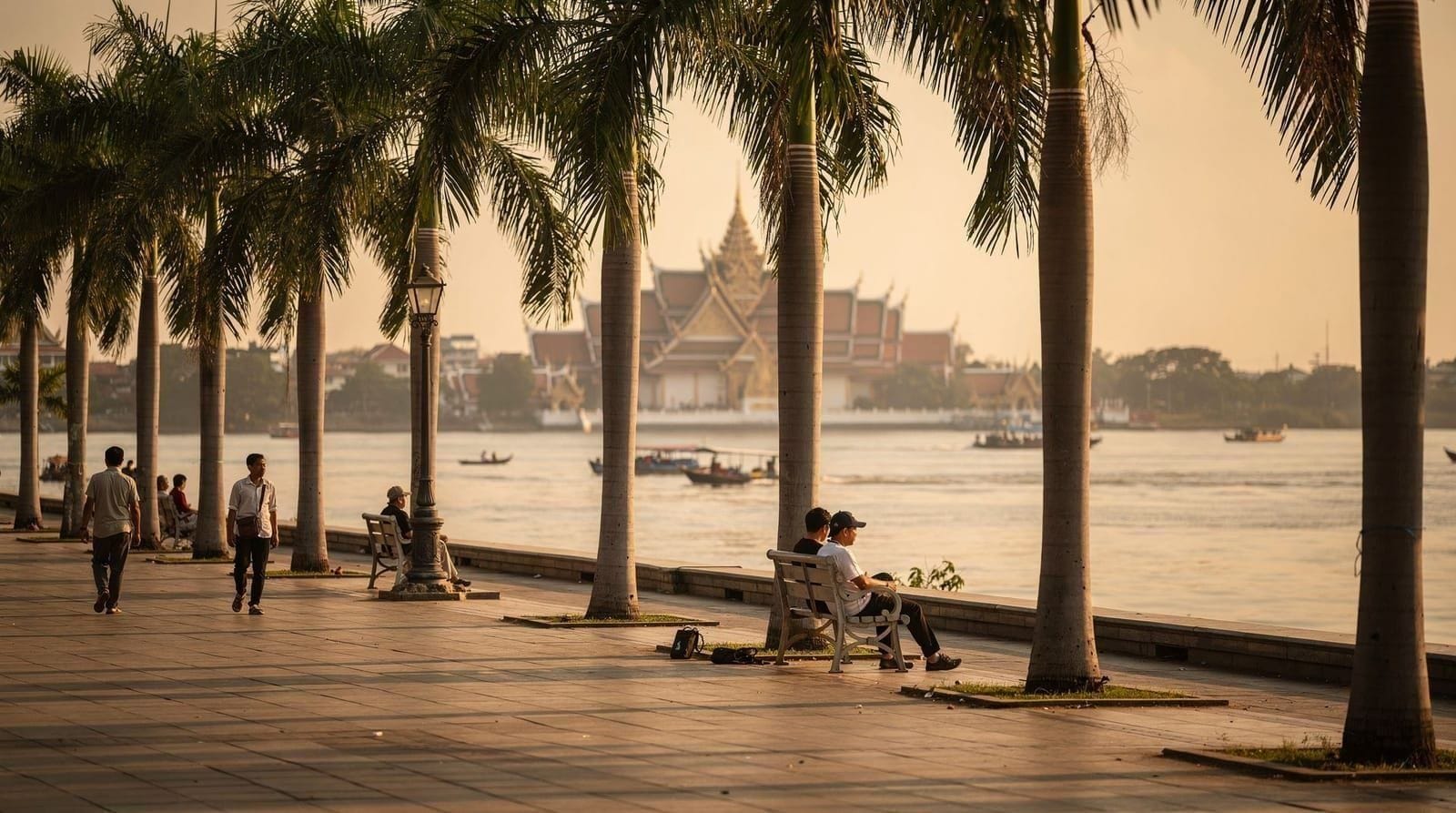
Beyond these core sights, the riverside promenade, the National Museum (Khmer art and archaeology, a useful complement to what you’ve seen at Angkor), and Phnom Penh’s markets (Central Market’s distinctive Art Deco dome, Russian Market for shopping) round out a 1-2 day visit at a comfortable pace.
Understanding what you’re seeing at Tuol Sleng and Choeung Ek
Some historical context makes these two sites considerably more comprehensible, and most visitors benefit from at least a brief pre-read before arriving. Tuol Sleng, known during the Khmer Rouge period as S-21, was a former high school converted into the regime’s primary interrogation and torture facility between 1975 and 1979, through which an estimated 14,000-20,000 prisoners passed — the vast majority did not survive. It’s preserved largely as it was found after the regime’s fall, including classroom-turned-cell blocks, and photographs of many of the facility’s victims, systematically documented by the regime itself, line several rooms — a specific, harrowing feature of this museum that some visitors aren’t prepared for.
Choeung Ek, roughly 17 km outside the city center (closer to 30 minutes’ drive with traffic), was one of the execution and mass burial sites where many S-21 prisoners were ultimately taken; a memorial stupa filled with thousands of recovered skulls now marks the site, and an audio guide (included in the entrance fee) walks visitors through the grounds at a deliberately unhurried, respectful pace. Both sites exist specifically so this history isn’t forgotten — approaching them with that context, rather than as a generic historical curiosity, changes the experience considerably.
The Royal Palace and Silver Pagoda, in more detail
Phnom Penh’s Royal Palace complex, built starting in 1866 after the capital moved from Oudong, remains an active royal residence — meaning some areas are closed to the public depending on the king’s presence and official functions, worth checking before you plan your visit around it.
The Silver Pagoda (Wat Preah Keo Morakot), within the same walled complex, takes its name from over 5,000 silver tiles covering the floor (mostly protected under carpet today to prevent wear), and houses the Emerald Buddha of Cambodia (distinct from Thailand’s more famous Emerald Buddha) alongside a life-size gold Buddha statue set with thousands of diamonds. Photography is restricted inside several buildings — check current signage rather than assuming your phone or camera is welcome everywhere, a common point of confusion for first-time visitors used to fewer restrictions at Angkor’s temples.
What’s overrated, what’s underrated
Nothing here is overrated — Tuol Sleng and the Killing Fields in particular are consistently described by visitors as among the most meaningful, if difficult, experiences of a Cambodia trip. What’s underrated is simply budgeting enough time: many single-day Phnom Penh add-ons try to cram the Royal Palace, Tuol Sleng, and the Killing Fields into one rushed afternoon, which shortchanges the weight each site deserves.
How to combine it with the rest of your trip
Given the distance and the emotional weight of the core sights, we recommend against squeezing Phnom Penh into a single frantic day if you can avoid it. If a single, well-organized day is genuinely your only option (for example, a long layover structure), our full-day Phnom Penh private tour covers the Royal Palace, Tuol Sleng and the Killing Fields with a driver and guide handling logistics, which at least removes the added stress of navigating an unfamiliar capital’s traffic on your own.
For travelers building a longer, multi-stop Cambodia trip that naturally ends or begins in Phnom Penh — flying in or out of the capital rather than Siem Reap — the 7-day private tour from Phnom Penh to Siem Reap structures the whole route as one continuous trip rather than a there-and-back day excursion, which suits the distance far better. See our Siem Reap vs. Phnom Penh comparison guide if you’re still deciding how to split your time between the two cities generally, and our Phnom Penh from Siem Reap guide for a more detailed day-by-day version of a 1-2 night add-on.
A realistic 2-day itinerary
Day 1: Arrive by bus, flight or car; check into accommodation; afternoon at the Royal Palace and Silver Pagoda, followed by a walk along the riverside promenade and dinner near the river. Day 2: Morning dedicated to Tuol Sleng, followed by the drive out to Choeung Ek (the Killing Fields) — this is genuinely a half-day commitment once travel time and the audio-guided walk are included, and it’s worth protecting the rest of the day for something lighter rather than scheduling more heavy sightseeing immediately after.
Afternoon or evening: the National Museum for Khmer art and archaeology context, or Central Market and Russian Market if shopping is a priority, before departing the following morning or continuing onward. Visitors with a third day sometimes add a Mekong river cruise or a day trip to Koh Dach (“Silk Island”), though neither is essential to a first Phnom Penh visit focused on the core historical sights.
Accessibility
Tuol Sleng’s original classroom-cell blocks retain uneven floors and stairways without modern accessibility adaptations, given the building’s preservation-focused approach — a genuine consideration for visitors with mobility limitations. Choeung Ek’s grounds are mostly flat, unpaved paths, manageable for most visitors with the included audio guide setting a naturally slow pace. The Royal Palace complex is largely flat and easier to navigate, though some interior areas involve steps. Phnom Penh’s broader streets and sidewalks are less consistently maintained than Siem Reap’s more tourist-adapted center, so ride-hailing apps are generally a more comfortable choice than walking longer distances between sights.
Practical notes
Phnom Penh’s traffic is significantly heavier than Siem Reap’s — budget more time between stops than you would in the smaller, more tourist-oriented Angkor town. Tuol Sleng and the Killing Fields both charge separate entrance fees (unrelated to the Angkor Pass, which has no relevance in Phnom Penh at all). If visiting in November, the Bon Om Touk Water Festival — boat races and fireworks on the riverfront — is centered in Phnom Penh, not Siem Reap, and can be a strong reason to time an extension around it; see our water festival guide for dates and logistics.
Ride-hailing apps (PassApp, Grab) work reliably in Phnom Penh and are generally a more comfortable, transparent way to get around the city than negotiating tuk-tuk fares on the street, particularly given the heavier, less predictable traffic compared to Siem Reap’s more compact and tourist-adapted road network.
Frequently asked questions about visiting Phnom Penh from Siem Reap
Can I visit Phnom Penh as a day trip from Siem Reap?
Technically yes, but it’s a genuinely long day — roughly 10-12 hours round trip including travel, which significantly compresses time at the actual sights. We recommend a 1-2 night extension instead if your schedule allows.
How do I get from Siem Reap to Phnom Penh?
Bus (5-6 hours, $10-15), flight (about 45 minutes in the air, 2.5-3 hours door to door), or private car (5-6 hours, more flexible but pricier than the bus). The river-boat route is slow and unreliable.
Is the Angkor Pass valid in Phnom Penh?
No — the Angkor Pass covers only temples inside the Angkor Archaeological Park near Siem Reap. Phnom Penh’s sights (Royal Palace, Tuol Sleng, Killing Fields) each have their own separate entrance fees.
Are Tuol Sleng and the Killing Fields appropriate to visit with children?
Both sites are heavy, graphic in places, and generally considered more appropriate for older teens and adults. See our Siem Reap with kids guide for broader family-trip planning across the region.
How many days should I budget for Phnom Penh?
1-2 nights is the realistic minimum to see the core sights (Royal Palace, Tuol Sleng, Killing Fields) without rushing, given the 5-6 hour travel time each way from Siem Reap.
Is Phnom Penh worth visiting if I’ve already seen the Angkor temples?
Yes — it’s a genuinely different kind of experience, centered on modern and 20th-century Cambodian history rather than the Angkorian era, and most visitors describe it as an important complement to, not a repeat of, a Siem Reap-based trip.
What was Tuol Sleng before it became a Khmer Rouge prison?
It was a high school, converted in 1975 into S-21, the Khmer Rouge regime’s primary interrogation and torture facility. It’s preserved largely as it was found, including original cell blocks and extensive photographic documentation of victims.
Is photography allowed inside the Royal Palace and Silver Pagoda?
Restrictions apply in several buildings, including inside the Silver Pagoda itself — check current on-site signage rather than assuming photography is permitted everywhere, since rules differ from the generally more relaxed policies at Angkor’s temples.
How far is Choeung Ek (the Killing Fields) from central Phnom Penh?
Roughly 17 km, about 30 minutes’ drive with typical traffic. An audio guide is included in the entrance fee and walks visitors through the site at a deliberately measured pace.
Should I visit Tuol Sleng and the Killing Fields on the same day?
Many visitors do, often in the same order (Tuol Sleng first, Choeung Ek second, since the museum provides context the memorial site then reinforces), but be prepared for genuine emotional weight from both in a single day — some visitors prefer to split them across two days if their schedule allows.
Is Phnom Penh accessible for visitors with mobility limitations?
Partially — the Royal Palace and Choeung Ek’s grounds are mostly flat and manageable, but Tuol Sleng’s original, unmodified classroom-cell blocks have uneven floors and stairways without accessibility adaptations, a deliberate preservation choice rather than an oversight.
Top experiences
Bookable activities with verified prices and instant confirmation on GetYourGuide.

More tours on Viator
Top-rated experiences with verified reviews, bookable on Viator (a Tripadvisor company).