Preah Vihear
Preah Vihear's status as of July 2026: an ongoing Cambodia-Thailand border situation. Read this before planning any visit.
Quick facts
- Status as of July 2026
- Not currently recommended — see status note below
- Distance from Siem Reap (for reference only)
- ~200 km, ~4 hours by car
- Ticket (when accessible)
- Separate ticket, not covered by the Angkor Pass
- Location
- Dangrek Mountains, directly on the Cambodia-Thailand border
- Advisory level
- US State Dept Level 2; avoid travel within 50 km of the border per current advisories
Status note — updated 21 July 2026
Preah Vihear sits directly on the Cambodia-Thailand border, an area currently affected by an ongoing territorial dispute between the two countries. As of this update, a ceasefire is in place but remains fragile, and the U.S. State Department maintains a Level 2 advisory for Cambodia that specifically flags increased caution around the border zone, with guidance to avoid travel within 50 km of the Thailand-Cambodia border. This is not a routine “check the weather” caveat — the situation is actively monitored by multiple governments and can change with little notice.
We do not list Preah Vihear as a standard day-trip or itinerary stop on this site, unlike every other destination in this collection. If you’re considering a visit, the responsible first step is checking your own government’s official travel advisory for Cambodia (for US citizens, travel.state.gov; UK citizens, gov.uk/foreign-travel-advice; and equivalent foreign ministry sites for other nationalities) rather than relying on tour operator marketing or outdated blog posts, which are common in this niche and frequently understate the risk.
For a fuller, regularly updated discussion of what’s changed and what hasn’t, see our blog post Is Preah Vihear Safe Right Now? — treat any date on a page discussing this topic, including this one, as a snapshot, not a guarantee.
What Preah Vihear is, for context
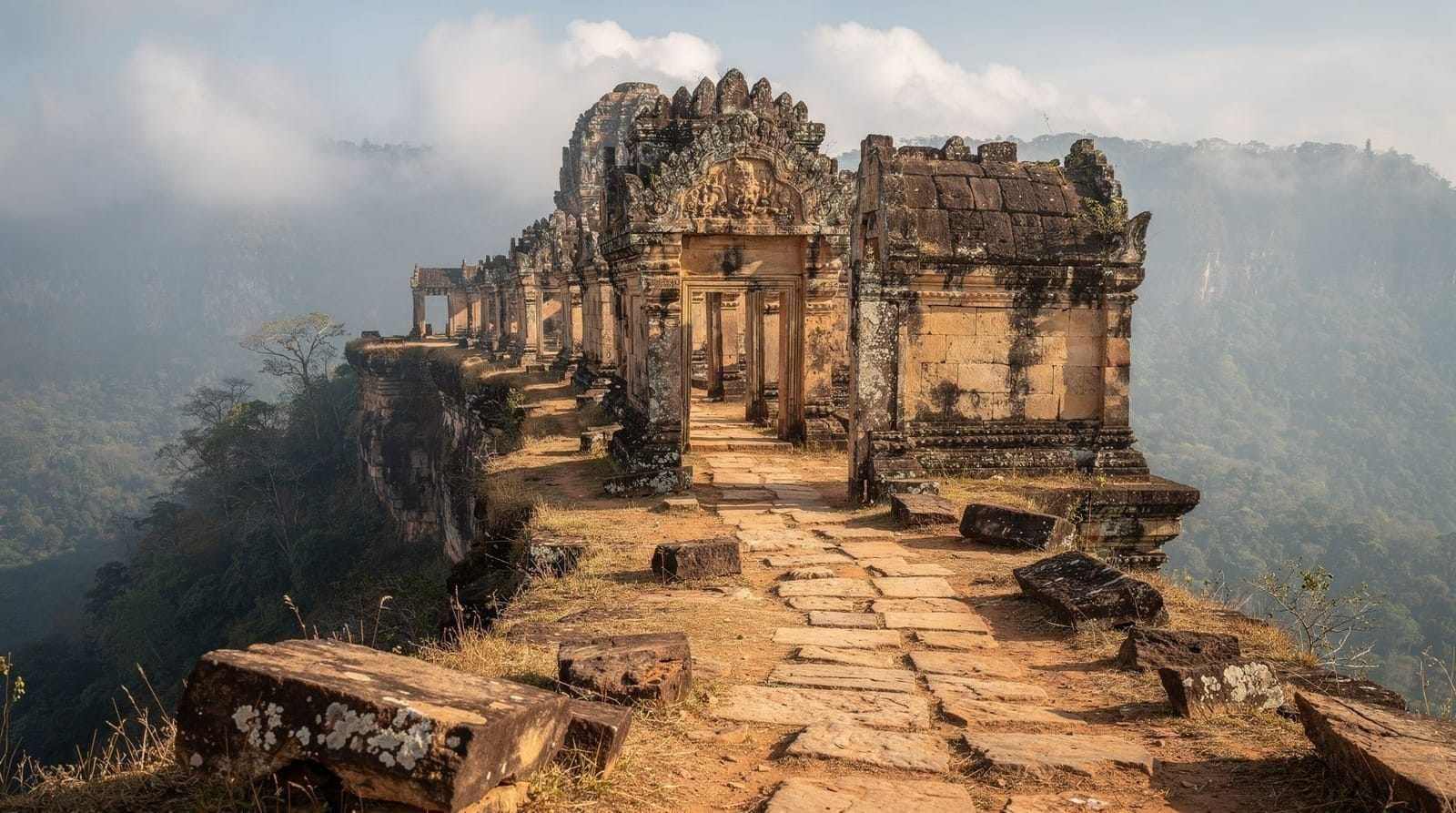
Setting the current situation aside, Preah Vihear is a clifftop temple complex built primarily in the 11th and 12th centuries, dedicated to Shiva, and its physical position is unlike anywhere else in the Angkor-era temple network: it sits atop a 525-metre escarpment in the Dangrek Mountains, with the temple’s long processional causeway running along the ridge and a dramatic drop to the Cambodian plains below.
It was the subject of a prolonged sovereignty dispute between Cambodia and Thailand dating back to the colonial-era border demarcation, resolved in Cambodia’s favor by the International Court of Justice in 1962 (and reaffirmed in a further 2013 ICJ ruling on the surrounding land), but the area has seen renewed friction in the years since, including the period covered by this status note.
It’s about 200 km from Siem Reap, roughly 4 hours by car in normal circumstances — geographically it’s Cambodia’s most remote major temple relative to Siem Reap, considerably farther than Koh Ker, the next-most-distant destination on this site.
Architecturally, Preah Vihear is unusual even by Angkor-era standards because it wasn’t built in one reign. Construction stretched across roughly two and a half centuries, starting under Yasovarman I (r. 889–910), continuing under Suryavarman I (r. 1002–1050), and reaching its most developed form under Suryavarman II (r. 1113–1150) — the same king who built Angkor Wat.
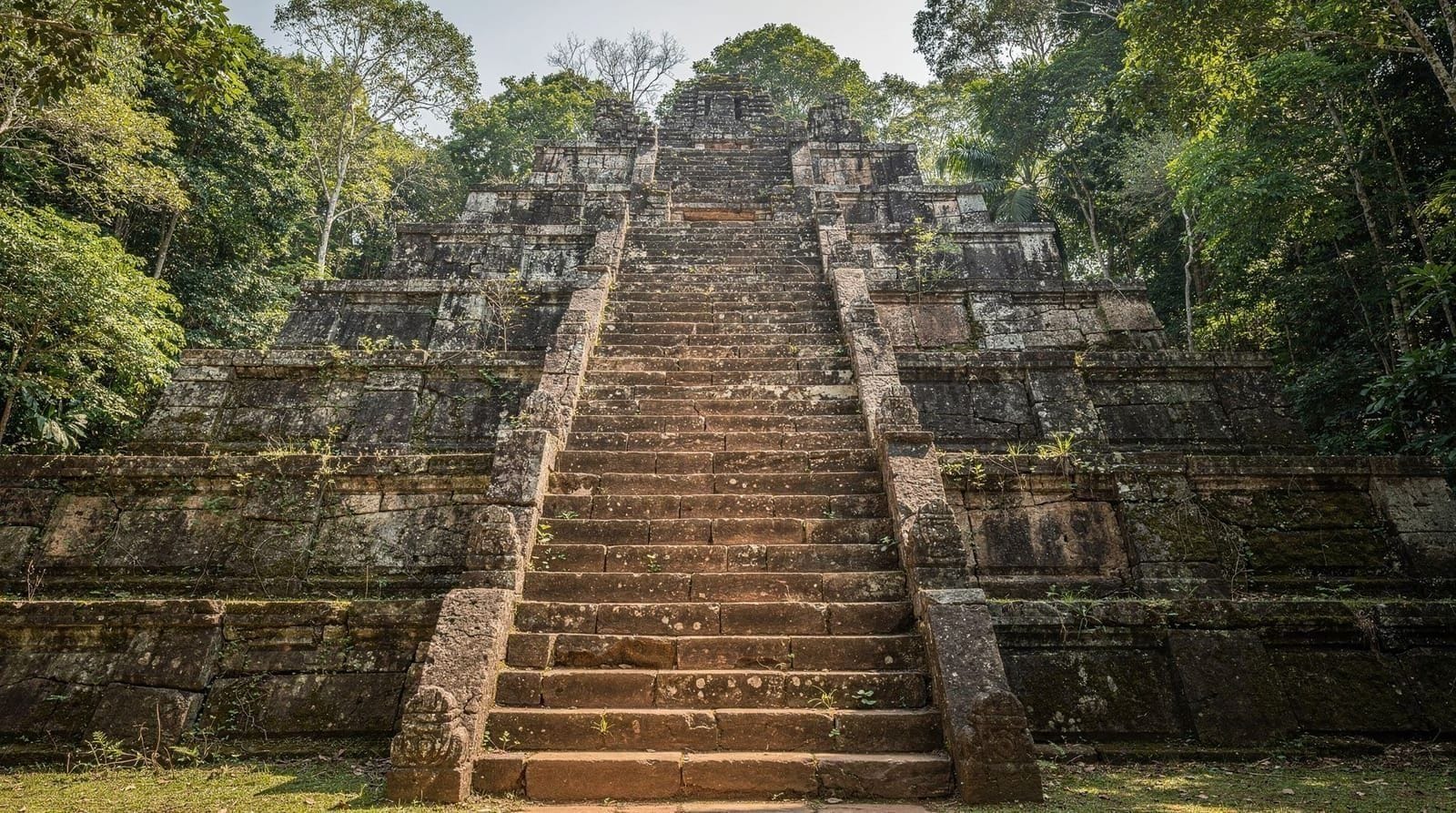
Rather than a single enclosed temple-mountain, the site is a linear sequence of five gopuras (gateway pavilions), each set higher than the last, connected by a stone causeway roughly 800 metres long that climbs the ridge before ending at the main sanctuary, dedicated to Shiva under the name Sri Shikhareshvara (“Lord of the Mountain Peak”). Naga balustrades, lintels carved with churning-of-the-sea-of-milk and Shiva-on-Kailasa scenes, and long processional stairways make it, by most academic assessments, one of the finest examples of classical Khmer religious architecture — comparable in carving quality to Banteay Srei, though far larger in scale and dramatically sited.
Why the border dispute exists
The root of the current situation predates the Angkor era’s end by many centuries but became a modern territorial problem through a colonial-era mapping error. A 1907 French-Siamese boundary commission produced a map that placed the temple on the Cambodian side of the border, even though the most direct road access runs from the Thai side. Thailand disputed this for decades; the International Court of Justice ruled in Cambodia’s favor in 1962, awarding sovereignty over the temple itself (though not conclusively over the surrounding land, which is why a second ICJ case followed).
Tension flared again after UNESCO inscribed Preah Vihear as a World Heritage Site in 2008 — Thailand objected to the unilateral listing, and the following years saw periodic armed clashes near the temple, including a serious escalation in 2011 that damaged parts of the site and displaced villagers on both sides. A 2013 ICJ clarification reaffirmed Cambodian sovereignty over the temple promontory. The 2025–2026 conflict referenced in the status note above is a renewed round of the same underlying dispute over the surrounding land, not a new or unrelated event — which is part of why observers don’t expect it to resolve quickly or predictably.
Preah Vihear’s place in the Angkorian road network
Beyond its clifftop setting, Preah Vihear mattered strategically because it sat along one of the royal roads that connected the Angkorian heartland to its northern territories — part of the same infrastructure system of stone-paved roads, bridges, and rest houses (dharmasala) that Jayavarman VII expanded across the empire in the late 12th and early 13th centuries to link Angkor with distant temples, including Wat Phu in what’s now southern Laos.
That road network is one reason historians treat Preah Vihear as more than a remote outpost: it was a functioning waypoint in an empire that, at its height, stretched across most of mainland Southeast Asia. None of that history changes the current access situation, but it explains why the site keeps drawing renewed academic and diplomatic attention even during periods when it’s physically off-limits to travelers.
What visiting looked like before the current dispute flared
In periods when the border was calmer, Preah Vihear was typically visited as a long, standalone day trip from Siem Reap — the road distance and driving time meant it wasn’t usually combined with other outer temples in a single day the way Koh Ker and Beng Mealea often are. Most visitors who made the trip did so specifically for the temple, not as a add-on stop, given the four-hour drive each way. Access from the Thai side, via Sa Kaeo province, was historically shorter for travelers coming from Bangkok, which is part of why the site has long straddled two very different tourism markets depending on which country visitors approached from — another reason the current border closure disrupts access asymmetrically for travelers on each side.
What to do instead, right now
If outer-temple history and dramatic elevated views are what draw you to Preah Vihear, Koh Ker — with its climbable seven-tier pyramid and comparably remote, uncrowded atmosphere — is a reasonable substitute that doesn’t carry the same border-zone advisory. Phnom Kulen, the birthplace of the Khmer Empire, offers a different kind of “founding history” significance without any current access concerns. Neither is a substitute for Preah Vihear’s specific clifftop architecture, but both are accessible now and deliver a comparable sense of remoteness and scale.
| Preah Vihear (current status) | Koh Ker | Phnom Kulen | |
|---|---|---|---|
| Distance from Siem Reap | ~200 km / ~4 hrs | ~120 km / ~2 hrs | ~50 km / ~1.5 hrs |
| Separate ticket | Not currently applicable | $15 | $20 |
| Covered by Angkor Pass | No, even normally | No | No |
| Current advisory concern | Yes — border zone | None | None |
| What you’d be going for | Clifftop causeway, 800m gopuras | Climbable 7-tier pyramid | Waterfalls, River of a Thousand Lingas, founding-era history |
Neither Koh Ker nor Phnom Kulen requires the multi-hour detour toward the Thai border that Preah Vihear does, and both fold naturally into a standard outer-temple day (see our Beng Mealea and Koh Ker day-trip guide) without the planning complications a border-zone advisory adds — travel insurance exclusions, checkpoint delays, and the general unpredictability of a still-active dispute.
If and when the situation changes
We’ll update this page’s status note and last-reviewed date if the border situation is resolved or materially changes. Historically, tours to Preah Vihear have been sold by some operators even during periods of elevated tension — the tour listings referenced below exist in GetYourGuide’s catalogue, but their operational status should always be verified directly with the operator and cross-checked against your government’s current advisory before booking, not assumed from the listing’s existence alone. We are not recommending these tours as of this update; they’re included here strictly for completeness and future reference once conditions allow.
In practical terms, “the situation changes” usually means one of three things: a formalized, durable ceasefire agreement replacing the current fragile one; a withdrawal of occupying forces from disputed territory near the temple, as confirmed by independent monitors rather than either government’s own statements; or a downgrade in official travel advisories from multiple governments (not just one) specifically covering the border zone around Preah Vihear and Preah Vihear province, not just Cambodia generally. A general Cambodia advisory easing while the border-specific warning remains in place would not, on its own, be enough for us to change this page’s guidance.
How to check the current status yourself
Don’t rely on tour operator marketing, forum posts, or older blog content when deciding whether the situation has changed — check primary sources directly. The clearest signals are:
- Your government’s official travel advisory — for US citizens, travel.state.gov and the country-specific page for Cambodia; for UK citizens, gov.uk/foreign-travel-advice; most foreign ministries publish a country page with a dated “last updated” stamp, which matters more than the headline risk level.
- Cambodia’s Ministry of Tourism and the Angkor Enterprise / APSARA National Authority communications, for whether the temple itself has reopened to visitors administratively (a separate question from whether it’s safe).
- Wire-service reporting (Reuters, AP, Al Jazeera, Khmer Times, Bangkok Post) rather than travel-blog summaries, since blog content — including pages like this one — lags real events by days or weeks even when actively maintained.
If you’re planning a trip to Cambodia more broadly and just want to know whether the border situation affects the rest of your itinerary, it generally doesn’t — Angkor Park, Tonlé Sap, Battambang, and Phnom Penh are all well outside the affected zone and see no operational impact from this dispute.
Frequently asked questions about Preah Vihear
Is it safe to visit Preah Vihear right now?
As of this July 2026 update, no — the temple sits directly in a border zone affected by an active, if currently ceasefire-covered, Cambodia-Thailand territorial dispute. Check your government’s official travel advisory before considering any visit, and see our dedicated blog post for ongoing updates.
Why isn’t Preah Vihear included in Siem Reap itineraries on this site?
Because of the current border situation described above. Every other destination on this site is treated as a standard, planable excursion; Preah Vihear is the one exception, flagged specifically because the situation is unresolved and can change without much notice.
Is Preah Vihear covered by the Angkor Pass?
No, even under normal circumstances — it requires a separate ticket and is managed independently of the Angkor Enterprise system that covers the main park.
What’s a comparable alternative I can visit now?
Koh Ker, for a remote, climbable temple-mountain experience, or Phnom Kulen, for founding-era Khmer Empire history — both accessible without any current advisory concerns.
How far is Preah Vihear from Siem Reap under normal conditions?
About 200 km, roughly 4 hours by car — the most remote major temple site relative to Siem Reap on this list.
Where should I check for the most current, official information?
Your own government’s foreign travel advisory (travel.state.gov for US citizens, gov.uk/foreign-travel-advice for UK citizens, and the equivalent for other nationalities) rather than tour operator marketing or older blog content.
Why did UNESCO listing the temple make the dispute worse, not better?
Because Thailand objected to Cambodia’s 2008 UNESCO World Heritage application, arguing it implicitly asserted sovereignty over disputed surrounding land, not just the temple itself. The listing was meant to protect the site; in practice it triggered a fresh round of nationalist tension and armed clashes in the years that followed.
Does the border dispute affect the rest of a Siem Reap trip?
No. Angkor Archaeological Park, Tonlé Sap, Battambang, and Phnom Penh all sit well outside the affected border zone and operate normally. This advisory is specific to Preah Vihear province and the immediate Thailand-Cambodia border area.
Can I still book a tour to Preah Vihear online right now?
Some listings may still appear in tour operator catalogues, but their existence doesn’t confirm the site is currently safe or accessible — verify directly with the operator and cross-check against official government advisories before booking anything.
What’s actually at stake in the current dispute — just the temple, or more?
More than the temple. The 1962 and 2013 ICJ rulings settled sovereignty over the temple promontory itself, but disagreement over the surrounding land and broader stretches of the border has persisted for over a century and is the substance of the current conflict.
Is Preah Vihear the same thing as Angkor Wat or part of Angkor Park?
No. It’s a separate, independently managed temple roughly 150 km north of Angkor Park, built across different reigns, dedicated primarily to Shiva rather than the Vishnu dedication of Angkor Wat’s original construction, and it has never been part of the Angkor Pass system even in normal circumstances.
Top experiences
Bookable activities with verified prices and instant confirmation on GetYourGuide.

Siem Reap: Full-Day Preah Vihear and Koh Ker Temple Join-In Tour
Siem Reap: Angkor Wat 5-Day Tour Including Preah Vihear Temple

Siem Reap: Preah Vihear Temple and Koh Ker Private Tour
Cambodia: Private Preah Vihear Temple Tour

Cambodia: Full-Day Preah Vihear and Koh Ker Temple Tour
More tours on Viator
Top-rated experiences with verified reviews, bookable on Viator (a Tripadvisor company).